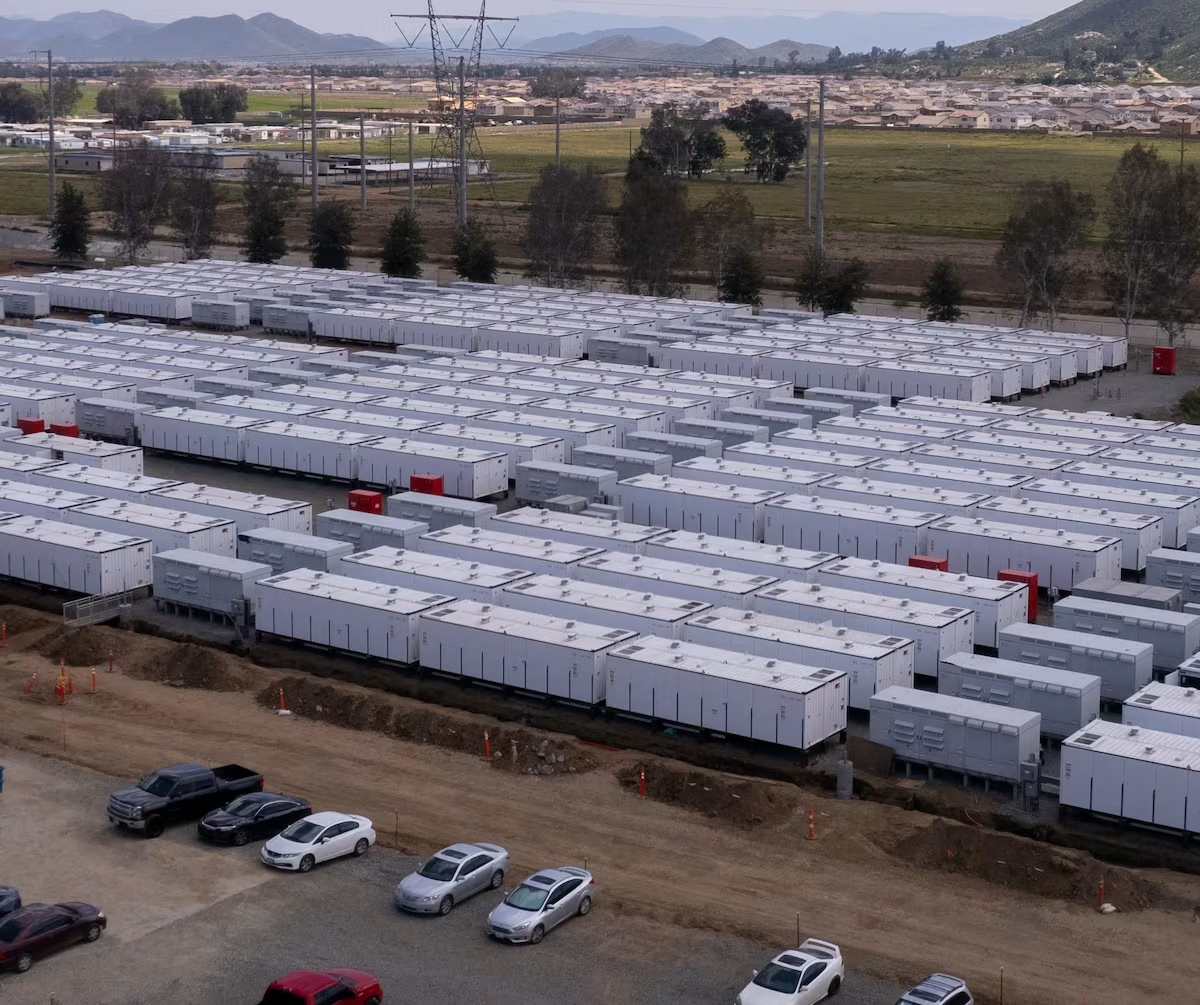
- From 2026, U.S. energy storage developers must grapple with stricter import rules and policy tightening by the Trump administration and factory buildout is uncertain.
October 13 – U.S. energy storage installations are set to hit record highs this year but lower deployment rates are expected from 2026 as developers adapt to a suite of new policies from the Trump administration.
Record U.S. power demand is forecast in the coming years on the back of rapid growth in data centers and a wider shift towards electrification. Rising renewable energy capacity and falling battery prices have spurred demand for utility-scale energy storage that strengthens grid reliability and provides additional revenues for clean power developers.
U.S. utility-scale energy storage installations are expected to hit a record 16.2 gigawatts (GW) in 2025, a 49% jump from 2024, as developers accelerate projects ahead of stricter tax credit regulations set to take effect in 2026, Allison Weis, Global Head of Storage at Wood Mackenzie, told Reuters Events.
MAP: US planned power installations in 2025

Source: U.S. Energy Information Administration (EIA), December 2024 Purchase Licensing Rights
From 2026, energy storage projects must comply with foreign entity rules imposed under Trump’s One Big Beautiful Bill Act to gain investment tax credits (ITCs). The Act also requires solar and wind developers to rapidly start construction in order to gain tax credits, impacting projects coupled with battery storage.
Under the foreign entity rules, energy storage projects seeking to receive ITCs must ensure 55% or more of the total material costs of their installations are not sourced from foreign entities of concern (FEOC), which includes China, the largest manufacturer. This threshold gradually increases for projects that begin construction in subsequent years, reaching 75% by 2030.
From 2025 to 2029, the U.S. is expected to install 87.8 GW of energy storage, driven by utility-scale and residential installations, but this could be reduced by as much as 16.5 GW due to uncertainties over policies implemented by the Trump administration, Wood Mackenzie Power & Renewables and the American Clean Power Association (ACP) said in a report last month.
Key factors which could hold back installations include a shortage of components that comply with the FEOC rules, trade barriers between the U.S. and China, and a reduction in permit approvals for clean power and transmission projects following Trump’s recent expansion of federal oversight, the report said.
Join 3,000+ senior decision-makers across energy and finance at Reuters Events Energy LIVE 2025.
In 2029, storage installations could return to 2025 levels after companies adapt to new equipment sourcing requirements and trade policy changes.
“Developers are trying to investigate all options and see what they’re going to have available as they look at projects that they’re developing a little later in their pipeline,” Weiss told Reuters Events.
American factories
The combination of policies implemented by the Trump administration, as well as the tax credits initially created by the Biden administration, should make American batteries more competitive than imports from China, Weiss said.
In the short term, developers will likely consider a mix of batteries made in the U.S. or imported from abroad, as Chinese suppliers continue to offer low prices and manufacturers in Southeast Asia ramp up production, Robert Greskowiak, Chief Commercial Officer (CCO) at Lightshift Energy, told Reuters Events.
“As we move forward over the next couple of years, I see a three-headed approach: it’s domestic, it’s non-Chinese foreign, and Chinese,” he said.
The pace at which the FEOC rules will accelerate U.S. storage manufacturing capacity is not yet clear and will depend on developer appetite for ITCs.
“There’s still a wide range of possible build-out of U.S. supply, but it is possible that it could get to levels to support full domestic demand for [energy storage systems] by 2030, or potentially sooner, if it’s the choice demanded by developers to keep getting the ITC,” said Weiss.
Download our exclusive report: Soaring US Power Demand Opens New Paths for Developers.
Energy storage developers may be able to capitalize on an oversupply of batteries for the electric vehicle market, where demand has been lower than expected, Greskowiak said.
LG Energy is expanding US energy storage manufacturing capacity to 16.5 GWh by the end of 2025 and is “looking at expanding that to probably over 40 GWh by the end of next year” due to surging demand from customers, said Tristan Doherty, Chief Product Officer (CPO) at LG Energy Solution Vertech.
The conversion of existing electric vehicle battery production lines to battery energy storage systems – which can take around nine months compared to up to four years to build a greenfield plant – allows the supplier to respond quickly to market demand, Doherty said.
Storage opportunities
Texas and California continue to lead the U.S. on energy storage installations but deployment has been spreading into many other markets, including Oklahoma, Florida, and Georgia.
For exclusive energy insights, sign up to our newsletter.
Energy storage allows developers to take advantage of higher prices as growing renewable energy capacity flattens prices at certain times of the day. Storage operators can use price arbitrage to purchase electricity when prices are low and sell when they are high.
Some 66% of U.S. installed utility-scale battery capacity used price arbitrage in 2024 and 41% of capacity was primarily used for arbitrage, according to EIA’s annual survey of power plant activity. In the Texas ERCOT network, where solar and wind accounted for 30% of total in-state electricity in 2024, half of the installed battery capacity was primarily used for price arbitrage.
CHART: US utility-scale battery capacity, price arbitrage

Source: U.S. Energy Information Administration (EIA) Purchase Licensing Rights
Clean energy developer X-Elio is focusing most of its energy storage development on Texas, driven by attractive economics and significantly faster deployment than other markets, Mirko Molinari, Chief commercial Officer and head of X-Elio’s global battery strategy, said.
“We are very present in ERCOT, and we’re also looking at MISO and SPP [markets]. Clearly, the more renewable energy there is, the more storage is interesting,” Molinari said.
–Editing by Robin Sayles
Opinions expressed are those of the author. They do not reflect the views of Reuters News, which, under the Trust Principles, is committed to integrity, independence, and freedom from bias. Reuters Events, a part of Reuters Professional, is owned by Thomson Reuters and operates independently of Reuters News.