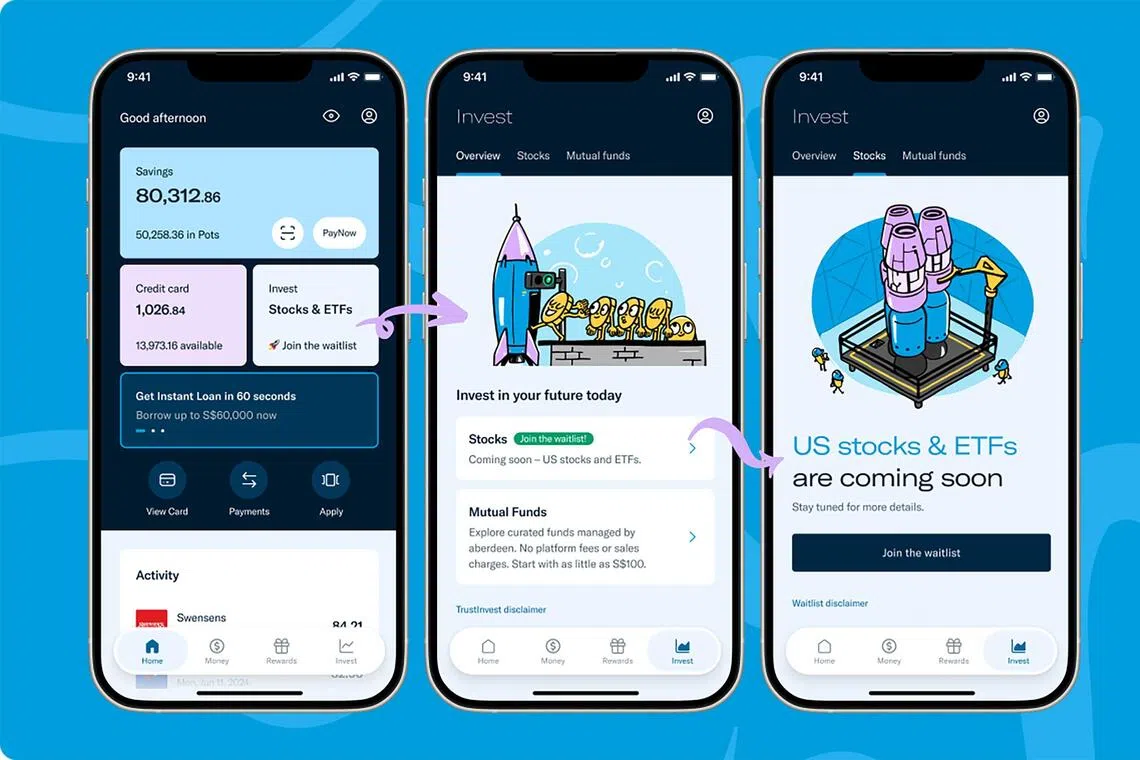
SINGAPORE – Trust Bank will launch a platform for its customers to trade US stocks and exchange-traded funds (ETFs), becoming the first Singapore digital bank to offer the service.
The trading platform, which sits within the TrustInvest offering, will be open to those with a Trust savings account.
Customers can sign up from Oct 15 and will be invited to open a trading account over the coming weeks.
Trust joins other overseas digital banks, such as South Korea’s KakaoBank and the UK’s Revolut, in offering a trading service on its app.
The digital bank has a full bank licence but not a capital market licence, which is required to deal in brokerage activities.
It is thus working with a third-party brokerage to offer trading services, and will share more details about its partner in the coming months.
Mr Dwaipayan Sadhu, the digital bank’s chief executive, said this trading platform widens the options for customers to a broader range of investment opportunities, which will now include US stocks and ETFs.
The ETFs could track an underlying stock index or industry sector, or digital assets, Trust noted in its statement.
TrustInvest, its investment solution, already offers five funds managed by Aberdeen Investments.
They are: a money market fund that invests in Singapore government securities, one that targets dividend-paying stocks and corporate bonds, and three other funds that allow investors to grow their wealth according to their risk appetite.
Trust’s peers GXS and MariBank do not offer trading in stocks or ETFs just yet.
GXS Invest, the digital investment platform of GXS Bank, has a money market fund that is managed by Fullerton Fund Management.
MariBank has two investment offerings. The Mari Invest SavePlus is a money market fund that is managed by Lion Global Investors, while Mari Invest Income is a bond fund managed by Pimco.
Mr Sadhu said Trust Bank customers will be able to invest in fractions of a share, instead of buying a whole share.
In response to queries from The Straits Times, Trust said the minimum investment sum is US$10 (S$12.98).
The digital bank noted that fractional trading options meant that popular US stocks and ETFs which cost hundreds of dollars per share are now more accessible to investors.
They can start with a small investment sum and still build a diversified portfolio.
As an example, one share of Netflix costs US$1,215.35 as at Oct 14. With fractional trading, an investor can put in a minimum of US$10 to own a fraction of Netflix, rather than commit US$1,215.35 for a full share.
The transactions are completed within the Trust banking ecosystem, so there is no need to juggle and transfer money between multiple platforms, Trust noted.
Associate Professor of Finance Ben Charoenwong at French business school Insead said this seamless integration has its pros and cons.
If done right, it presents a tremendous opportunity to democratise access to financial services, he added.
Trading becomes more convenient as an investor is able to invest directly from his everyday banking app.
However, this same convenience may also “reduce the psychological friction in ways that encourage behavioural mistakes”, Prof Charoenwong noted.
They may overtrade and take on more leverage than necessary, so accessibility may actually harm rather than help retail investors, he added.
Trust’s move into online trading comes as the space gets more crowded.
Prof Charoenwong noted that Singapore now has numerous platforms, including Moomoo, Syfe Trade, Tiger Brokers, Longbridge, and Webull, which are offering competitive rates on US stocks and ETFs.
This “race to the bottom” has lowered transaction costs for investors, he said.
At the same time, the stiff competition is concerning because it removes barriers to trade as platforms fight for trading volumes and could inadvertently encourage more risk taking in the process, he added.
Mr Yaki Razmovich, managing director for Singapore and Asia at eToro, said even though there are many players in the market, retail participation has been growing. This means there is still room for everyone in the crowded trading space.
eToro’s third-quarter trading report showed that retail investors in Singapore flocked to buy the dip in stocks like health insurer UnitedHealth and athletic apparel retailer Lululemon.
Investors here also continued to buy into the artificial intelligence story, by investing in semiconductor shares like Nvidia and Broadcom, the report showed.