A decade ago the notion of a “connected car” may have been limited to whether it had Bluetooth.
These days we expect modern cars to integrate with our lives as full-on digital companions that listen, take orders and make our daily commutes more immersive.
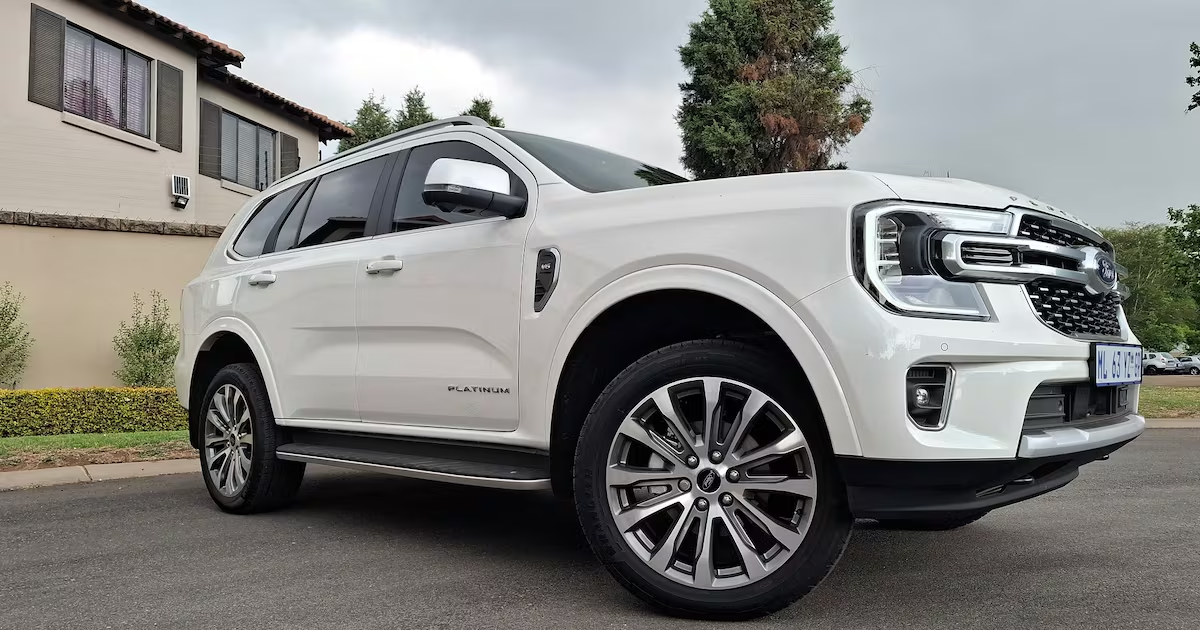
It has been our second month with the Ford Everest Platinum, a test duration which will see us reporting on the vehicle until February next year. We recently explored some of the connectivity highlights as part of the FordPass smartphone application.

The offering is available for most Ford models in the present lineup. Download it, link the vehicle using its VIN details, and you are good to go.
It allows the owner to keep tabs on various aspects of the vehicle, including its parked location, tyre pressures and fuel level. You can also operate the hooter remotely or start the car from afar. Seems gimmicky, but there are instances where this has proven useful, if only to make a quicker exit.
Owners are also able to schedule a service using the system, an occasion we are far away from, since the car has only just reached the 1,300km mark. Though it has crossed my mind to check on whether any of Ford’s numerous recall campaigns might apply to our Everest. Put a pin in this for a future report.

So far, the 3.0l V6 turbocharged diesel engine source has proven to be an absolute peach. While we have had many Ford models in our long-term programme over the past few years, this is my first encounter as custodian of a six-cylinder. It feels like a treat each time you fire it up and hear that silky, refined sextet breathe into life. Filling station visits are less fun, given the sizable 76l tank. A first-world problem.
Diesel consumption over the past 1,000km or so has settled into the 11l/100km region. The vehicle was collected with only 300km on its odometer, so that figure might improve once the break-in period has been properly observed.
The 3.0l unit is a torque-rich powerhouse that does not need to be wound out to hustle the 2,487kg SUV briskly. Judicious accelerator use is all that is needed to get the hefty Everest towards an acceptable pace. To give you an indication of how effortless the grunt is, look at the digital tachometer at about 100km/h: barely ticking over at an easy 1,700rpm.

At that point one hardly hears the motor from within the well-insulated cabin, with its upmarket trappings that provide a clear distinction from what is experienced behind the wheel of humbler XLT, Sport or Wildtrak versions.
We look forward to seeing what 0-100km/h sprint times we can get down the straight track at Gerotek test facilities. So far, the car has spent most of its time in the Eco driving mode, which also gives the digital instrument cluster a nice green tinge. The start-stop function can be deactivated by a button on the centre console.
Despite its luxuriously trimmed cabin designed to cosset families, the Platinum can still roll up its sleeves and be put to work, honouring the grafter roots of that ladder-frame chassis. The third row of seats folds down electronically; place the second row flat and you get a whopping 1,818l of storage space. Just about hearse-like, but we have no intentions for such activities. Instead, the Everest showed its hauling strengths for a recent celebration of life, lugging heavy LED numbers and a lengthy backing board for a birthday display.
Ladder-frame SUVs are a South African staple, with a number of contenders in the mix. But the Everest in Platinum trim dials a level of plushness and sophistication into the recipe that none of its direct peers seem to have matched yet. One looks forward to munching countless miles behind the wheel.
LONG-TERM UPDATE 1 | Ford Everest Platinum 3.0TD V6 4WD
ODOMETER ON DELIVERY: 300km
CURRENT ODOMETER: 1,400km
PRAISES: Clever connectivity functions, creamy six-cylinder motor, ability to haul as if it were a minivan.
GRIPES: There has to be a way to deactivate the loud hoot every time you lock the vehicle.
AVERAGE CONSUMPTION: 11.3l/100km