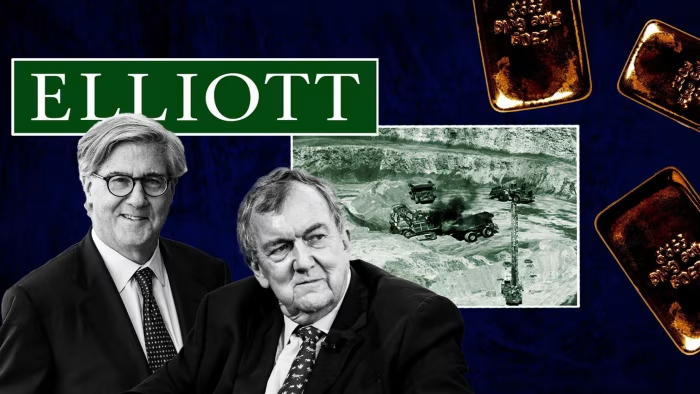
When John Thornton and Mark Bristow sealed the merger of Barrick Gold and Randgold Resources in 2018, creating then the world’s biggest gold miner, it was seen as one of the smartest deals in the sector.
Nearly seven years later, after a series of mis-steps at Barrick, the $64bn company is under mounting pressure to restructure or split up, in effect unwinding the deal.
The question of how the giant gold mining empire might be divvied up and who might buy its parts, particularly the massive Reko Diq project in Pakistan, has gripped a sector that is already reeling from record-high bullion prices and a wave of consolidation.
Activist investor Elliott Management has built a stake in the group worth at least $700mn, encouraged by reports that the board was considering a break up. Other investors feel the same.
“Barrick has amazing assets, but in recent years the operating costs went up as much as the gold price, which wasn’t great,” said Alec Cutler, fund manager at Orbis Balanced Fund. A break-up could create value, he says, adding that the high-risk Reko Diq project in Pakistan has become a “distraction”.
Despite the run-up in gold prices this year, Barrick’s share price has lagged its rivals due to setbacks at its mine in Mali, three fatal accidents, falling gold production, and the perceived risks of Reko Diq.
A few hours after news of Elliott’s stake broke, the company announced leadership changes to sharpen its focus on its valuable Nevada gold mines, including replacing its chief operating officer for North America and appointing a new chief development officer. Sources close to the company say the moves were long-planned.
At the heart of the changes lies a falling-out between Thornton, Barrick’s longtime chair, and Bristow, its chief executive, who departed abruptly in September.
The close relationship between the two high-power executives had been forged in the creation of the Barrick-Randgold deal. At the time Thornton, formerly co-president at Goldman Sachs, was chair of Barrick, while Bristow was chief executive of Randgold. As the two negotiated, they spent more than 50 days together in 2018, according to people close to them, and greatly admired each other.
Yet as Bristow presided over Barrick during a period when it repeatedly missed guidance and its gold production declined, their relationship grew fraught. By this year the two were barely on speaking terms, according to people who worked with them.
Tensions bubbled to the surface when the board last year commissioned headhunters Egon Zehnder to review internal candidates to succeed Bristow as chief executive. When Bristow found out, he was furious, according to people close to the board.

Other events catalysed Bristow’s sudden departure.
Barrick recently held unreported talks with rival Newmont over acquiring its 40 per cent stake in the Pueblo Viejo mine in the Dominican Republic. The massive project produces 490,000 ounces of gold a year and has a net asset value of about $10bn, according to analysts at RBC. At that valuation Newmont’s stake would be worth about $4bn.
Yet the deal talks fell through at the last minute over a tax issue. Some board directors blamed Bristow for the collapse, according to people close to the situation.
Another disappointment came in Mali, where a dispute with the government led to the arrest of four Barrick staff last year, and the closure of the Loulo-Gounkoto gold mine in January. Barrick is still trying to free the four employees who remain in jail, and negotiate a restart for the mine under Mali’s new mining code.
While rival gold miners were able to reach agreement with the government, under Bristow Barrick did not.
The episodes further fuelled tensions between Bristow and Thornton, according to people familiar with the situation. In July the board discussed Bristow’s departure, and at the end of September it asked him to step down, appointing Mark Hill as interim chief executive.
“The board is very focused on delivering value for shareholders. It has already taken significant actions in shareholders’ interest and will continue to do so,” the company said in a statement.

Bristow’s unexpected departure and the pressure on the company to improve its valuation increased speculation about a restructuring — and whether it could get snatched up by a rival.
With a diverse portfolio of mines from Zambia to Papua New Guinea, Argentina to the US, Barrick’s shares trade at a much lower valuation multiple than peers such as Agnico Eagle or AngloGold Ashanti, noted Matt Murphy, analyst at BMO.
Splitting the portfolio into two companies, one focused on North America and another everywhere else, is one option that could help, he added: “Each would have its different appeal, maybe the two pieces would be worth more [separately] than they are together.”
Under Hill, the company has already shifted its focus towards improving operations at its mines in Nevada — which is one of the world’s richest gold deposits, but has been plagued by performance issues. Hill is also working to improve safety after three fatalities in separate accidents this year in Nevada, Tanzania and the Democratic Republic of Congo.
Barrick’s safety performance has been “deeply concerning”, Hill wrote in a letter to staff on Tuesday, which also announced the leadership changes. “We cannot continue to operate in this way,” said the letter, seen by the Financial Times.
Barrick also on Tuesday said it was combining its Dominican Republic mine with its Nevada assets, to form a North American regional group, as well as putting put a separate leadership structure in place for Reko Diq. The moves fuelled speculation of a break-up or a deal to come.
A combination with Newmont, which is already Barrick’s partner in the Nevada Gold Mine JV and in the Dominican Republic, is one possibility, according to analysts. However the Denver-based company, which in 2023 acquired Newcrest, has dismissed suggestions that it will pursue further deals.

One of the biggest question marks in Barrick’s portfolio is the $9bn copper-gold mine it is developing in Pakistan’s Balochistan province, an area marked by a violent separatist uprising.
“It’s not clear how Reko Diq fits into the break-up plans,” says Josh Wolfson, analyst at RBC. “It is more copper-focused, it is a different jurisdiction. It might not be consistent with what public investors want to see in a portfolio.”
Bristow was personally committed to getting the high-risk project off the ground and frequently travelled to Pakistan.
Several of Barrick’s largest shareholders say privately that they feel the project is too risky and would prefer for the company to return more money to shareholders rather than spending heavily on Reko Diq.
James Luke, portfolio manager at the Schroders Global Gold Fund, says that Bristow’s recent departure creates an opportunity for the company to reframe its narrative “away from the excessive focus on Mali or Balochistan”.
As Pakistan’s government works on building a rapport with the Trump administration, the sudden departure of Bristow has prompted discussions about the mine’s ownership. US miner Freeport has been approached about taking a stake in the project if the Canadian miner chooses to sell, according to two Pakistani officials familiar with the matter. Freeport declined to comment.
One of the people added: “Since Bristow stepped down, it’s been endless drawing-room chatter about whether Barrick will divest and who will buy the stake if so.”
Additional reporting by Camilla Hodgson