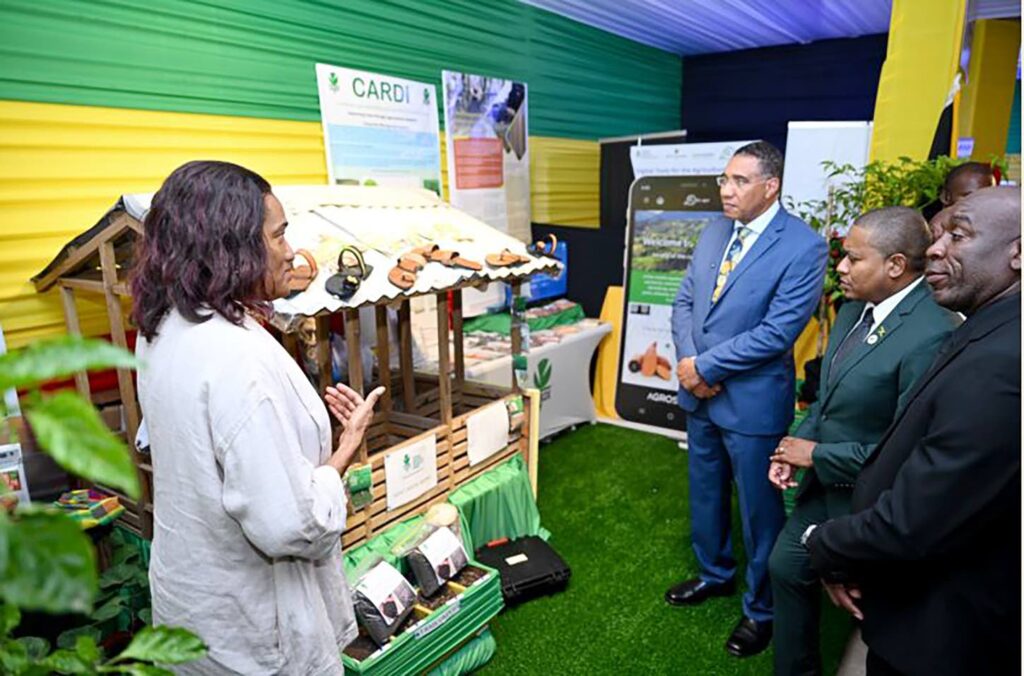
Caribbean Agriculture Research and Development Institute (CARDI) country representative to Jamaica Dionne Harris-Clarke highlights the features of her organisation’s booth to (from second left) Prime Minister Dr Andrew Holness, Agricuture Minister Floyd Green, and Caricom Assistant Secretary General Dr Wendell Samuel on the opening day of the 20th staging of CWA 2026.
This year’s staging of the Caribbean Week of Agriculture (CWA) is placing practical solutions at the centre of efforts to tackle the immediate challenges facing regional agriculture, with stakeholders sharpening their focus on food security, climate resilience, technology and investment to strengthen production.
At the 20th edition of the flagship regional event now underway in Trelawny, more than 600 regional and international delegates from the agriculture and fisheries sectors have gathered in Jamaica for a week of activities slated to run from September 27 to October 2.
Held under the theme ‘The New F.A.C.E. of Caribbean Food Systems’, this year’s event comes at a critical time for the local agriculture sector, which contracted by 17 per cent during the April-to-June quarter amid back-to-back weather-related disruptions. Prolonged drought in recent months has added further pressure on farmers, threatening crop production and contributing to higher food prices.
Against this backdrop, the six-day event is expected to advance a plan of action to accelerate agricultural development, strengthen food security, expand agribusiness and increase the adoption of climate-smart technologies.
Speaking ahead of the start of the week-long activities, Minister of Agriculture, Fisheries and Mining Floyd Green said the event’s agenda is intended to move countries beyond discussion towards solutions that can be implemented.
“For us, it’s an opportunity to bring together the principal actors from across the region into the same space to confront the structural issues that continue to constrain agriculture. Aside from confronting the issues as a country and region, we also want to advance practical solutions that will be implemented,” Green said.
“I had said at the launch that we don’t want this to be a talk show. As a region, we are very good at talking, but oftentimes we fall down on implementation but we want to correct this,” he added.

GREEN…our responsibility now is to use those experiences alongside our regional partners to help develop practical solutions that will make our farmers, our food systems and, ultimately, our region more resilient (Photo: Horace Hines)
Underscoring the need for a “definitive plan of action” for the region, Green said greater focus is being placed on growing the sector in the shortest possible time while improving food security, developing agribusiness, expanding climate-smart technologies and increasing exports.
He also said mobilising capital will be critical to achieving those objectives, with greater private sector involvement needed to expand production and strengthen agricultural value chains.
“We do believe the private sector has to drive the transformation of the region’s agriculture,” the minster noted.
The CWA programme is anchored around the pillars of food security, agribusiness, climate-smart technologies and export expansion, which organisers have identified as critical to strengthening national food systems, increasing production and improving access to regional and international markets.
The programme comprises 75 technical sessions, daily plenaries, ministerial meetings, an exhibition and trade show, business-to-business engagements and field visits.
The opening day of the event was used to focus on food security under the theme ‘Transforming Regional Food Systems: A Case for Accelerating Vision 25 by 2025’.
Senior director of trade in agriculture in the Ministry of Agriculture Shelleka Darby said discussions will also assess progress under Caricom’s ‘Vision 25 by 2025 Plus Five’ initiative which aims to reduce the region’s food import bill by 25 per cent by 2030.
“Ministers of agriculture at the event will be having practical and transparent conversations around the strategies that have been implemented so far, especially as it relates to the progress that has been made under the Vision 25 by 2025 Plus Five and the road map that has been laid for going forward into 2030,” she said.

The opening day of CWA 2026 was used to focus on food security under the theme ‘Transforming Regional Food Systems: A Case for Accelerating Vision 25 by 2025’. Discussions were held to assess progress under Caricom’s ‘Vision 25 by 2025 Plus Five’ initiative which aims to reduce the region’s food import bill by 25 per cent by 2030.
Among the other topics slated for technical discussion are roots and tubers, animal genetics, ruminant production and value addition across the livestock sector. Technology is also expected to feature prominently, particularly as the region seeks to overcome persistent challenges related to labour, productivity and climate resilience.
Darby said several sessions will also feature private sector-led demonstrations of agricultural technologies, allowing participants to see their practical applications.
“I’m very excited about this because it’s showcasing not just in dialogue but in demonstration — the level to which the region is going in terms of climate adaptation through technologies,” she said.
Discussions at the event are also examining how private investment will be mobilised to support smart technologies, including automation and artificial intelligence, while exploring ways to increase technology adoption among farmers and fishers. Attention is likewise being given to improving the productivity of priority crops and livestock and developing more efficient and resilient production systems.
For Jamaica, the urgency of these interventions stems from the need to strengthen systems against recurring shocks following Hurricane Beryl in 2024, Hurricane Melissa in 2025 and the current drought.
Green said the repeated disruptions have provided valuable lessons that Jamaica can share with regional partners as they work to strengthen the resilience of Caribbean food systems.
“Our responsibility now is to use those experiences alongside our regional partners to help develop practical solutions that will make our farmers, our food systems and, ultimately, our region more resilient,” he said.