ABSTRACT
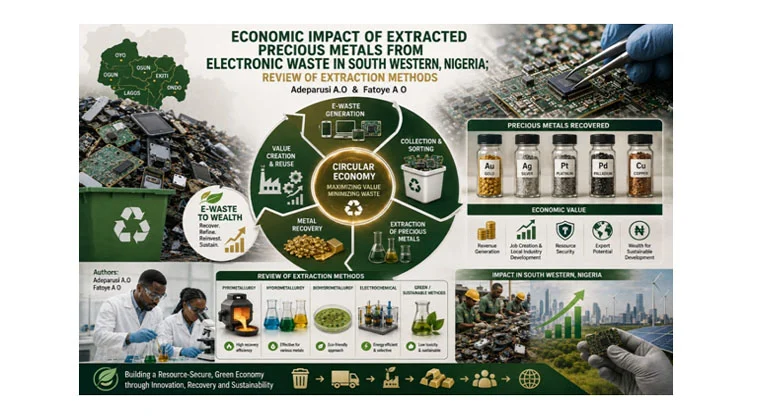
The progressive depletion of metalprimary sources has led to the search for alternative sources, such as metal recovery. E-waste, also known as waste from electrical and electronic equipment, is a solid waste that accumulates quickly due to thehigh demand for replacing electrical and electronic products with newer versions. The global e-waste generation is estimated to be between 53.6 million tons, and it is increasing by 3–5% per year. The experimental analysis conducted on printed circuit boards (PCB) indicated the abundance of precious metals in electronic waste. This review addresses issues related to chemical and biological extraction techniques and proposes a hybridmethodology that incorporates both, also with safer chemicals and compatible microbes for better and efficient extraction of metals from the E-waste.
Keywords: depletion; sources; extraction; precious; metals
I. INTRODUCTION
Several metals both, base and precious metals are used in making essential components of electronic devices. The properties of these metals make them ideal for recycling and reuse yet, studies have it that only 15-20% of electronic devices are recycled. This shows a huge volume of untapped valuable metals that could be reused instead of sitting in landfills. Effectively recovering metals from these devices could have multiple economic and ecological benefits,ranging from reducing the economic burden of electronics recycling to reducing the demand for ore mining.
The proliferation of smartphones, tablets, future phones, and, technological advancements in consumer electronic and electrical devices are spiking the growth of the integrated circuit (IC) market. Additionally, the launch of supportive government initiatives for the development of infrastructure for electric and autonomous vehicles (EVs) is further contributing to the growth of the IC market (Wood 2018). The Global Automotive IC market was valued at $43,240 million in 2017 and is projected to reach $89,140 million by 2025, growing at a rate of 9.3% from 2018 to 2025.
The extraction of metals from waste was done using established techniques and the characterization was done using non-destructive techniques.
E-waste is a generic name, considered collectively for discarded electronic devices and/or electronic components [1]. Generally, metals make up approximately 50% of the total e-waste [2]. The remaining consists of ceramics, refractory oxides, and plastics along with several hazardous substances, such as chlorofluorocarbons (CFCs), polycyclic hydrocarbons, polybrominated biphenyls, dioxins, epoxy resins, polychlorinated biphenyls, fiberglass, and polyvinyl chlorides [3]. E-waste is among the fastest-growing wastes, with an annual growth rate of 3–5% [4]. Only about 17% of the e-waste is collected and recycled, and the rest ends up in landfills and waste dumps [5]. There is a considerable variation in the estimation of global e-waste generation viz. 53.6 million megatons (Mt) [5], 40 Mt [6], 52.2 Mt [7], and 44.7 Mt [8]), an average, of 47.62 Mt generated globally. Of the total of 53.6 Mt of e-waste generated globally in 2019, a major share of 24.9 Mt was generated from Asia, with China (10.129 Mt) and India (3.230 Mt) with estimated formal recycling rates of 34.6% and 5%, respectively [5, 9, 10]. The per capita e-waste generation in 2014 and 2016 was 5.8 and 6.1 kg per person, respectively. With the rise in e-waste generation by 3% per annum, the global e-waste generation is projected to reach 74.7 Mt and 243 Mt by 2030 and 2050, respectively [5, 11, 12].
The estimated net worth of e-waste was estimated to be USD 61.05 billion and Euros 55 billion [13] in 2016 globally whereas, the value of e-waste from the United States of America (USA) alone amounts to be about USD 57 billion [5, 14]. Furthermore, Greenpeace International reported that the contamination levels due to e-waste recycling in China and India were 80% higher than in the rest of the world [15].
The global precious metals e-waste recovery market is expected to grow from $9.22 billion in 2021 to $9.61 billion in 2022 at a compound annual growth rate (CAGR) of 4.28%. The market is expected to reach $11.51 billion in 2026 at a CAGR of 4.61%.
The present e-waste management practices, i.e., dumping of e-waste in landfills and incineration, are not environmentally friendly owing to the high risks of health hazards and space occupation [2] therefore, unsustainable. As a result, e-waste recycling and other non-conventional management methods, integrating several green approaches offer economic potentiality for enterprises with long-term sustainability for the future.
Synopsis of E‑wastes
E-waste, being a complex and heterogeneous waste comprising both recyclable and non-recyclable hazardous components i.e., plastic, glass, wood, rubber, metal, and other items [16, 17], has kindled the interest of scholars, policymakers, and entrepreneurs for its reuse, management, and recovery. It is generally composed of 30% organic (polymers, flame retardants, and glass fibers), 30% ceramic (silica, mica, and alumina), and 40% inorganic components (ferrous and non-ferrous metals) [18]. The higher composition of inorganic components includes various metals, including base metals (Al, Sn, Cu, and Fe), noble metals (Ag, Au, and Pd), heavy metals (HMs) (Ni, Cd, Cr, Zn, Pb, and Hg) and REEs (Ga, Pt, and tantalum group elements) [19, 18]. The heterogeneous nature of e-waste increases the complexity of e-waste management, combined with the inefficient techniques of its processing, resulting in a great burden on the ecosystem anda huge carbon footprint.
Landfilling and incineration have been among the most common and cost-effective methods of disposing of e-waste in developing nations. Landfilling is the most adopted method for waste dumping with minimal input cost, whereby the waste is directly disposed of with minimal equipment, energy, and material recovery [20]. Alternatively, incineration is also a prevalent waste management technique for significant waste reduction in both volume and matter. Several organic components are altered or converted to fewer hazardous compounds during combustion [20, 21]. However, these methods are environmentally unsafe due to the release of several environmental contaminants with a high carbon footprint.

Residents living in the vicinity of e-waste recycling areas are at high risk of exposure to multiple toxic chemicals, including organic flame retardants, chlorofluorocarbons, polycyclic aromatic hydrocarbons (PAHs), polybrominateddiphenyl ethers (PBDEs), and polychlorinated dibenzodioxins and furans (PCDD/Fs), as well as inorganic HMs, such as Pb, Cd, Hg, and Ni [22].Children have the potential to develop lower cognitive scores, slower sensory processing difficulties, disruption of thyroid function, and attention-deficit hyperactivity disorder due to blood Pb, lower lung function levels including forced vital capacity (FVC) and forced expiratory volume (FEV1) through exposed to various chemicals from e-waste [23].
E‑waste Recycling and Metal Recovery Technologies
Physical separation
A physical separation technique is required to segregate each component into a few categories as different waste components adopt varying recycling routes. With this step, all the reusable materials, such as capacitors, resistors, keys, light-emitting diodes (LEDs), and transistors, are recovered. E-waste scrap materials are screened according to their sizes and shapes, and the waste is segregated into non-metal and metal classes before undergoing further recycling processes [16, 24]. These procedures can be performed using industrial machinery, such as shredders and granulators [17, 25]. On an industrial scale, the separation between metal and non-metal materials from e-waste can be performed using several techniques, such as magnetic separation, eddy current separation, electric conductivity-based separation, and density-based separation, based on the physical properties of the e-waste components [16, 25, 24, 26].
Pyrometallurgy
Pyrometallurgy is a traditional method to recover precious and non-ferrous metals from e-waste. It includes different treatments at high temperatures: incineration, melting, and so on. Pyrometallurgical processes might not be considered as best available recycling techniques anymore because some of the PCB components, especially plastics and flame retardants, produce toxic and carcinogenic compounds. Most of the research activities on the recovery of base and precious metals from waste PCBs are focused on hydrometallurgical techniques because they are more exact, predictable, and easily controlled techniques.
Hydrometallurgy
Hydrometallurgy is concerned with processes that use aqueous solutions to extract metals from ores. The most common hydrometallurgical process is leaching, which involves the dissolution of the valuable metals into the aqueous solution. After the solution is separated from the ore solids, the solution is often subjected to various processes of purification and concentration before the valuable metal is recovered, either in its metallic state or as a chemical compound. The solution purification and concentration processes may include precipitation, distillation, adsorption, and solvent extraction. Extraction of precious metals from PCBs, including leaching, purification, and recovery, is the second stage after the recovery of base metals. The most common leaching reagents for precious metal leaching include cyanide, thiourea, and thiosulfate due to the stable metal complex formed.
Bio‑metallurgy
In contrast to the traditional hydrometallurgical process, bioleaching, also known as the bio-hydrometallurgical process, is a simple process that offers multiple advantages, including higher efficiency and safety, lower operating costs and energy consumption, easier management, normal operating conditions at atmospheric pressure and room temperature, eco-friendliness, and fewer industrial steps without the need of skilled workers [27].The separation of metals from e-waste using a biological process occurs mainly through acidolysiscomplexation. However, the limitation of bioleaching of metals from e-waste is the inherent toxicity of the toxicants to microorganisms. Auxoautotrophs i.e., Sulfobacillusacidianus, Acidiphiliumthiobacillus, and Leptospirillumferrooxidans and auxo-heterotrophs are widely used in bioleaching [28] and extract HMs using organic substrates to produce acidic metabolites (HCO3, HNO3, H2SO4, CH3COOH, citric acid, oxalic acid, gluconic acid, and formic acid) [29].
Recovery Experiment
The experiment is necessary to support the claim that e-waste contains valuable precious metals which can turn around the national economy and reduce the burden on foreign exchange.
Pulverized PCBs obtained from dumpsite were leached with 1.0 M H2SO4 in a 0.5 L glass reactor and the temperature was controlled using a thermostatic water bath. The leaching conditions are temperature 500C, mixing 300 rpm, and time 1h. The metal concentration of leachate is presented in Table 1.
Table 1. Concentration of metal leached from solution of waste PCBs
| Metal | Cu | Fe | Ni | Zn | Mn | Co | Al |
| Concentration (mg/L) | 1656.10 | 202.50 | 342.20 | 8230.0 | 106.80 | 76.60 | 420.20 |
II. CONCLUSIONS AND CALL TO ACTION
Recycling of e-waste for extraction of precious metals viz. Au, Ag, Pt, and Pdare occurring in various proportions across the globe, mostly through the informal sectors. A systematic approach is required to treat pollution load from this sector. The extraction of precious metals from the e-waste in developing nations occurs through manual scavenging, pyrometallurgy, and hydrometallurgy, which are not only hazardous to the people but also to the entire environment. All the methods should be evaluated from a techno-economical point and their feasibility should be accessed.Between 2022 and 2050, e-waste is estimated to increase from 47.62–167.05 Mt, with an average annual rate of increase of e-waste generation at 4%. The e-waste is the rich source of precious metals particularly, the PCB, with estimated levels of Au and Ag in 80 and 1000 mg kg−1, respectively, almost 40–70 times higher than the natural ores.
Acknowledgment
The authors are thankful to Tertiary Education Trust Fund (TetFund), for providing the necessary financial support for this research work.
REFERENCES
- [1]. Widmer R, Oswald-Krapf H, Sinha-Khetriwal D et al (2005) Global perspectives on e-waste. Environ Impact Assess Rev 25:436–458. https:// doi. org/ 10. 1016/J. EIAR. 2005. 04. 001
- [2]. Needhidasan S, Samuel M, Chidambaram R (2014) Electronic waste—an emerging threat to the environment of urban India. J Environ Heal SciEng 12:1–9. https:// doi. org/ 10. 1186/ 2052
- [3]. 336X- 12- 36/ TABLES/3
- [4]. Tipre DR, Khatri BR, Thacker SC, Dave SR (2021) The brighter side of e-waste—a rich secondary source of metal. Environ SciPollut Res 28:10503–10518. https:// doi. org/ 10. 1007/
- [5]. s11356- 020- 12022-1
- [6]. Tuncuk A, Stazi V, Akcil A et al (2012) Aqueous metal recovery techniques from e-scrap: hydrometallurgy in recycling. Miner Eng 25:28–37. https:// doi. org/ 10. 1016/J. MINENG. 2011. 09. 019
- [7]. Forti V, Balde CP, Kuehr R, Bel G (2020) The global E-waste monitor 2020: quantities, flows and the circular economy potential. 120
- [8]. 6Hazra A, Das S, Ganguly A et al (2019) Plasma arc technology: a potential solution toward waste to energy conversion and of GHGs mitigation. Waste ValorisRecycl. https:// doi. org/ 10. 1007/ 978- 981- 13- 2784-1_ 19
- [9]. Wang J, Bai J, Xu J, Liang B (2009) Bioleaching of metals from printed wire boards by Acidithiobacillusferrooxidans and Acidithiobacillusthiooxidans and their mixture. J Hazard Mater 172:1100–1105. https:// doi. org/ 10. 1016/J. JHAZM AT. 2009. 07.
- 102
- UNEP (2017) UN report: Time to seize opportunity, tackle challenge of e-waste. https:// www. unep. org/ news- and- stories/ press- relea se/ un- report- time- seize- opportunity- tackle- challenge-e
- Accessed 22 Oct 2022
- Jha MK, Kumar A, Kumar V, Lee JC (2011) Prospective scenario of E-waste recycling in India. TMS Annu Meet. https:// doi. org/ 10. 1002/ 97811 18086 391. CH10
- Wu Q, Leung JYS, Geng X et al (2015) Heavy metal contamination of soil and water in the vicinity of an abandoned e-waste recycling site: implications for dissemination of heavy metals. Sci Total Environ 506–507:217–225. https:// doi. org/ 10. 1016/J. SCITO TENV. 2014. 10. 121
- Phengsaart T, Ito M, Azuma A et al (2020) Jig separation of crushed plastics: the effects of particle geometry on separation efficiency. J Mater Cycles Waste Manag 22(3):787–800. https:// doi. org/ 10. 1007/ S10163- 019- 00967-6
- Nnorom IC, Osibanjo O (2008) Electronic waste (e-waste): material flows and management practices in Nigeria. Waste Manag 28:1472–1479. https:// doi. org/ 10. 1016/J. WASMAN. 2007. 06. 012
- Dutta D, Rautela R, Gujjala LK, Kundu D, Sharma P, Tembhare M, Kumar S (2022) A review on recovery processes of metals from E-waste: a green perspective. Sci Total Environ 859:160391
- Thakur P, Kumar S (2021) Evaluation of e-waste status, management strategies, and legislations. Int J Environ Sci Technol. https:// doi. org/ 10. 1007/ s13762- 021- 03383-2
- Brigden K (2005) Recycling of electronic wastes in China & India: workplace & environmental contamination electronic wastes contamination
- Tembhare SP, Bhanvase BA, Barai DP, Dhoble SJ (2021) E-waste recycling practices: a review on environmental concerns, remediation and technological developments with a focus on printed circuit boards. Springer, Netherlands
- Debnath B, Chowdhury R, Ghosh SK (2018) Sustainability of metal recovery from E-waste. Front Environ SciEng 12:1–12. https:// doi. org/ 10. 1007/ s11783- 018- 1044-9
- Rautela R, Arya S, Vishwakarma S et al (2021) E-waste management and its effects on the environment and human health. Sci Total Environ. https:// doi. org/ 10. 1016/j. scitotenv. 2021. 145623
- Jadhao PR, Ahmad E, Pant KK, Nigam KDP (2022) Advancements in the field of electronic waste recycling: critical assessment of chemical route for generation of energy and valuable products coupled with metal recovery. Sep Purif Technol. https:// doi. org/ 10. 1016/J. SEPPUR. 2022. 120773
- Ismail H, Hanafiah MM (2021) Evaluation of e-waste management systems in Malaysia using life assessment and material flow analysis. J Clean Prod. https:// doi. org/ 10. 1016/j. jclep ro. 2021. 127358
- Luhar S, Luhar I (2019) Potential application of E-wastes in construction industry: a review. Constr Build Mater 203:222–240. https:// doi. org/ 10. 1016/j. conbuildmat. 2019. 01. 080
- Alabi OA, Adeoluwa YM, Huo X et al (2021) Environmental contamination and public health effects of electronic waste: an overview. J Environ Heal SciEng 19:1209. https:// doi. org/ 10. 1007/ S40201- 021- 00654-5
- Parvez SM, Jahan F, Brune MN et al (2021) Health consequences of exposure to e-waste: an updated systematic review. Lancet Planet Heal 5:e905–e920. https:// doi. org/ 10. 1016/ S2542- 5196(21) 00263-1
- Ashiq A, Kulkarni J, Vithanage M (2019) Hydrometallurgical recovery of metals from e-waste. Elsevier Inc., Amsterdam
- Ahirwar R, Tripathi AK (2021) E-waste management: a review of recycling process, environmental and occupational health hazards, and potential solutions. Environ Nanotechnology MonitManag. https:// doi. org/ 10. 1016/j. enmm. 2020. 100409
- Rene ER, Sethurajan M, Kumar Ponnusamy V et al (2021) Electronic waste generation, recycling and resource recovery: Technological perspectives and trends. J Hazard Mater 416:125664. https:// doi. org/ 10. 1016/j. jhazm at. 2021. 125664
- Vakilchap F, Mousavi SM, Shojaosadati SA (2016) Role of Aspergillusniger in recovery enhancement of valuable metals from produced red mud in Bayer process. BioresourTechnol 218:991–998. https:// doi. org/ 10. 1016/J. BIORT ECH. 2016. 07. 059
- Islam A, Ahmed T, Awual MR et al (2020) Advances in sustainable approaches to recover metals from e-waste—a review. J Clean Prod. https:// doi. org/ 10. 1016/J. JCLEP RO. 2019. 118815
- Gu W, Bai J, Feng Y et al (2019) Biotechnological initiatives in E-waste management: recycling and business opportunities. Electron Waste Manag Treat Technol. https:// doi. org/ 10. 1016/B978-0- 12- 816190- 6. 00009-1