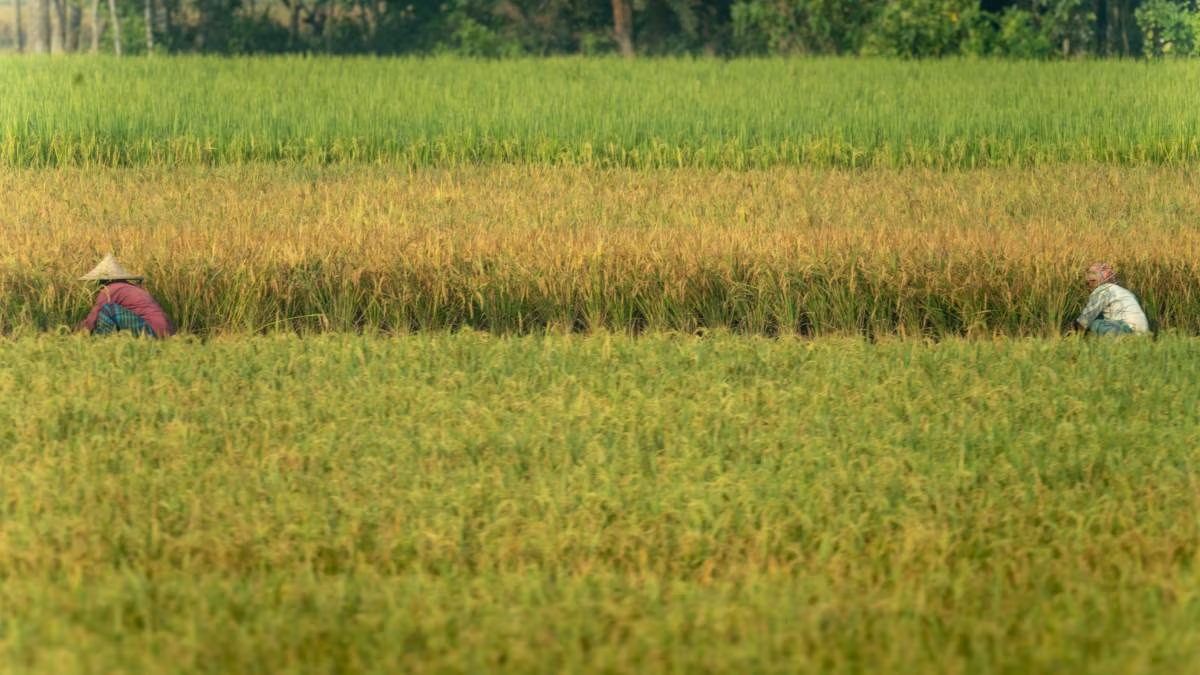
As India pushes toward ambitious food security and economic growth targets, women remain the backbone of its agricultural sector – yet experts noted that systemic barriers in land ownership, credit access, decision-making power and formal training continue to limit their potential.
Recent data from the Periodic Labour Force Survey (PLFS) underscores this reality: women now constitute over 42% of India’s agricultural workforce, with rural women engagement in agriculture reaching approximately 76.9% in 2024, up steadily from prior years. Overall, agriculture accounts for a significant share of female employment, often around 60% or more of women’s work.
This “feminization of agriculture” is driven in part by male out-migration to urban jobs, leaving women to manage farms, often as unpaid family workers. Nearly half of women in agriculture fall into this category, highlighting both their critical contributions and their economic marginalization.
“Women are the backbone of Indian agriculture, forming nearly 80% of its workforce. However far too many still lack access to the knowledge, resources, and markets needed to truly thrive. Empowering women across the agrivalue chain, from farm practices to storage, processing, and market linkages, is critical to building resilient and sustainable food systems,” Subroto Geed, President, South Asia, Corteva Agriscience, said.
Globally, the Food and Agriculture Organization (FAO) estimates that women make up about 43% of the agricultural labour force, facing consistent gaps in resources and advisory services. In India, most rural women workers are engaged in agriculture, often without control over income or key decisions. With 2026 designated as the International Year of the Woman Farmer, attention is sharpening on these disparities.
“Through Corteva’s 2 Million Women in Agriculture initiative, we are equipping over two million women with climate smart practices, strengthening women led FPOs and cooperatives, and enabling them to participate in markets with confidence. Geed said.
A 2023 study published in World Development found that access to extension services increased adoption of improved practices by 10 to 20% among smallholders. Work by the International Food Policy Research Institute (IFPRI) indicates that closing gender gaps in access to resources could raise farm yields by up to 30%. Broader analyses, including FAO reports, suggest that addressing gender disparities in agrifood systems could significantly boost global GDP and reduce food insecurity.
Poonam Tiwari, who only had education till the eighth grade, spoke about how FPOs can enhance incomes and livelihoods, “I studied only till eighth grade and could only do some sewing work and small-scale business to make ends meet. When we came together to form Bandhavgarh Krishi Vanopaj Producer Company, my skills and leadership potential were recognised”.
Adding to it she mentioned that, “I went from a woman who stitched at home to a Director of an FPC that secured Rs 25 lakh in government support. Today, our Mahua laddu brand ‘Tribo’ is creating livelihoods for women like me. When women work together, we can create change for many.”
Industry players like Corteva, alongside government schemes and NGOs, are scaling targeted efforts. Experts emphasize that sustained investment in gender-responsive extension, land rights, and market access will be essential—not only for women’s empowerment but for India’s broader goals of sustainable agriculture, higher productivity, and inclusive growth.