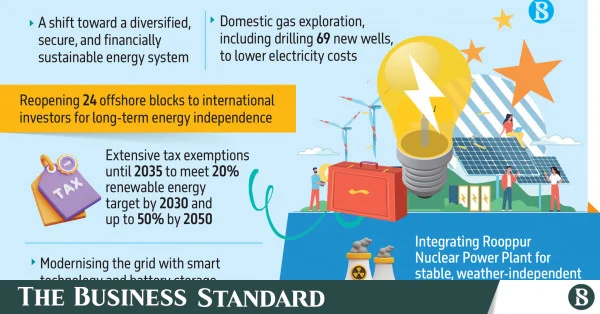
While the reduction in sectoral allocation has drawn attention, the more important story may be the budget’s attempt to align energy security, domestic resource development, renewable energy expansion, fiscal discipline, and long-term economic resilience within a single policy framework
Infograph: TBS
“>

Infograph: TBS
Much of the discussion surrounding Bangladesh’s FY2026–27 energy budget has centred on a single headline figure: the reduction in overall budgetary allocation to the power and energy sector.
Yet an exclusive focus on the size of the allocation risks overlooking a far more important question: whether the budget provides a credible roadmap for addressing the structural challenges that have long constrained the country’s energy sector.
The significance of this year’s budget lies less in the scale of its allocation than in the direction of its policy priorities. The budget signals a gradual yet important transition from an import-dependent, subsidy-intensive and increasingly costly energy model towards a more diversified, secure and financially sustainable energy system. Viewed through this lens, the FY27 budget represents a strategic realignment of Bangladesh’s energy policy.
More importantly, the budget reflects a growing recognition that energy policy is no longer merely about keeping the lights on; it is fundamentally linked to industrial competitiveness, export performance, investment attraction, employment generation and macroeconomic stability.

For an economy aspiring to accelerate industrialisation, strengthen its position in global value chains and sustain higher economic growth, reliable and affordable energy is no longer a supporting factor; it is a prerequisite.
The broader significance of the budget therefore extends well beyond the energy sector. Its success will ultimately be measured not only by megawatts generated or infrastructure built, but by its ability to strengthen economic resilience, enhance industrial productivity and reduce vulnerabilities associated with excessive dependence on imported energy.
Energy security as economic security
Energy security can no longer be viewed as a standalone sectoral concern; it has become a fundamental pillar of economic security. Bangladesh currently imports approximately 95% of its petroleum products, a significant share of its natural gas demand in the form of LNG, and nearly all of its LPG requirements. As a result, fluctuations in global energy markets have direct implications for inflation, foreign exchange reserves, fiscal stability and overall economic growth.
Recent geopolitical tensions in the Middle East, the aftermath of the Russia–Ukraine conflict and recurring disruptions to global supply chains have underscored a critical reality: countries with high levels of energy import dependence are increasingly vulnerable to external economic shocks. For Bangladesh, the challenge is not simply securing adequate energy supplies, but ensuring that energy remains affordable, reliable and resilient in an increasingly uncertain global environment.
In this context, the government’s emphasis on domestic gas exploration, offshore bidding, refinery expansion, LNG infrastructure development and the creation of strategic energy reserves reflects a broader effort to strengthen the country’s energy security architecture. These initiatives should therefore be viewed not merely as energy-sector projects, but as strategic investments aimed at enhancing economic resilience, reducing exposure to external shocks and supporting long-term sustainable growth.
Domestic gas: The foundation of affordable and secure energy
For Bangladesh, no energy source currently offers greater economic value than domestically produced natural gas. Every additional unit of domestic gas production reduces LNG imports, conserves foreign exchange, lowers electricity generation costs and eases the fiscal burden associated with energy subsidies.
With pressures on the balance of payments remaining elevated and energy demand continuing to grow, increasing domestic gas production remains one of the most effective ways to strengthen energy security and reduce exposure to external shocks.
The budget’s emphasis on Bapex’s exploration programme, including the drilling of 69 new wells, 31 workover operations, expanded seismic surveys and the procurement of new exploration rigs, represents one of its most strategically important initiatives. It signals a renewed policy focus on developing domestic energy resources rather than relying excessively on imported fuels to meet growing energy needs.
Exploration, of course, carries inherent risks, and not every well will lead to a commercial discovery. Yet countries that fail to invest in exploration effectively guarantee continued dependence on imported energy. From that perspective, the budget’s renewed commitment to domestic resource development is both economically prudent and strategically necessary.
Offshore exploration: Bangladesh’s next energy frontier
Few developments are likely to have a greater impact on Bangladesh’s long-term energy future than a significant offshore gas discovery. Recognising this opportunity, the government has revised the Production Sharing Contract (PSC) framework and reopened 24 offshore blocks, nine shallow-water and 15 deep-water blocks, to international investors.
However, attracting major international energy companies will require more than competitive contract terms. Investors also place considerable emphasis on policy consistency, regulatory efficiency, access to high-quality geological data, profit repatriation mechanisms and foreign-exchange convertibility.
Encouragingly, the government appears to be pursuing a dual-track strategy: attracting international expertise and capital while simultaneously strengthening BAPEX’s own exploration capabilities. This balanced approach can help combine global experience with domestic institutional development.
At a broader level, offshore exploration is not merely an energy initiative; it is a strategic investment in Bangladesh’s future economic and energy security.
Renewable energy: From policy ambition to economic opportunity
Perhaps the most forward-looking aspect of the FY27 budget is its strong and sustained support for renewable energy. The government has proposed tax exemptions for the renewable energy sector until 2035, duty waivers on key solar components, tax incentives for battery manufacturing and energy storage technologies, and tax rebates for renewable energy users.
More importantly, it has reaffirmed ambitious targets of generating 20% of electricity from renewable sources by 2030 and between 30% and 50% by 2050.
Collectively, these measures signal a broader shift in policy thinking. For much of the past two decades, Bangladesh’s energy strategy was primarily focused on expanding electricity generation capacity to meet rapidly growing demand. The challenge today is fundamentally different. The objective is no longer simply to generate more electricity, but to produce it in a manner that is more affordable, sustainable, resilient and economically efficient.
The success of the budget will ultimately be measured not only by megawatts generated or infrastructure built, but by its ability to strengthen economic resilience, enhance industrial productivity and reduce vulnerabilities associated with excessive dependence on imported energy.
The FY27 budget therefore reflects the early foundations of a broader transition from energy expansion to energy transition.
The significance of this transition extends well beyond its environmental benefits. For a country that remains heavily dependent on imported fuels, renewable energy is increasingly becoming an economic necessity as much as an environmental imperative. Diversifying the energy mix can reduce exposure to volatile international energy markets, strengthen long-term energy security and improve economic resilience.
At the same time, renewable energy presents a significant economic opportunity. The expansion of solar power, battery storage, energy management systems and associated supply chains could stimulate new investment, encourage technology transfer and create green employment opportunities.
Why grid modernisation matters
Achieving renewable-energy targets will require a comprehensive transformation of the energy system, not merely the addition of new generation projects. A modern energy system depends not only on how electricity is produced, but also on how efficiently it is transmitted, distributed, stored and managed.
As the share of renewable energy increases, investments in smart grids, battery storage, advanced transmission infrastructure and rooftop solar integration will become increasingly important. The next phase of Bangladesh’s energy transition will therefore be less about building additional power plants and more about modernising the systems that connect, distribute and manage electricity.
Rooppur and Bangladesh’s future energy mix
Another significant development highlighted in the budget is the anticipated integration of the first 1,200 MW unit of the Rooppur Nuclear Power Plant into the national grid. This represents an important milestone in Bangladesh’s efforts to diversify its energy mix and establish a more balanced and resilient power system. Unlike solar and wind power, nuclear energy is not weather-dependent, while its exposure to international fuel-market volatility is generally lower than that of gas-fired generation.
As Bangladesh plans for the coming decades, a balanced energy portfolio combining domestic gas, renewable energy, nuclear power and regional electricity trade is likely to provide the most resilient and cost-effective pathway for meeting growing energy demand.
Power sector reform: The missing piece of long-term sustainability
The budget also acknowledges a critical reality: achieving energy security will ultimately require a financially sustainable power sector. Annual subsidies in the power and energy sector now exceed Tk40,000 crore. While subsidies have played an important role in maintaining affordability and supporting economic activity, their continued expansion is neither fiscally desirable nor economically sustainable.
Given these realities, the government’s emphasis on reviewing capacity payments, reassessing power purchase agreements (PPAs), adopting least-cost generation principles and promoting competitive bidding represents an important step towards improving efficiency and strengthening financial discipline. These measures have the potential to reduce unnecessary costs, improve resource allocation and ensure that future investments deliver greater value for both consumers and taxpayers.
The challenge, however, is not simply to reduce subsidies, but to do so in a manner that preserves affordability, protects vulnerable consumers and maintains industrial competitiveness.
EVs and the future of energy demand
The budget’s support for electric vehicles (EVs) deserves particular attention. While EV incentives are often viewed primarily through an environmental lens, they are equally important from the perspectives of energy security and economic efficiency.
The transport sector remains one of the largest consumers of imported petroleum products. Gradual electrification, particularly of public transport, could reduce dependence on imported diesel, improve urban air quality, lower carbon emissions and ease pressure on foreign exchange reserves.
Viewed through a broader policy lens, the expansion of electric mobility represents not merely a transformation of the transport sector, but a strategic component of Bangladesh’s efforts to strengthen energy security, reduce dependence on imported fuels and advance the transition towards a cleaner, more resilient and sustainable energy future.
The bigger picture: From energy expansion to energy transition
The FY27 energy budget is not without its challenges. Important hurdles remain, including project implementation, financing constraints, regulatory reforms, institutional capacity and the need to sustain investor confidence. Yet despite these challenges, the broader policy direction is increasingly clear.
The budget seeks to bring together energy security, domestic resource development, renewable energy expansion, fiscal discipline, technological modernisation and sectoral governance within a single strategic framework.
Its significance therefore lies not in the size of the allocation, but in the vision it articulates for the future of Bangladesh’s energy sector. At its core, the budget reflects a growing recognition that energy policy and economic policy are increasingly inseparable. Energy security, industrial competitiveness, export performance, investment attraction and macroeconomic stability are now deeply interconnected policy objectives.
If effectively implemented, the FY27 budget may ultimately be remembered not for the size of its allocation, but for marking the beginning of Bangladesh’s transition towards a more secure, competitive and sustainable energy future, one that supports industrial transformation, strengthens economic resilience and enhances long-term growth prospects.
Sketch: TBS
“>

Sketch: TBS