

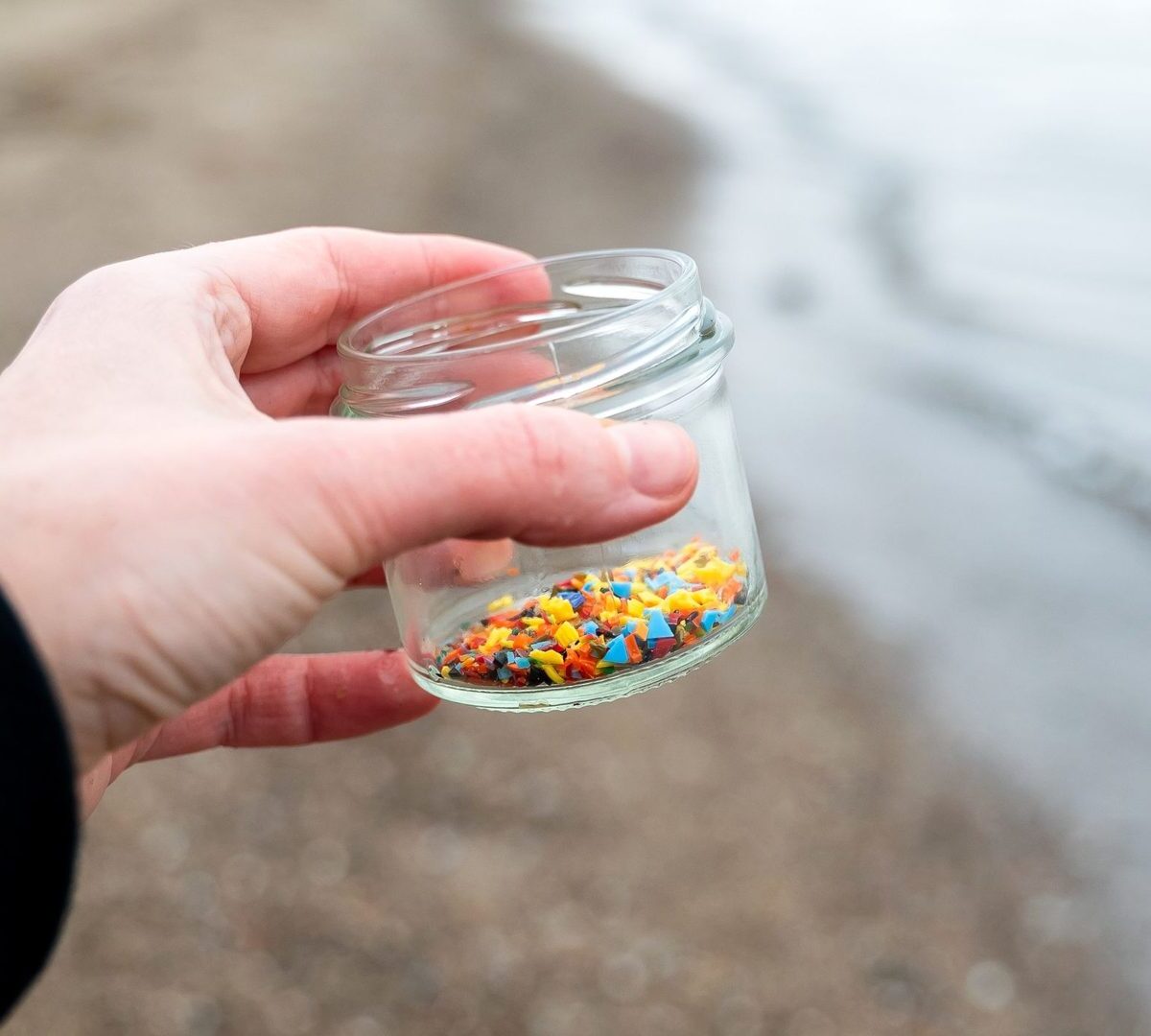
Scientists discover that sunlight-aged microplastics can transform toxic heavy metals into less harmful forms, revealing surprising new chemistry.
A recent study has found that, under the right conditions, microplastics can detoxify heavy metals.
The research was led by scientists at the Northeast Normal University. They found that polystyrene microplastics, after sitting in sunlight long enough, become chemically active in a specific and surprising way.
The particles start converting hexavalent chromium, a toxic industrial pollutant, into a far less dangerous form.
The researchers emphasize that this discovery does not make plastic pollution beneficial. Instead, it reveals an unexpected way that plastic can influence water chemistry.
It ultimately suggests that the standard picture of microplastics as passive, chemically inert contaminants is incomplete.
The chromium problem
Chromium-6 can enter waterways through waste from metal finishing plants.
It dissolves readily in water, travels easily, and is toxic enough to be classified as a hazardous substance in China’s pollutant lists. It was also the contaminant at the center of the Erin Brockovich case in the United States.
In the environment, it exists alongside a much less dangerous cousin, chromium-3. This form tends to bind with other substances and become less mobile in water.
Getting from Cr(VI) to Cr(III) is a detoxification reaction, and natural organic matter in sunlit water already drives it to some degree.
The question is whether microplastics, which are accumulating in aquatic environments faster than anyone is cleaning them up, participate in that chemistry too.
The experiments showed that they can, particularly after prolonged exposure to ultraviolet light.
Sunlight changes plastic
A fresh polystyrene microplastic is smooth, spherical, and unreactive. Leave it under UV light and the story changes.
The benzene rings that give polystyrene its structure absorb radiation and start breaking down.
Chemical bonds break, creating reactive molecules called free radicals, while oxygen-containing groups accumulate on the surface.
What builds up are environmentally persistent free radicals. These are reactive chemical species that, unusually, don’t vanish in milliseconds the way most radicals do.
They stay stable on the particle surface and remain available for electron transfer reactions.
The team aged polystyrene particles under UV light for 0, 6, 12, 24, 48 and 96 hours, then put them in chromium solutions.
Fresh particles reduced 38 percent of the Cr(VI) under UV irradiation. Ninety-six-hour-aged particles reduced nearly 90 percent.
Without UV light, the reaction barely happened at all.
Two unexpected mechanisms
To understand how the reaction works, the researchers ran parallel experiments under normal air and pure nitrogen.
The nitrogen blocked one of the two pathways, allowing the researchers to examine their contributions separately.
The direct route is the aged particle surface itself. Persistent free radicals transfer electrons straight to Cr(VI) molecules, reducing them on contact.
A chemical analysis confirmed that after the reaction, over 90 percent of the chromium on the particle surface had converted to Cr(III).
Removing oxygen reduced the reaction’s overall efficiency by about 20 percent, suggesting that direct electron transfer from the aged plastic surface plays an important role.
The second pathway involves chemicals released as the plastic breaks down.
Aging microplastics continuously shed dissolved organic matter into the surrounding water – fragments, additives, small aromatic breakdown products.
Under UV irradiation, this microplastic-derived dissolved organic matter generates superoxide radicals, which reduce Cr(VI) through a separate chemical chain.
That indirect pathway accounts for about 78 percent of what the dissolved fraction contributes on its own.
An open question, not a solution
“Our findings suggest that microplastics are not simply passive carriers of pollutants. As they age under light exposure, they can become chemically active participants in environmental processes,” said senior author Jiunian Guan from the Northeast Normal University.
“Understanding these reactions is important for evaluating how plastic pollution may alter the behavior of heavy metals in aquatic ecosystems.”
Because the experiments took place under controlled laboratory conditions, researchers still need to determine whether similar reactions occur in natural waterways.
What happens at the pH, ionic strength and organic matter concentrations found in actual rivers is unknown.
Polystyrene’s aromatic structure makes it unusually susceptible to radical formation. Polyethylene and polypropylene, which are far more abundant in the real world, may behave differently.
A much more complicated chemistry
Microplastics are already known to carry pollutants, break into even smaller particles, and provide surfaces where microorganisms can grow.
Now, researchers have shown that sunlight can also turn certain microplastics into active participants in chemical reactions that influence the behavior of toxic metals.
Whether these reactions make contaminated waterways safer or introduce additional environmental risks remains uncertain.
For now, the discovery offers another reminder that plastic pollution doesn’t simply sit in the environment.
It continues to change, interact with surrounding chemicals, and influence ecosystems in ways scientists are only beginning to understand.
The study is published in the journal Environmental and Biochemical Processes.
—
Like what you read? Subscribe to our newsletter for engaging articles, exclusive content, and the latest updates.
Check us out on EarthSnap, a free app brought to you by Eric Ralls and Earth.com.
——-