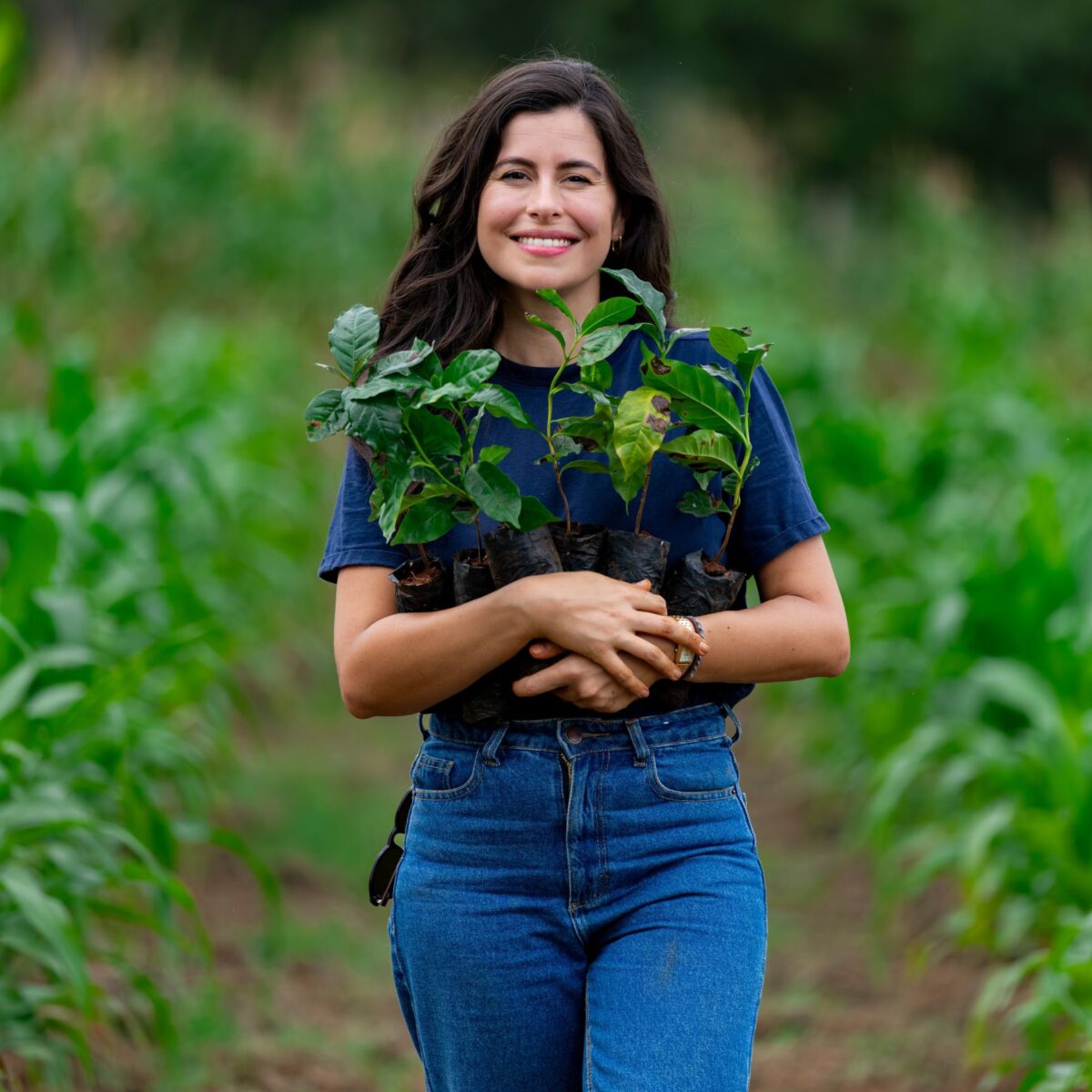
Aline Baroni is a journalist and the Executive Director of ProVeg Brasil, bringing over 15 years of experience in strategic communications across the public and non-profit sectors. Having previously led communications for the Brazilian Labor Public Prosecutor’s Office and worked with Brazilian and international food systems and animal protection NGOs, her work spans food systems, environmental sustainability, human rights, and labor rights. Today, she leads ProVeg Brasil’s mission to transform food systems by advancing healthy, sustainable, plant-rich agriculture and diets.
In this interview, Aline discusses how a ProVeg Brasil study on plant-based agroforestry was cited in Paulo Petersen’s Special Envoy report for COP30, what its findings mean for farm transition in one of the world’s largest animal agriculture producers, and what support would be needed to turn the research into policy.
Could you start by telling us a bit about ProVeg Brasil and your role, and how the agroforestry study fits into your wider work?
ProVeg Brasil is part of ProVeg International, a global food awareness organization working to transform the global food system by reducing animal consumption by 50% by 2040 and replacing animal products with plant-based and cultivated alternatives.
The agroforestry study is central to our strategy to transform food systems from both sides: supply and demand. While our consumer-facing and institutional work focuses on boosting demand for plant-rich foods in public institutions, our farm transition pillar works directly with farmers on the supply side. We encourage them to transition away from livestock to plant-based agroecological systems.
In this sense, the agroforestry study fits directly into our core strategy on farm transitions. While a lot of conversation around plant-based diets focuses on consumer choices, we recognize that a just transition must start at the source: with farmers. Brazil’s agricultural landscape is heavily dominated by livestock and monoculture feed crops. Through this study, we wanted to demonstrate that transitioning away from animal agriculture toward plant-rich, agroforestry systems is ecologically necessary, economically lucrative and socially transformative for producers.

The study was cited in Paulo Petersen’s Special Envoy report for COP30. Could you walk us through how that came about and where exactly the study appears in the report?
It was the result of a very dedicated effort to make the case for the transition during COP30, build bridges with the Special Envoy’s team ahead of COP30, and also engage with the civil society listening processes organized by them afterwards.
The impact of this work started being built at COP30, where we co-hosted panels and official press conferences alongside the Ministry of Agrarian Development (MDA) and the Federation and Confederation of Family Farmers (CONTAG).
In the Special Envoy report, our study appears in the core section dedicated to the promotion of sustainable and healthy diets, and also when they discuss financial mechanisms to promote just transition of our agrifood system. The report itself takes a bold step by directly addressing the heavy environmental and climate impacts of animal agriculture in Brazil, explicitly emphasizing the need to shift toward plant-rich food systems.
Animal agriculture is rarely mentioned in COP documents. Why do you think this study was included?
Animal agriculture is indeed the elephant in the room at international climate summits. In Brazil, it accounts for nearly 60% of greenhouse gas emissions and over 90% of Amazon deforestation, yet it remains politically difficult to address in formal negotiator texts.
I believe this study was included because it reframes the narrative from a critique into an actionable solution. It moves away from top-down restrictions and instead presents a just transition model rooted in science and economic viability.
The study offers a truly pragmatic roadmap for that shift. Often, conversations around climate transition focus on what farmers should do for the environment out of obligation. This study is groundbreaking because it presents a concrete, economically viable pathway: it proves that moving to plant-based agroforestry can contribute to rural development, being significantly more lucrative for producers than livestock, while also offering climate, food security and employment benefits. By showing that climate action, diet diversification, and higher farmer incomes go hand in hand, the report highlights a realistic route forward for Brazilian agriculture.
Policymakers often fear that curbing animal agriculture will harm rural livelihoods or food security. Our study directly dismantles that fear by showing that converting degraded pastures into horticulture-based agroforestry not only slashes emissions and sequesters carbon, but it also generates up to 12 times more land efficiency and on average doubles income for farmers. It gave the COP30 framework a concrete, peer-backed blueprint that aligns climate mitigation with economic prosperity and food sovereignty.

What does it mean for your work to be cited in an official report like this?
It is a huge institutional milestone and a crucial validation of our approach. Paulo Petersen is a major actor in family farming and agroecology in Brazil. I was just at another event this week in Brasilia, in the Ministry of Social Development, and on the panel they encouraged people to download this report, highlighting exactly this: how Paulo Petersen is a respected authority in his area. Being featured in his official COP30 report, in which he reiterates our study’s findings and speaks so openly about the impacts of livestock and the need for a predominantly plant-based food system, gives incredible weight to our mission.
For a long time, suggesting that animal farmers transition to plant-based systems was met with skepticism. Having our research anchored in an official report by such an esteemed figure shifts that narrative entirely. It proves that farm transition is grounded in solid socioeconomic and scientific reality.
On a practical level, this recognition gives immense credibility and momentum to our entire portfolio at ProVeg Brasil. It fuels our public policy advocacy, provides strong backing for our on-the-ground pilot projects like the Cultiva Project, and strengthens our broader institutional programs. It signals that the transition toward plant-rich food systems is officially recognized as a legitimate, necessary, and viable climate solution.
The study says farmers could earn much more income by moving to plant-based agroforestry. What are the main findings that support this? And what needs to be in place for those results to happen?
The study shows that hortifruti crops agroforestry outperforms animal agriculture across every Brazilian biome. On average, when transitioning from cattle ranching to plant-based production in agroforest system, a farmer’s net income per hectare more than doubles (+110% median increase). In cases transitioning from degraded pasture to high-yield, biodiverse agroforestry with access to premium markets, income can jump by over 1,500%.
Beyond raw income, agroforestry requires 12 times less land to generate the same revenue as livestock farming, and it creates four times as many jobs per million reais (BR currency) produced—making it a powerful engine for rural development.
Crucially, the study highlights the enormous climate benefits of this transition. Unlike livestock, which is a major driver of methane and overall greenhouse gas emissions, plant-based agroforests function as net carbon sinks, meaning they sequester and store more carbon than they emit. This makes them an exceptionally effective strategy for climate mitigation by reversing emissions from degraded land, as well as climate adaptation by restoring soil health, improving water retention, and protecting crops against extreme weather.
However, these results don’t happen in a vacuum. For farmers to make this shift successfully, three key pillars must be established:
Transition Financing: Farmers face an income gap during the initial setup years. We need public credit programs and financial institutions to offer specific transition credit lines with flexible grace periods.
Technical Assistance: Rural extension workers must be trained in plant-based agroforestry management so producers aren’t left navigating the agronomic shift alone.
Guaranteed Offtake Markets: Farmers need immediate demand for early-stage short-cycle crops. This is where programs like PNAE (school feeding procurement) play a vital role, securing predictable local demand for fresh produce while long-term agroforest crops mature.

Brazil is one of the biggest animal agriculture producers in the world. Is it difficult to make the case for transition there? How have people responded?
It is undeniably complex. Animal agriculture accounts for a massive portion of Brazil’s GDP, and the agribusiness caucus holds enormous political influence as the largest voting bloc in Congress. Culturally, agriculture has long been synonymous with livestock, which remains deeply embedded in rural mindsets. However, we are seeing significant movement and openness. In Brazil, two powerful narratives operate simultaneously: the dominant traditional agribusiness model, and a strong counter-hegemonic movement that has been advocating for fairer and more sustainable practices. These worlds increasingly intersect because the current model leading to pasture degradation and deforestation for crops for animal feed is economically and environmentally unsustainable.
By framing our work around agroecology and just transitions, we have built strong bridges with family farming organizations and key institutions like the Ministry of Agrarian Development, which leads national initiatives like Florestas Produtivas to convert degraded pastures into productive agroforests. Crucially, the key to bringing producers along is speaking their language: focusing on rural development, income growth, and treating them as a fundamental part of the solution rather than the problem.
When we talk about a just transition, it goes far beyond financial opportunities. Agroforestry directly increases food security for the farming family, provides far safer working conditions in shaded microclimates away from extreme heat, and creates significantly higher resilience against price shocks and climate impacts compared to animal agriculture. By demonstrating these tangible benefits, we are finding real enthusiasm and curiosity among smallholders and institutions ready to build a fairer, more sustainable agricultural system.
What support from government or institutions would help turn this report into real change?
Turning this research into systemic, nationwide change requires concrete institutional alignment. While our study outlines a comprehensive list of measures to accelerate this shift, two key fronts stand out.
First, we need the government to adjust existing public policy and credit mechanisms. Programs like PRONAF, which fund family farming across Brazil, should explicitly prioritize plant-based and agroecological transitions by offering subsidized, low-interest credit lines with grace periods tailored to agroforestry establishment. To be fair, PRONAF already includes a specific sub-program for agroecology, but looking at overall PRONAF allocations, investments are still split 50-50 between livestock and crop production—and the crop side remains heavily dominated by soy monoculture. We need government and financial institutions to help rebalance what gets funded, what gets produced, and ultimately what ends up on people’s plates. We certainly shouldn’t be filling half our plates with animal products.
Second, we need massive expansion of technical assistance and rural extension services. Farmers cannot navigate this shift without technical know-how. State-level extension agencies must train field agronomists in plant-based agroforestry design so they can directly assist smallholders in planning, planting, and managing these diversified systems.
What are your next steps? And what should we watch for from ProVeg Brasil this year?
Our roadmap is directly tied to ProVeg Brasil’s Theory of Change, which focuses on connecting both sides of the food system: supply and demand. Through our Prato Verde program, we work with public institutions to increase the demand for nutritious, plant-rich meals in school, universities, hospitals and soup kitchens, canteens and restaurants. Simultaneously, through our farm transition work, we empower farmers to shift from low-yield livestock to plant-based agroforestry, enabling them to supply the exact foods demanded by schools through public procurement policies like PNAE. By bridging local institutional demand with sustainable local supply, we build a resilient, self-sustaining food ecosystem that directly benefits child health, farmer livelihoods, and the environment.
On a practical level, our focus this year is on strengthening these on-the-ground implementations while scaling our broader national strategy. On the rural transition front, we are working to expand our farm transition pilots across different contexts, while continuing our public policy advocacy to ensure mechanisms and programs to actively support this shift. We are also engaging directly with public and private financial institutions to identify bottlenecks and unlock transition financing. Finally, building on the release of our transition guide for rural producers and extension workers, we aim to start training technical assistance (ATER) teams. We want to empower field agronomists to identify farmers struggling with low-productivity livestock and give them the knowledge and tools to guide those producers toward more lucrative, diversified, and climate-resilient plant-based agroforestry systems.
Find out more about the work ProVeg Brasil is doing here.