
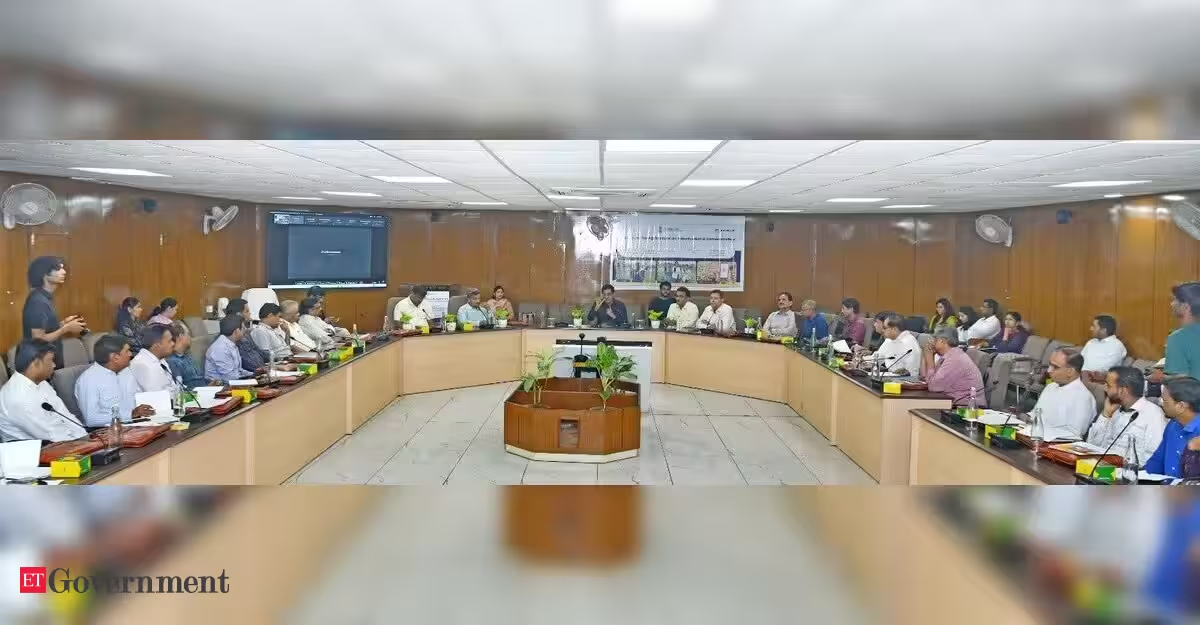
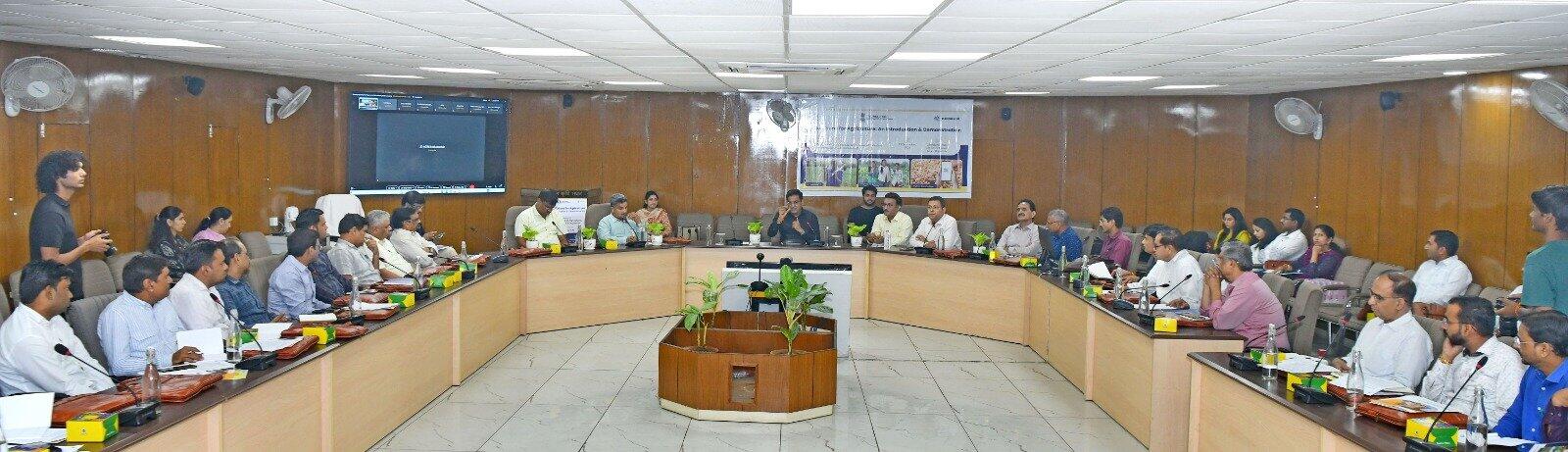
The Rajasthan Agriculture Department organised a one-day workshop on the use of artificial intelligence (AI) in agriculture for agriculture officials from 13 districts.
Experts from the Wadhwani Institute for Artificial Intelligence (Wadhwani AI) conducted the training at Pant Krishi Bhawan.
The workshop focused on the use of AI in agricultural administration, planning, monitoring, decision-making and delivery of services to farmers. The department is also working on integrating AI-based solutions into agriculture and farmer services.
Agriculture Commissioner Naresh Kumar Goyal said AI could be used across the agricultural value chain, from sowing and harvesting to marketing. Potential applications include weather-based advisories, crop monitoring, pest and disease identification, production forecasting, irrigation and resource management, and market-related information.
The department is examining the use of AI and data analytics to analyse agriculture, weather and crop-related data and provide location-specific advisories. These systems could assist farmers in making decisions related to sowing, irrigation, fertiliser use, pest control, and harvesting.
Crop insurance assessment
AI and other data-based technologies are also proposed for implementation of the Pradhan Mantri Fasal Bima Yojana. Remote sensing, image analytics, and drones could be used to assess crop conditions and losses caused by natural disasters.
The department said these technologies could support crop-loss assessment, claim settlement and monitoring of the scheme.
Institutional framework for AI
The department is working on an institutional framework for the development, testing, implementation and expansion of AI-based agricultural projects and solutions. The framework is expected to facilitate coordination among the Agriculture Department, technical institutions, experts, research organisations and the private sector.Potential areas identified for AI, machine learning and data analytics include crop and weather advisories, early identification of pests and diseases, crop-yield forecasting, irrigation and resource management, crop-loss assessment, monitoring of agriculture schemes, market and price information, and grievance redressal.
Raj Kisan Portal
The Raj Kisan Portal is also proposed for integration with AI-based technologies. AI and data analytics could be used to provide information on schemes and services based on a farmer’s crop, location and profile.
The technology could also assist in identifying pending applications, service delivery issues, and potential problems, to provide services based on individual farmers’ requirements.
The department is also focusing on digital awareness and technical capacity-building among farmers and field-level personnel. It said AI-based services would need to take into account farmers’ language, local conditions and requirements.
The department is also working to link platforms such as RAJAIIMS and the Raj Kisan Portal to AI- and data-driven technologies.
Multiple MoUs with organisations
The Agriculture Department has signed MoUs with 38 organisations, including TAFE-JFarm Services, Manipal University, Wadhwani AI, Shri Ramshantaya Organic Agriculture and Training Centre, National Institute of Agricultural Marketing (NIAM), 10 agri-tech startups and 20 civil society organisations (CSOs).
The partnerships cover natural farming, climate-resilient agriculture, agricultural innovation and the use of modern technologies. The organisations will work through a common platform, with quarterly meetings to review progress.
District-level seminars will also be organised in collaboration with district administrations.
Under these partnerships, farmers will receive training in natural and climate-resilient farming practices. The initiatives will also cover demonstration plots, formation of farmer groups, technical guidance and local-level support.
The department said the partnerships would also provide technical assistance, certification, value addition and marketing support to farmers adopting organic and natural farming.
Small and marginal farmers, women farmers, young farmers, and farmers in tribal areas have been identified as beneficiaries.