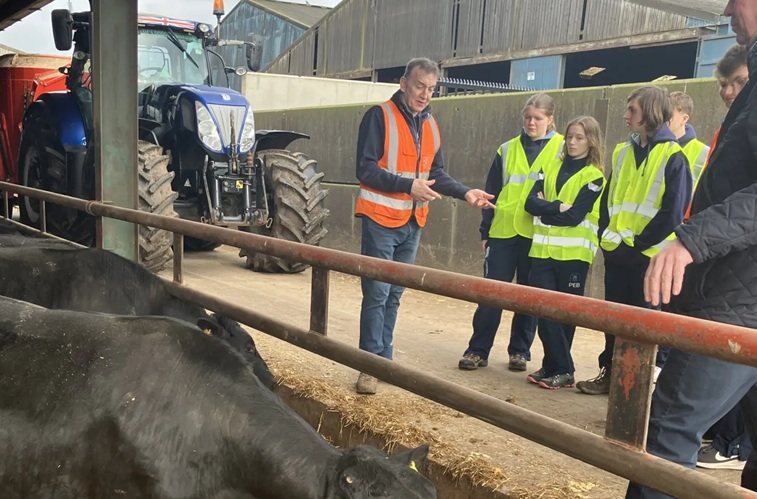
A Northumberland school is launching a new agriculture BTEC to help more young people explore careers in modern farming.
Longridge Towers School is expanding its Sixth Form curriculum with new BTECs in Agriculture and Business, giving pupils a more practical route into university, apprenticeships or employment.
BTECs are work-related qualifications focused on hands-on learning, and the new courses will sit alongside the school’s existing BTEC Sport provision.
Students will be able to take a vocational route through Sixth Form, follow a traditional A Level pathway, or combine both depending on their future plans.
Deputy Head Jenell Arnott said the courses were equivalent to a full A Level and would give pupils greater flexibility.
“These BTEC courses provide the equivalent of a full A Level, so whether aiming for university, an apprenticeship or direct employment, students can now blend practical, vocational learning with traditional A Levels,” she said.
She said the new courses reflected Longridge’s aim to offer more individualised, career-ready pathways for pupils.
To mark the launch of the agriculture BTEC, pupils visited Lurdenlaw Farm, near Kelso, which straddles the Scottish-English border.
The farm, owned by David and Caroline Baird, will provide work experience and support for the course.
The visit was arranged by Longridge Governor David Armstrong, a local farmer and supporter of the new BTEC provision.
Mr Armstrong said there was a need to raise awareness of the range of opportunities available in agriculture.
“I’m very passionate about Longridge Towers and how we help educate our children coming through across many areas,” he said.
“But there is no doubt that we currently need to raise awareness of agriculture in our young people and the endless possibilities that exist for careers in the farming world.”
He said Lurdenlaw Farm was a strong place to start because it offered pupils a view of both livestock and arable enterprises.
“I thought this would be a good farm to start on because it has both livestock and arable sides of the business, from being well known for its potatoes to the sheep and cattle, and now pig enterprises, which are becoming much more popular in local farms,” he said.
Mr Armstrong said modern farming required far more than traditional livestock and land skills, with farmers now needing knowledge of machinery, business, science, finance and supply chains.
He added that Longridge Towers was well placed to offer the course because it sits in a major agricultural region.
Many pupils come from families linked to farming-based industries, but Mr Armstrong said that did not always mean they understood the range of careers available.
“I think we can change that with the BTEC and hopefully the pupils have taken away some of that enthusiasm that Mr Baird and myself have tried to share with them,” he said.
Mr Baird said the partnership with Longridge Towers could help encourage more young people into agriculture.
“I think we want to encourage people into our industry, so having a partnership with a school like Longridge, where lots of children have come through a farming system, has to be a positive move,” he said.
He said farming had moved far beyond the traditional image many people still held, with a wider range of roles now involved in helping farms operate successfully.
“We spoke about how there are so many different elements to agriculture these days, so many different jobs that a farmer perhaps used to do but, due to advances in different areas, various different people now work on to help a farm be successful, which means lots more opportunity,” he said.
“So, the message to the children was that we need all kinds of people with different skills, different approaches to life and working things out, to tackle lots of different jobs we now have.”
Mr Baird said the industry had struggled to attract enough young people in recent years, despite the number of opportunities available.
“There’s no doubt that there’s not enough youngsters coming into any part of the agricultural industry, and that’s been the case going back a few years,” he said.
“But there are many more opportunities for youngsters coming through that are not very well communicated.”
He said farmers had a responsibility to help young people better understand what modern agriculture involved.
“So, there is a responsibility on us as farmers to help to educate the youngsters about what farming means and perhaps open their eyes to the fact that it may not be quite what they think,” he said.
Despite the challenges facing the sector, Mr Baird said farming remained a rewarding career.
“I’m passionate and I love the industry,” he said.
He said one of the rewards of farming was the environment in which farmers worked.
“I told the kids how I often take the tractor up the top of the fields and just stop for a minute and look as far as I can,” he said.
“On a clear day, I can look south down across the wonderful north of England and north all the way to beautiful East Lothian and the Firth of Forth, and that’s a pretty decent office window to have.”