Global agriculture and the food supply chain account for nearly a third of total global greenhouse gas emissions, with farms responsible for almost half of those emissions.
At the same time, agriculture is one of the sectors most threatened by climate change, with rising temperatures set to devastate food crops around the world.
“It’s never been so apparent that our food system needs fixing,” said Chuck de Liedekerke, CEO and co-founder of Soil Capital, a Belgian company that pays farmers to reduce their carbon emissions and improve soil quality through regenerative agriculture practices that focus on restoring land.
“For centuries now, we’ve actually been depleting the natural fertility of our soils,” he said. “If you can invest, through regenerative practices, in the fertility of those soils then you can make your whole system more resilient.”
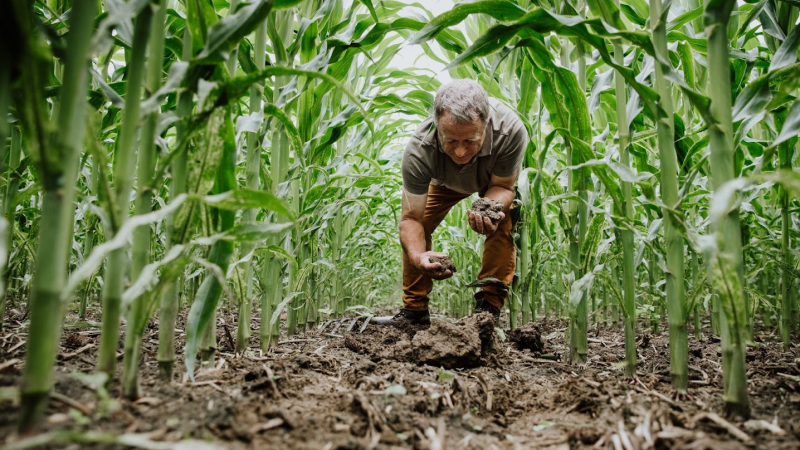
Soil can lock away the carbon absorbed by plants. The carbon stored in soil is “one of the biggest drivers of fertility,” said de Liedekerke, and it increases water retention, which can make crops more drought resistant. But when fields are worked with heavy machinery, their soils leach carbon back into the air.

The farmers Soil Capital works with commit to increasing their soil carbon levels through regenerative practices, including reducing land disturbance and the use of chemical fertilizers; increasing plant diversity; planting cover crops between their cash crop growing seasons; and planting trees and other vegetation on their land.
The company monitors the amount of carbon stored in farmers’ soils and issues a certificate for carbon improvements. The certificates are sold to businesses that partner with Soil Capital and are each worth one metric ton of CO2 equivalent emissions reduced or removed, allowing these businesses to offset their carbon emissions.
Certificates cost between 20-60 euros ($23-$69), with the farmer receiving 70% of the proceeds. “What’s holding farmers back (from regenerative agriculture) is the risk that they’re going to take in a context where they operate with very low margins,” said de Liedekerke. “So a financial incentive is really what’s most important today to get farmers to actually change practices at scale,” he added.
In April, Soil Capital announced a multi-year partnership with Nestlé, the world’s largest food and beverage company. Nestlé aims to source 50% of its key ingredients from farmers using regenerative practices by 2030. According to its most recent figures, ingredient sourcing accounts for over 70% of Nestlé’s total greenhouse gas emissions.
“We’re investing in the long-term health of our supply base, strengthening resilience, and focusing on soil,” said Anita Wälz, head of sustainability at Nestlé Europe, at the time of the announcement.
Regenerative agriculture is also gaining traction elsewhere. In May, drinks giants Carlsberg and Diageo were among 40 organizations that signed a declaration of intent to scale regenerative agriculture across their supply chains, through a program developed by the Sustainable Agriculture Initiative platform.
Unilever aims to implement regenerative practices over 1 million hectares (2.5 million acres) by 2030, and PepsiCo across 10 million acres of land that support the growth of its ingredients, by the same year.
Other companies offering soil carbon offsets include Denmark’s Agreena, which describes itself as the largest soil carbon program in Europe.
According to the Organisation for Economic Co-operation and Development, net soil carbon sequestration on farmland could offset “4% of annual global human-induced greenhouse gas emissions over the rest of the century.”
But some are less convinced that regenerative farming can help to mitigate climate change.
“The idea that you’re going to sequester a lot of carbon in soils on working agricultural land, I think is unlikely,” said Timothy Searchinger, technical director for agriculture, forestry and ecosystems at the World Resources Institute.
He said that while planting cover crops “might sequester a little bit of carbon over time,” they currently occupy less than 4% of US cropland and face barriers to wider adoption, including costs and limited time to establish them before winter begins.
He added that there is also scientific debate over the extent to which farming without tilling the soil increases soil carbon and that, in the US, the majority of farmers that practice no-till also plow their fields at least every few years, which, he says, is likely to reverse most of any carbon-storage benefit.
“They’re good practices, but they don’t do much for the climate,” said Searchinger, adding that regenerative agriculture can reduce soil erosion and improve water retention and quality.

But de Liedekerke stressed that the potential benefits of regenerative agriculture go beyond climate change. In addition to carbon, Soil Capital monitors indicators of soil health, biodiversity, and water management.
“It’s not just because we want to reduce greenhouse gas levels, it’s because we want to drive that (soil) fertility,” said de Liedekerke. “If there’s no fertility, there are no farms. If there are no farms, there’s no food.”
The company currently supports 1,800 farmers over 500,000 hectares (1.2 million acres) across six countries. De Liedekerke said the goal is to be working with farmers over 10 million hectares (24.7 million acres) within the next decade.
“I think, within 10 years’ time, regenerative agriculture can be the norm,” he said. “We’ve just passed the starting line, so there’s still exciting progress to make.”