
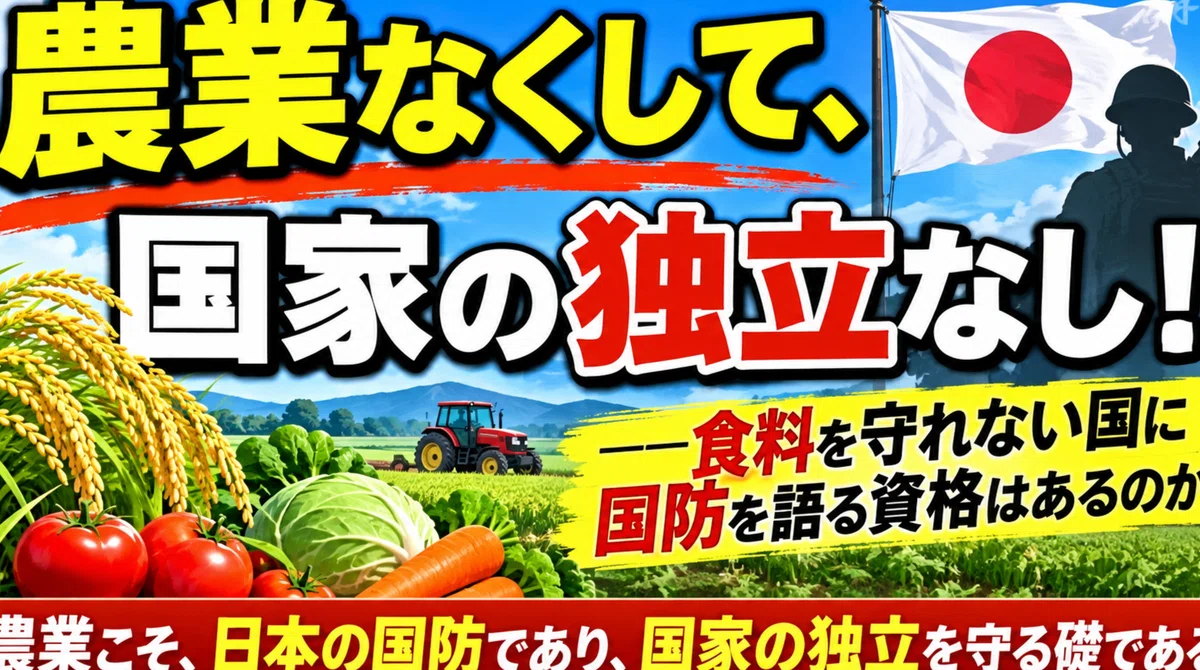
Agriculture is not merely an industry. It is the foundation that protects the lives of the people and the independence of the nation.
What is agriculture?
Many people classify agriculture as one of the ‘primary industries.’ However, perhaps we need to rethink this very perception itself.
We can live without cars. We can survive without smartphones. Humans can survive without entertainment or tourism.
However, humans cannot survive without food.
Agriculture is not just an industry for generating profit. It is the foundation that produces the food for the people to live and supports the survival of the nation. In other words, protecting agriculture is protecting the lives of the people and is nothing less than protecting the independence of the nation.
No matter how much the economy develops, how advanced the technology is, or how many world-class financial assets are held, if a nation cannot secure the food its people eat within its own borders, its independence and security become extremely fragile.
Relying on foreign countries for food means entrusting the fate of the nation to foreign countries.
Japan relies on imports from overseas for much of its food.
In peaceful times, purchasing inexpensive food from overseas might seem rational. The idea is that if it can be imported more cheaply than it can be produced domestically, it is more efficient to import it.
However, that is a story based on the premise that the world is at peace, international logistics are functioning normally, and exporting countries will always sell food to Japan.
So, what happens if a war or international conflict occurs?
-
What if grain exports are halted due to international conflict?
-
What if maritime shipping routes are blockaded?
-
What if transportation costs and agricultural materials skyrocket due to a surge in crude oil prices?
-
What if food-exporting countries prioritize supply to their own citizens and implement export restrictions?
-
What if global abnormal weather causes a significant decrease in grain production?
When such situations occur, will Japan be able to supply sufficient food to its people?
There is no guarantee that you can buy food just because you have money. In the first place, if there is no country willing to sell it, you cannot obtain food no matter how much capital you have.
National security is not something that is established by military power alone. Being able to secure the food for the people to live is also an important part of national defense.
Can we judge the true strength of Japanese agriculture based solely on the figure of a 38% food self-sufficiency rate?
For many years, Japan’s food self-sufficiency rate has been cited as 38% on a calorie basis.
However, we must not assume that we fully understand Japan’s food production capacity by looking only at this number.
In the first place, by aggregating the entire country of Japan into a single figure, the inherent food production capacity of each region becomes obscured.
For example, Hokkaido’s calorie-based food self-sufficiency rate reached 227% in the preliminary figures for fiscal year 2024. In other words, Hokkaido has the capacity to produce food far exceeding its local consumption.
On the other hand, in densely populated metropolitan areas, farmland is limited, and much of the food must be brought in from other regions.
Hokkaido has its own production capacity, Tohoku has its own agriculture, and Kyushu has its own livestock and farming. Each region of Japan possesses its own unique agricultural strengths.
What exactly can we learn by uniformly representing all of these with a national average figure of 38%?
Of course, the national average has meaning in terms of grasping the overall domestic supply situation. However, that alone is not enough to fully evaluate the production capacity of each region or the potential for inter-regional food distribution within the country.
Furthermore, in the calculation of the food self-sufficiency rate, even if livestock products are produced domestically, if they depend on imported feed, the portion derived from that imported feed is not counted as domestic production. Dependence on overseas sources for fertilizer, fuel, and the like is also a major weakness in sustaining food production.
In short, the problem is not simply whether the 38% figure is high or low. It is inherently unreasonable to discuss Japan’s food security based on that number alone.
What we truly need to examine is how much food each region can produce, how food can be distributed among domestic regions, and whether the entire population can be fed if imports from overseas are cut off.
What is the point of continuing to import unnecessarily while letting domestic agriculture decline?
In Japan, while we import food from overseas, domestic agriculture is placed in a difficult situation.
The aging of the agricultural workforce, the shortage of successors, the increase in abandoned farmland, the soaring prices of fertilizer and fuel, and the imbalance between the selling price of agricultural products and production costs.
Is it truly rational for the nation to continue importing cheap agricultural products from overseas while leaving these problems unaddressed?
If we easily rely on imports even for agricultural products that can be produced domestically, it will squeeze the management of domestic farmers and could eventually lead to the loss of the production base itself.
Once farmland, agricultural technology, and regional production systems are lost, they cannot be easily restored just because they become necessary.
Agriculture is not like a factory production line where you can increase output from the next day just because demand has risen. It requires a certain amount of time and labor, starting from soil preparation, sowing, cultivation, and finally harvesting.
It is cheap, so we import it. Domestic farmers decrease. Domestic production capacity falls. Dependence on imports increases even further.
How long do we intend to continue this vicious cycle?
Whatever can be produced in Japan should be produced in Japan as much as possible. We should not completely reject imports from overseas, but we must review policies that easily rely on imports even for items that can be produced domestically.
Agriculture is one of the most important national defense policies.
When people hear the word ‘national defense,’ many likely think of the Self-Defense Forces, fighter jets, destroyers, missiles, and so on. Of course, these are important.
However, no matter how powerful a military force a nation possesses, if it cannot secure food for its citizens, its continuity as a nation is in jeopardy.
Food is the most fundamental strategic commodity for a nation.
Japan, in particular, being an island nation, relies heavily on food shipments from overseas. If maritime traffic routes are obstructed, the food supply could be severely impacted.
That is precisely why the maintenance of domestic agriculture should be considered an investment in national security, not merely support for farmers.
To achieve this, the following efforts are necessary.
First, protect the production base of domestic agriculture.
To ensure farmers can continue farming with peace of mind, we must aim for price formation that allows for reproduction and stable income. We must also strengthen the maintenance of farmland, the cultivation of successors, and support for new farmers.
Second, increase domestic supply capacity for fertilizers, feed, and seeds.
For fertilizer raw materials and feed, which have a high degree of dependence on overseas sources, we must promote the expansion of domestic production, the use of alternative resources, and the diversification of procurement sources. We also need to establish a system to stably secure seeds domestically.
Third, review unnecessary imports of agricultural products that can be produced domestically.
Instead of expanding imports based solely on low prices, we must consider domestic production capacity and the impact on food security. For items that do require imports, we should avoid excessive dependence on specific countries.
Fourth, establish food stockpiles and emergency supply systems.
It is necessary to build a crisis management system that includes not only stockpiles of rice and wheat but also the production, processing, transportation, and distribution of food.
Fifth, position agriculture as a core national policy.
We must think of the agricultural budget not as mere subsidies, but as necessary expenses to protect the lives of the people and the independence of the nation.
Protecting agriculture also means protecting Japan’s land and local communities.
What agriculture protects is not just food.
Farmland also plays a role in shaping regional landscapes, storing water, preventing floods, and maintaining the rural environment.
If agriculture declines, people will leave rural areas, and it will become difficult to maintain local communities. If abandoned farmland increases, it will also hinder the management of the national land.
Protecting agriculture leads to protecting local employment, preserving traditions and culture, and safeguarding the nation’s land.
And above all, the fact that Japanese people can live by eating food grown on Japanese soil is directly linked to the nation’s self-reliance.
Conclusion: A country that cannot secure its own food has no true independence.
Japan should not be satisfied with being an economic powerhouse.
No matter how large the GDP is, or how many assets are held overseas, if the nation continues to rely on foreign countries for the food of its citizens, it harbors a fundamental weakness as a nation.
Agriculture is not just an industry for generating profit. It is one of the most important national functions for protecting the lives of the people, supporting national independence, and passing on the land and production base to the next generation.
It is too late to neglect agriculture in times of peace and then panic about the lack of food when an emergency arises.
What is needed is a shift from policies based on the premise of continuing to buy cheap food from overseas to building a nation with the capacity to produce food domestically and feed its own people.
Agriculture is not just one category of primary industry. It is the root of human survival and the foundation for the continuation of a nation.
Protect the farmland. Protect the farmers. Protect the food.
Protecting agriculture is, in itself, Japan’s national defense and the protection of Japan’s independence.
Connecting, Nurturing, the Future of Kashiwa. | Toshiaki Naganuma Official Website
>>Return to Top Page