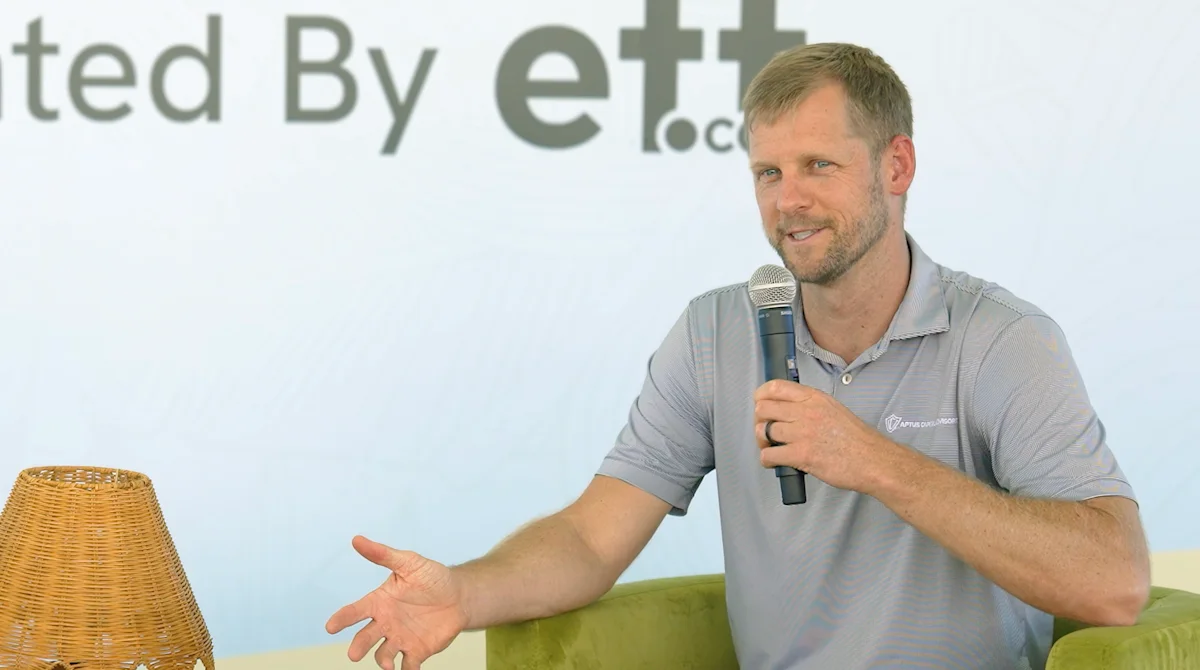
JD Gardner smiles while gesturing and speaking on stage.
The fiscal deficit and money printing will likely continue to erode the purchasing power of bonds, and advisors would do well to start thinking outside of the 60/40 box. JD Gardner, CFA, CMT, Founder and Chief Investment Officer at Aptus Capital Advisors, believes investors should set their sights on higher compounded returns and makes the case for options at this sit down with industry veteran Lara Crigger at the ETF Oasis at Future Proof. The following is a transcript of their conversation.
Unlocking Higher Compounding Returns With Options
Lara Crigger: I am so happy to welcome you to the ETF Oasis stage, and not just because there’s another person with a southern accent here.
JD Gardner: It’s great to be here. Thank you for the welcome.
Lara Crigger: The premise of this session is very simple. If we think of a portfolio as a car, then stocks historically have been the engine and bonds have been the brakes, right? But you have made the case that in modern markets, advisors shouldn’t see bonds as the brakes per se, but options instead, which are instruments known for lots of volatility. So let’s discuss this. First, I want you to explain how bonds have kind of failed to live up to their historical reputation as that brake for the portfolio engine.
JD Gardner: If you look at bonds for the last five, ten, fifteen years, it’s compounded at a negative rate on a real, after‑tax basis. And when you think about all of wealth management, the 60/40 portfolio is so ingrained. And a lot of people say the 60/40 is dead, and…
Lara Crigger: They’ve been saying that for as long as I think both of us have been in this industry.
JD Gardner: Right. The problem, though, is it’s “we’ll own more stocks and buckle up.” And in our opinion, the difference between how we view construction versus the traditional way is: bonds are a diversifier, so they should pay you positive carry, but they give you unknown correlation. We would argue both of those things, they’re not going to be positive carry and they’re not going to protect you.
So versus options, we call that the Dennis Rodman effect. If you look at a hedge by itself, it looks really bad, just like Dennis Rodman looked really bad on the basketball court by himself. But you put him on a team and he gets a whole lot better. And that’s how we view options: hey, can we onboard more risk because of the presence of this option?
Lara Crigger: Okay. I want you to press on that a little bit more, because there’s probably some folks in the audience who are not yet convinced that options can really serve this function that bonds historically have.
JD Gardner: When you look at attribution of return, most of your returns are going to come from allocation decisions. So that’s one of the advantages we have at Aptus: we’re trying to impact asset allocation. We’re not trying to impact the fund selection or stock selection, the things that are responsible for less than 10% of return.
So we feel like, in general, for the next decade, we think stocks outperform bonds tremendously. And so if we can take a 60/40 to a 75/25 without injecting more drawdown, we feel like we’ve done what’s most valuable, which is increase the terminal value through higher compounding returns. Our only objective as a business is to increase compounded returns through options‑based strategies.
Lara Crigger: Now, you just said that you think stocks are going to continue to outperform. They’ve been outperforming for a while now, right? So what happens if you’re wrong, and instead stocks collapse? They plummet 20, 30% all at once. What happens when the correlations are going to one, but in the wrong way? How is this going to impact the execution of your trades?
JD Gardner: One of the things about options, specifically hedges, is you have a known correlation. It’s a negative correlation. So there’s no question mark around “will they help if the stock market falls.” So we could get into the weeds on what happens…
Lara Crigger: I think this is the right crowd for the weeds.
JD Gardner: It’s the conviction around why equities outperform fixed income is we have a 7% fiscal deficit. Does anybody in the audience think we’re going to tighten our fiscal belt and become more responsible? So how do you make up for 7% fiscal deficits? You print the money, and we’ve seen that on steroids since 2008.
And if we have these bond issues, my simple question is: do you think they protect the value of your dollar, or do you think they protect the bond market first? It’s a clear answer. They’re going to protect the bond market first, and what’s going to be exposed is the value of your dollar. That needs to impact your asset allocation decisions. Are there going to be periods where bonds outperform stocks? 100%, but over long‑term wealth compounding, I think the biggest value we can add is freeing an advisor to feel comfortable owning more of the risk asset, which we think can defend purchasing power much better than fixed (income).
Modern Options Across Market Environments
Lara Crigger: We’re talking about stock markets going up, stock markets going down, but sometimes they’re sideways, right? They just chop along. In those cases, when it’s not a market that’s really trending in either direction, it can be expensive to be in options. It can be a very expensive proposition, especially when you compare it to bonds, where bonds are just boring. They just kind of stay, that’s kind of the whole thing, that they’re boring. So how do you explain why an advisor should consider an option strategy when that’s a potential outcome?
JD Gardner: This is probably what I’m most excited about answering so far. I think the default view of options strategies is either, “hey, we’re going to hedge things with options,” or “hey, we’re going to increase income.” Whereas I think there are two paths to improving compound returns. The first one is improving asset allocation, which I’ve already discussed. The second one is upgrading exposures that already exist.
And I pat ourselves on the back a little bit with the innovation in the options‑based space is only just beginning. One way we’re doing that is we are creating strategies that allow that allocation shift to happen without more risk. But a bigger one is, hey, can we just give you the beta exposure that you have and improve it in a way that you’re really comfortable with? One point that I’d stress, and I do think the world’s shifting, is the days of factor tilts and sector tilts… any value investor for the last 15 years, how’s that going?
Lara Crigger: Nobody is willing to raise their hands. There, there we go.
JD Gardner: There’s a few. But our point is, if you can harness vol through options‑based strategies in a way that enhances the beta you already have… to your question is: what happens in the tail environments? Well, options‑based strategies look great, left tail and right tail, meaning big up markets or big down markets. But in the middle is where you can use things like carry, through harnessing volatility, to improve beta exposures. And actually you don’t have to take these big factor tilts or sector bets in order to do that. That’s a big part of what we’re doing now; it’s our fastest‑growing area, that area of our suite.
Lara Crigger: Do you want to tell us a little bit more about the places that you’re seeing the biggest demand in your suite?
JD Gardner: And I do want to make one point, because it’s a hard point for us to get past. Defined‑outcome and buffers is obviously a really fast‑growing area. The enhanced‑yield things are a fast‑growing area. One of the things I would stress is like the nightmare conversation I have ten times a day: if I gave you the option of a strategy that has a stated 10% yield but it compounds at 7%, or I gave you option B, which is, “hey, we compound at 12 with a stated yield of two”. The highest terminal value is what matters, and it’s the highest compounded rate that matters.
But the world is so focused on “but it doesn’t have a 10% yield.” Yeah, but I can give you the yield with a higher compounded return. That’s one of the things that’s different about our suite is we’re less focused on pure income improvement and more focused on total‑return improvement, because we think, does a client want to retire with $10 million or $8 million? I’d say ten. So let’s compound capital to make the higher terminal value happen.
Lara Crigger: Okay, but how do you have that conversation with a client who is just seeing that one number and saying, “well, this guy over here is promising me 20%, and here’s 2%,” how do you have that conversation?
JD Gardner: I think it’s education around total return. What are the components of total return, and how do you get there? That’s my professional answer. My nonprofessional answer is, that’s the advisor’s job. We’ll just build the strategies to increase the return, and hopefully the advisor can have that conversation. This will help with that.
The Importance of Education and Time
Lara Crigger: You mentioned just now education, education being something that I think Aptus puts a lot of effort into. You have your blog, your weekly charts. I love the weekly charts, by the way. There’s been a lot more education in recent years about how options work. However, what do you think is one thing that still needs more education around, something that maybe people are overlooking or just not talking about enough?
JD Gardner: Education is a big focus for our business, specifically the options space. You say “options” is almost like a financial dirty word in a lot of realms. And so being able to address that before you get to the mechanics of the option, I think that whole paradigm needs to be adjusted. And I think you adjust that through education, and that is a focal point for us moving forward.
Because I do think, from an advisory seat, you’re dealing with this proliferation of options‑based strategies that is, like I said earlier, only just in the first few innings, because there are plenty of people, us included, that will innovate in the options space. And the more you understand what they’re doing and how they’re doing it, the more benefit the shareholder will get from better incorporation of these strategies.
Lara Crigger: It’s funny to hear you say that we’re still in the beginning innings, the first couple of innings here, because options‑based strategies have been in ETF form for quite some time now. And yet I think you’re right, it feels like it still has yet to really gain mainstream, or gain that critical mass, I suppose. Let me ask again: what is it that people are still overlooking about this? What do you think is maybe a barrier that needs to be torn down?
JD Gardner: I think education is one thing. And I think time is the other. This is the conversation we have all the time: I sit down with an advisor and I say, “We’re not the biggest fan of bonds.” And a lot of times the advisor says, “We aren’t either.” So, what are you doing about it? “Well, we allocate a lot to bonds.” Okay, well, why is that?
This is my simple point that I think options help with: if I compound your capital at 8% and another strategy compounds it at 6%, the argument is, well, the 6% ended up with a lower terminal value but it had a higher Sharpe ratio, I would say, let me ask the client, do you want $2 million or $1.6 million? So how can we reframe risk around compound returns relative to drawdown, and not some view of volatility? And I think the only path to do that, just to be a drone again, is: options have known correlation, you know what you’re getting; bonds have unknown correlation is the education piece.
But the more bonds struggle, the more people are going to look for alternatives. And so we need to be ready, to have the education and content available to say, okay, now I get this, and this makes sense.
Lara Crigger: And that’s predicated on the idea that bonds are continuing to struggle, right? But we are starting to see maybe a little bit of a turnaround, at least in terms of yields, seeing the ten‑year yield relatively high levels. So if bonds somehow manage to find their way out of the toilet that they’ve been in for the past several years, in a higher‑yield environment, are advisors who’ve abandoned fixed income going to regret that?
JD Gardner: Let me ask a question, and this is probably… I’m trying to rein myself in here.
Lara Crigger (Moderator): I don’t think you should rein yourself in. I think you should.
JD Gardner: Technology is deflationary, right?
Lara Crigger: Got some nods of the head.
JD Gardner: The more we compete, that should… yeah. Has anybody ever heard of AI? So this is a new thing, probably the most deflationary force we’ve ever seen. So you have this deflationary force hitting the market. At the same time, we have the biggest need to roll over more bonds in the history of our world, and we have a system that is bent on inflationary pressures.
So what are they going to do to solve that problem? I’ll tell you exactly what they’re going to do: they’re going to print the money. So if you want to hold bonds, you’ve been warned. They will print the money to protect the system at all costs, and that means bond value will be eroded from a pure purchasing‑power. And so, for me, and I know I’m talking my business here, I personally have a ton of money on the line that bonds are going to be terrible to hold for the next ten, fifteen, twenty years. That’s my overwhelming point: we live in this inflationary need of the system, and they’re not going to change that all of a sudden. And AI is only going to speed that up.
Are Bonds Actually Meeting Your Needs?
Lara Crigger: Let me ask, is there a question that you wish folks would be asking you that you feel like you’re not getting asked enough?
JD Gardner: I don’t have a great answer off the top of my head for that. A lot of the line of questioning, this is one of our advantages as a business is in order for an advisor or an end, the only thing that needs to be agreed upon is, does anybody here think the next decade is going to be better for bonds than stocks?
Lara Crigger: I’ll raise my hand.
JD Gardner: Okay, so we couldn’t work with you, Lara. But that’s the… so the question is, well, how do we express that in portfolios? And the answer is not “we’re going to manage our duration better in the bonds,” like, good luck. No advisor and no client would ever allocate to something that cannot protect purchasing power.
And I think the biggest thing that we say that might ruffle feathers is, we just don’t, maybe that’s the answer: let’s dig more into why that is, which we don’t have to here. I just don’t think… why do bonds exist in allocations now? Yes, they lower volatility, they define income needs, I get that. But overwhelmingly, I think the allocation to bonds, there’s so much dependence.
Going back to this, the analogy I always use: if the race is being run to compound capital, well, I want the best engine I can possibly have with the strongest brakes possible. When you give me a 60/40 portfolio, I always say my brother’s first car was a 1990 Toyota Camry four‑cylinder. You don’t even need brakes because you can’t go fast enough to hurt yourself. So the trade‑off is, well, I want to go slower with bonds, they’re not really brakes, but I’m going to go slow instead. It’s like, give me that V8 that can really move, but I want to equip that V8 with actual brakes.
Lara Crigger: I think we’re coming up on time, but I want to ask one last question. I opened this session by remarking on the fact that we both have amazing southern accents. You’re based in Alabama. What advantage does being outside the hustle and bustle of New York City and Wall Street give to you as you’re navigating the industry?
JD Gardner: There’s not many people in Fairhope, Alabama, that are launching options‑based ETFs. If you’ve never been to Fairhope, we have thousands of people there, it’s enormous. But I do think our perspective is different, and I think that shines through in how we communicate. And I think sometimes, especially in the independent advisory channel, I think it is nice to not be called on by somebody from New York or Chicago. No offense, but, hey, I flew into LAX for the first time ever last night. Never again will I fly into LAX. Pensacola Airport is a little bit more efficient than LAX.
Lara Crigger: All right. Well, thank you so much, JD. It’s been a pleasure.
For detail about Aptus’s funds, please visit aptusetfs.com.