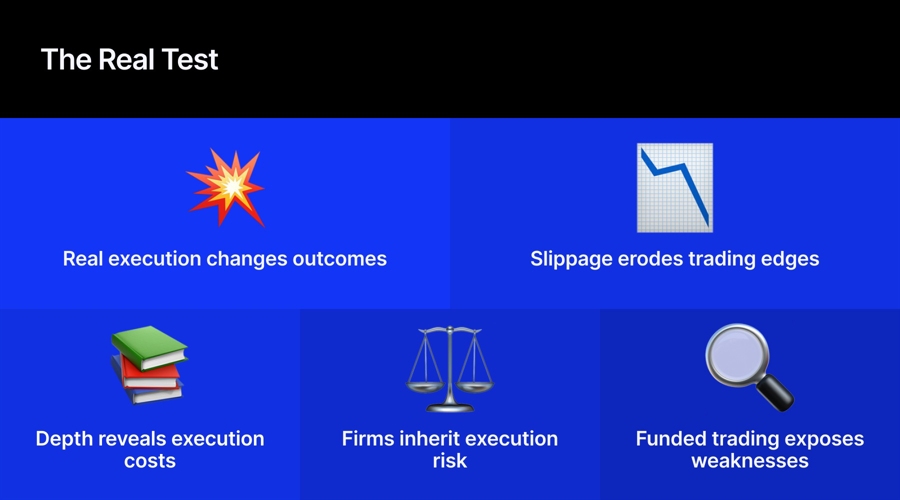
In proprietary trading, the challenge
stage is treated as a test of trading skill. Increasingly, it is not. It is a
test of whether a trader can perform inside conditions engineered to be
survivable, and those conditions rarely resemble what the same trader will face
once funded.
London’s trading industry is coming home!
The assumption behind most challenge
environments is straightforward: a clean simulation is a fair simulation.
Instant fills at the requested price. No queue at the touch. No widening spread
when volatility hits. That assumption
is the problem.
A challenge environment with no slippage
and no order book friction is not neutral. It systematically overstates a
trader’s edge, because a meaningful share of what separates a profitable
strategy from a losing one lives in the milliseconds between order submission
and fill.
Strip that friction out, and the firm is
no longer evaluating a trading strategy. It is evaluating a trader’s ability to
operate inside an idealised version of the market, then handing that trader a
funded account sized on the assumption that performance will carry over. It usually does not.
The rationale firms give internally is
that frictionless simulation improves onboarding economics: more passes, more
funded accounts, more perceived value for the challenge fee. That argument
holds only if the firm does not expect the trader to remain profitable once
real execution conditions apply.
The moment a funded strategy meets a
real order book, whether through live-routed execution or a simulation
calibrated to actual market depth, the edge that looked stable in the challenge
begins leaking on every fill. Firms that built
funded-stage risk models on challenge-stage performance data are
underpricing the drawdown that follows.
Depth of Market Is a Risk Control, Not a
Trader’s Convenience
DOM visibility is usually framed as a
tool for traders: reading intent, spotting resting size, timing entries around
liquidity. That framing undersells what depth of market actually does for the
firm running the book.
A simulated environment that
reconstructs real order book depth, including the layers behind the best bid
and offer, forces large or poorly timed orders to walk the book the way they
would against live liquidity. That is where realistic slippage originates.
Without a rebuilt order book, a demo server has no mechanism to punish size. A
fifty-lot market order fills the same way a one-lot order does, at the same
price, and the trader does not learn what that order actually costs until real
capital, or a live-mirrored account, exposes it.
This matters more for the firm than for
the trader. A firm that cannot model how funded orders interact with real depth
cannot forecast its own payout liability with any precision. It is running a
book that it cannot price.
The pace of consolidation across the
industry over the past two years has not been evenly distributed. Firms that
treated execution realism as a cost centre to minimise are disproportionately
represented among the exits. Firms that treated it as core infrastructure are
not.
Slippage Exposure Is the Mechanism, Not
the Education
A common defence of frictionless
challenge environments is that execution discipline can be taught separately,
through risk management content layered on top of a clean simulation.
That defence mistakes information for
exposure. A trader can be told that fast markets widen spreads and that stop
orders can fill several ticks from the trigger price, and still hold no
functional intuition for it. Intuition is built through repeated exposure to
consequence, not through being told a fact once.
A challenge environment that never
produces a bad fill teaches nothing about bad fills. It teaches the opposite:
that execution is reliable. That is the exact lesson that puts a funded trader
in the most trouble during their first high-volatility session with real
capital, or real-routed capital, behind them.
Firms building this correctly run
challenge and funded environments off the same execution model, so a trader’s
evaluation results already reflect the slippage , spread widening, and partial
fills they will face after funding. That is a harder and more expensive
simulation to build.
It is also the only version where a pass
rate means anything. A firm that can show a trader passed under conditions
statistically close to live execution has a defensible claim about that
trader’s edge. A firm that cannot is selling a credential, not a risk
assessment.
Payout Models Inherit Whatever Error
Sits in the Execution Model
Everything downstream in prop firm
economics, drawdown limits, scaling plans, payout splits, is calibrated against
an assumption about how a funded trader’s orders behave in the market.
If that assumption is built on
frictionless challenge data, every downstream number inherits the error. Risk
limits get sized for conditions the trader will never actually encounter.
Scaling plans get built on performance data that does not reproduce under live
depth. Payout ratios drift away from what the firm’s actual exposure supports.
The gap between
challenge fee revenue and funded-trader payout liability is what
determines whether a firm survives its own growth. That gap widens fastest at
firms where the execution model used to evaluate traders and the execution
model used to fund them are not the same model.
Slippage and depth of market are not
trading-education topics. They are the inputs a firm’s entire risk architecture
is built on, whether or not that firm has chosen to model them accurately.
The question is not whether a firm’s
challenge environment feels realistic to the trader taking it. It is whether
the firm can demonstrate, with the same rigour it applies to payout ratios and
drawdown limits, that its evaluation execution and its funded execution are
drawn from the same distribution.
Most cannot yet answer that question with
data. The firms that can are the ones whose growth will hold up under its own
weight.
In proprietary trading, the challenge
stage is treated as a test of trading skill. Increasingly, it is not. It is a
test of whether a trader can perform inside conditions engineered to be
survivable, and those conditions rarely resemble what the same trader will face
once funded.
London’s trading industry is coming home!
The assumption behind most challenge
environments is straightforward: a clean simulation is a fair simulation.
Instant fills at the requested price. No queue at the touch. No widening spread
when volatility hits. That assumption
is the problem.
A challenge environment with no slippage
and no order book friction is not neutral. It systematically overstates a
trader’s edge, because a meaningful share of what separates a profitable
strategy from a losing one lives in the milliseconds between order submission
and fill.
Strip that friction out, and the firm is
no longer evaluating a trading strategy. It is evaluating a trader’s ability to
operate inside an idealised version of the market, then handing that trader a
funded account sized on the assumption that performance will carry over. It usually does not.
The rationale firms give internally is
that frictionless simulation improves onboarding economics: more passes, more
funded accounts, more perceived value for the challenge fee. That argument
holds only if the firm does not expect the trader to remain profitable once
real execution conditions apply.
The moment a funded strategy meets a
real order book, whether through live-routed execution or a simulation
calibrated to actual market depth, the edge that looked stable in the challenge
begins leaking on every fill. Firms that built
funded-stage risk models on challenge-stage performance data are
underpricing the drawdown that follows.
Depth of Market Is a Risk Control, Not a
Trader’s Convenience
DOM visibility is usually framed as a
tool for traders: reading intent, spotting resting size, timing entries around
liquidity. That framing undersells what depth of market actually does for the
firm running the book.
A simulated environment that
reconstructs real order book depth, including the layers behind the best bid
and offer, forces large or poorly timed orders to walk the book the way they
would against live liquidity. That is where realistic slippage originates.
Without a rebuilt order book, a demo server has no mechanism to punish size. A
fifty-lot market order fills the same way a one-lot order does, at the same
price, and the trader does not learn what that order actually costs until real
capital, or a live-mirrored account, exposes it.
This matters more for the firm than for
the trader. A firm that cannot model how funded orders interact with real depth
cannot forecast its own payout liability with any precision. It is running a
book that it cannot price.
The pace of consolidation across the
industry over the past two years has not been evenly distributed. Firms that
treated execution realism as a cost centre to minimise are disproportionately
represented among the exits. Firms that treated it as core infrastructure are
not.
Slippage Exposure Is the Mechanism, Not
the Education
A common defence of frictionless
challenge environments is that execution discipline can be taught separately,
through risk management content layered on top of a clean simulation.
That defence mistakes information for
exposure. A trader can be told that fast markets widen spreads and that stop
orders can fill several ticks from the trigger price, and still hold no
functional intuition for it. Intuition is built through repeated exposure to
consequence, not through being told a fact once.
A challenge environment that never
produces a bad fill teaches nothing about bad fills. It teaches the opposite:
that execution is reliable. That is the exact lesson that puts a funded trader
in the most trouble during their first high-volatility session with real
capital, or real-routed capital, behind them.
Firms building this correctly run
challenge and funded environments off the same execution model, so a trader’s
evaluation results already reflect the slippage , spread widening, and partial
fills they will face after funding. That is a harder and more expensive
simulation to build.
It is also the only version where a pass
rate means anything. A firm that can show a trader passed under conditions
statistically close to live execution has a defensible claim about that
trader’s edge. A firm that cannot is selling a credential, not a risk
assessment.
Payout Models Inherit Whatever Error
Sits in the Execution Model
Everything downstream in prop firm
economics, drawdown limits, scaling plans, payout splits, is calibrated against
an assumption about how a funded trader’s orders behave in the market.
If that assumption is built on
frictionless challenge data, every downstream number inherits the error. Risk
limits get sized for conditions the trader will never actually encounter.
Scaling plans get built on performance data that does not reproduce under live
depth. Payout ratios drift away from what the firm’s actual exposure supports.
The gap between
challenge fee revenue and funded-trader payout liability is what
determines whether a firm survives its own growth. That gap widens fastest at
firms where the execution model used to evaluate traders and the execution
model used to fund them are not the same model.
Slippage and depth of market are not
trading-education topics. They are the inputs a firm’s entire risk architecture
is built on, whether or not that firm has chosen to model them accurately.
The question is not whether a firm’s
challenge environment feels realistic to the trader taking it. It is whether
the firm can demonstrate, with the same rigour it applies to payout ratios and
drawdown limits, that its evaluation execution and its funded execution are
drawn from the same distribution.
Most cannot yet answer that question with
data. The firms that can are the ones whose growth will hold up under its own
weight.