The 2026 Real Estate Notary (Takken) exam ended today (October 18).
I imagine many people spend the evening of the exam day checking the answer key and calculating their own scores. Since the results are announced on November 25, there is some downtime until then. It is likely that quite a few people start thinking about what to take next after the Real Estate Notary exam during this period.
Management Business Chief, Rental Real Estate Business Manager, and Financial Planner. Sometimes, Real Estate Appraiser is included among the candidates. However, the way it is introduced usually stops at ‘difficult’ or ‘high annual income,’ and I rarely see anything written about how it connects from the Real Estate Notary qualification.
From the perspective of the appraisal field, the Real Estate Notary and the Real Estate Appraiser are qualifications that stand quite close to each other. Because they are close, there are hurdles that are easy to overlook. I will compare both using only the official exam materials and legal statutes.
Studying for the Real Estate Notary already touches on the entrance to the Real Estate Appraiser qualification.
The first point of contact is in the scope of the Real Estate Notary exam itself.
Article 8 of the Ordinance for Enforcement of the Building Lots and Buildings Transaction Business Act lists seven fields covered in the Real Estate Notary exam. The sixth one is ‘matters concerning the assessment of the price of building lots and buildings.’ Questions involving the Land Price Publication Act or the Real Estate Appraisal Standards fall under this category. While it is not a prominent field in the Real Estate Notary exam, it serves as an entrance that connects to the core subjects of the Real Estate Appraiser exam.
Another point is Article 34-2 of the Building Lots and Buildings Transaction Business Act. When concluding a brokerage contract, if a real estate agent expresses an opinion on the selling price, they ‘must clarify the basis for it’ (Paragraph 2 of the same Article). When you start working as a Real Estate Notary, you will be on the side of providing the basis when you tell a seller, ‘It will sell at this price.’
Which materials to collect, which methods to use, and how to explain that basis. The Real Estate Appraisal Standards systematize this, and the ‘Appraisal Theory’ subject in the Real Estate Appraiser exam is based on these standards. This is something that is hard to notice while studying for the Real Estate Notary. You memorize it as one line in the Business Act and stop there.
There is also an overlap in laws and regulations. The multiple-choice section of the Real Estate Appraiser exam includes a subject called ‘Administrative Laws and Regulations Concerning Real Estate,’ and the scope of questions listed in the 2026 exam guide included 37 laws.
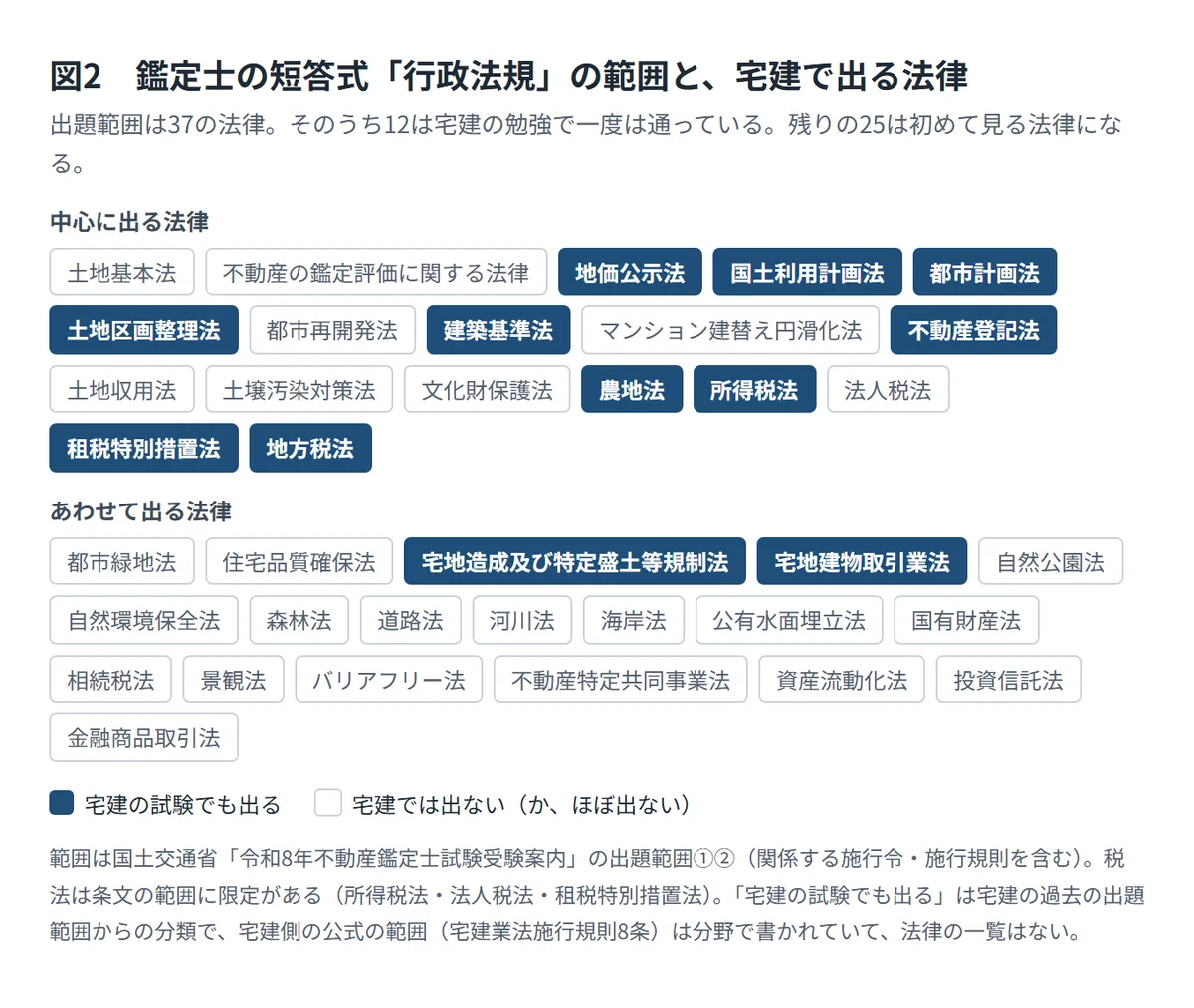
City Planning Act, Building Standards Act, National Land Use Planning Act, Farmland Act, Land Readjustment Act, and Building Lots and Buildings Transaction Business Act. Twelve of the laws you memorized for the Real Estate Notary are included.
The remaining 25 are laws you rarely see in the Real Estate Notary exam. They include the Soil Contamination Countermeasures Act, the Act on Protection of Cultural Properties, the Act on Securitization of Assets, and even the Financial Instruments and Exchange Act. In terms of the number of laws, the knowledge from the Real Estate Notary is only directly effective for about one-third of them.
There are two hurdles. The essay exam and the practical training after the exam.
If you put the path from Real Estate Notary to Real Estate Appraiser registration on one page, it looks like this.
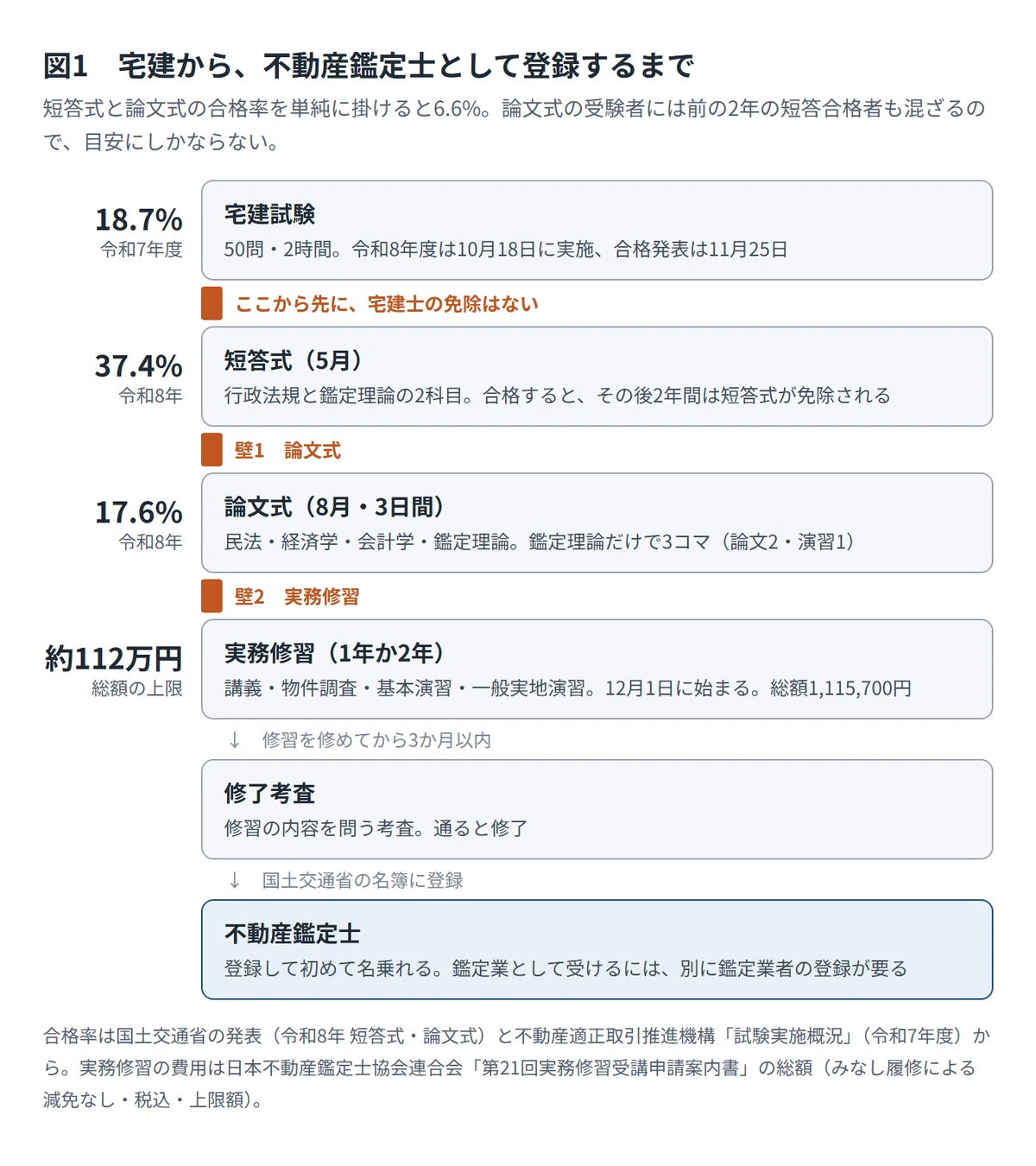
I will state this in advance: there are no subjects exempted just because you are a Real Estate Notary. The subject exemptions for the essay exam listed in the exam guide are for those with doctorates in law, economics, or commerce, those with experience as university professors or associate professors, those who have passed the Certified Public Accountant exam, or those who have qualified as legal apprentices; Real Estate Notaries are not included. Everyone starts from the same place in the multiple-choice section.
The first hurdle is the essay exam. It takes place over three days from August 1 to 3, covering four subjects: Civil Law, Economics, Accounting, and Appraisal Theory. There are six two-hour sessions, three of which are for Appraisal Theory (two essays and one practical exercise). Since the Real Estate Notary exam is a two-hour multiple-choice test with 50 questions, the format is completely different. Civil Law appears in the Real Estate Notary exam, but the muscles you use to choose from options are different from those used to construct and write out arguments yourself. If you put off Civil Law thinking, ‘I already did that for the Real Estate Notary,’ you might find yourself unable to write when it comes time to answer. Economics and Accounting are subjects that do not exist in the Real Estate Notary exam at all.
In 2026, the results for the short-answer exam were 900 passers out of 2,407 examinees, a 37.4% pass rate, and for the essay exam, 208 passers out of 1,182 examinees, a 17.6% pass rate. Simply multiplying the two gives 6.6%. This is not an exact figure, as the essay exam also includes short-answer passers from the previous two years. As a point of comparison, the pass rate for the Real Estate Notary (Takken) exam in 2025 was 18.7%.
Looking at the essay exam pass rates by age, in 2026, 26.8% were under 30, while 5.6% were 45 or older. The data does not include the number of attempts or the examinees’ occupations, so it is unclear why there is such a difference. However, if you are a working professional who has just obtained a Real Estate Notary license, these are figures worth knowing. I have laid out the age-based figures for four years in a separate article.
The second hurdle comes after you pass the exam: the practical training.
Even if you pass the essay exam, you cannot call yourself an appraiser yet. You must undergo one to two years of practical training starting December 1st, pass the final examination, and register with the Ministry of Land, Infrastructure, Transport and Tourism before you officially become an appraiser. According to the guide for the 21st training session starting in December 2026, the total cost for the training is 1,115,700 yen (the upper limit if there are no exemptions due to deemed credits).
Real Estate Notary registration also requires two years of practical experience or an equivalent training course (Article 18 of the Real Estate Brokerage Act). However, the fact that there is over a year of training and costs exceeding 1 million yen waiting after the exam is a clear difference from the Real Estate Notary license. If you decide based solely on the exam pass rate, you will overlook this one year and 1.11 million yen in your calculations.
When you open a business, the two licenses have opposite ways of earning money
This is where the romantic part of the story begins.
To open a real estate brokerage business, you must obtain a license and either deposit a business security deposit of 10 million yen for the head office or join a guarantee association and pay a share of the compensation business security deposit of 600,000 yen for the head office (Article 2-4 and Article 7 of the Real Estate Brokerage Act Enforcement Order). Association membership fees and annual dues are separate. Compensation is a success fee paid only after a sale or lease is concluded.
For the appraisal business, you must register as a real estate appraisal firm with the prefecture (or the Ministry of Land, Infrastructure, Transport and Tourism if you have offices in two or more prefectures) and place at least one full-time appraiser in each office (Article 22 and Article 35 of the Act on Real Estate Appraisal). The fee for a new registration is, for example, 15,600 yen according to Aomori Prefecture’s guide. Compensation is paid for the work of valuation itself, regardless of whether a transaction is concluded.
The way money comes in is exactly the opposite.
Brokerage can be lucrative if a deal is closed, but it is zero until then. Appraisal is built up case by case, but there are situations where people want to ‘determine the price first’ before deciding whether to sell. Examples include inheritance division, renewal of land leases, evictions, and sales between a family-owned company and the company president as an individual. In such cases, a price is needed regardless of whether a sale is concluded.
The entry points for consultation also overlap. Consultations about what to do with a parent’s house usually start with ‘How much is it worth?’ and proceed to ‘What should I do if I sell it?’ The first half is the appraiser’s domain, and the second half is the real estate brokerage’s domain. If you only hold one, there will be times when you have to pass the conversation to another office. If you hold both, the same person can oversee it from start to finish. This is the form that excites me the most.
Even if you hold both, there is a line you must not cross
However, this does not mean you can ‘earn twice from one case’.
The Real Estate Appraisal Standards state in Chapter 1 of the General Provisions that ‘in principle, one should not accept a real estate appraisal if there is a risk of harming a fair appraisal, such as when there is a personal connection or a special interest.’ Chapter 8, Section 2 requires the involved appraiser and appraisal firm to clarify the existence and content of any interest in the subject property.
If you set the appraised value yourself for a property for which you are acting as a sales broker, from the perspective of the client or buyer, the party wanting to sell at a high price is the one determining the price. This is the first thing that would be questioned in the field of valuation, and given the intent of the standards, it is natural to consider that you will encounter situations where you cannot accept the assignment.
There is also the question of whether one person can serve as the ‘full-time’ professional for both in a single office. The Ministry of Land, Infrastructure, Transport and Tourism’s ‘Interpretation and Operation of the Real Estate Brokerage Act’ states that when performing the duties of a land and house investigator or administrative scrivener in the same location, a person will not be recognized as a full-time real estate notary ‘unless it is recognized that they can serve full-time after considering the volume of work in other industries, etc.’ I did not find any description specifically naming the appraisal business, but it is possible that it would be viewed with the same line of thinking. This is an item to confirm with the licensing office before opening your business.
Ultimately, the strength of holding both is not about collecting two fees for the same property. It is about being able to handle the consultation from start to finish, while deciding in each situation whether to act as the ‘party providing the valuation’ or the ‘party facilitating the transaction.’ The more you are able to draw the line yourself, the better these two qualifications will mesh.
The results for the Real Estate Notary (Takken) exam will be announced on November 25th. If you are seriously considering becoming an appraiser, I would personally read just Chapter 1 of the General Provisions of the Real Estate Appraisal Standards in the meantime. Anyone can read it on the Ministry of Land, Infrastructure, Transport and Tourism website, and it is only a few pages long. You will be able to see just how deeply the ‘basis for price,’ which you memorized as just one line in the Real Estate Brokerage Act, is explored.
I have summarized what an actual answer for the appraisal theory exam looks like separately, as it is quite long. If you want to start by memorizing, please check this out.
Public information referenced
Ministry of Land, Infrastructure, Transport and Tourism: 2026 Real Estate Appraiser Examination Guide (Exam Subjects, Scope, and Exemptions)
https://www.mlit.go.jp/tochi_fudousan_kensetsugyo/content/001979330.pdf
Ministry of Land, Infrastructure, Transport and Tourism: 2026 Real Estate Appraiser Examination Results (Short-Answer Test)
Ministry of Land, Infrastructure, Transport and Tourism: 2026 Real Estate Appraiser Examination Results (Essay Test) (Attachment 2)
https://www.mlit.go.jp/report/press/content/002027014.pdf
Real Estate Transaction Improvement Organization: Exam Implementation Overview (10 years up to 2025)
https://www.retio.or.jp/wp-content/uploads/2025/12/10years_result2025.pdf
Japan Association of Real Estate Appraisers: 21st Practical Training Application Guide
https://jarea.org/cms_files/general/practical_training/1_21_jyukoannnai_20260911.pdf
Ministry of Land, Infrastructure, Transport and Tourism: Real Estate Appraisal Standards
https://www.mlit.go.jp/common/001204083.pdf
Ministry of Land, Infrastructure, Transport and Tourism: Interpretation and Operational Guidelines for the Real Estate Brokerage Act (Exclusivity of Full-time Real Estate Notaries – Comparison of New and Old Provisions)
https://www.mlit.go.jp/totikensangyo/const/content/001735503.pdf
Aomori Prefecture: Guide to New Registration for Real Estate Appraisal Businesses
https://www.pref.aomori.lg.jp/soshiki/kendo/kanri/files/shinki.pdf
Real Estate Brokerage Act, its Enforcement Order, and Enforcement Regulations; Act on Real Estate Appraisal (e-Gov Law Search)
For those who found this article helpful.
I have compiled everything from memorization mnemonics to techniques for completing your answer sheets in two pages, organized so you can read them in order.
#RealEstateAppraiser #RealEstateAppraiserExam #Takken #RealEstateNotaryExam #RealEstateNotary #CertificationExam #AppraisalTheory #IndependentPractice #RealEstate #WorkingProfessionalStudies