Over the past five years, retail investors, by and large, have been inclined to invest in small-cap mutual funds.
This is mainly because the small-cap segment of the Indian equity market has demonstrated large wealth-creation potential over the last few years. The years 2023 and 2024 (to be precise, up to 24 September 2024), particularly, were a golden era for small caps.
While in the ensuing year 2025 the Nifty Smallcap 250 index eroded wealth (posting a -6.0% absolute return) amid volatility, in 2026, thus far, small-caps have once again raced ahead of mid-caps and large-caps, clocking a 6.2% absolute return (as of 2 July 2026).
Cumulative over the last five years, the Nifty Smallcap 250 index has clocked an impressive compounded average growth rate (CAGR) of 16%. Small-caps have the potential to become tomorrow’s market leaders, as they are often in the growth stage.
If you, too, are one of those considering some of the best small-cap mutual funds to invest in now, we have you covered.
In this piece, we have compared two small-cap mutual funds for you — Nippon India Small Cap Fund and Bandhan Small Cap Fund.
Nippon India Small Cap Fund is an older small-cap fund launched in September 2010 as the Reliance Small Cap Fund. After Nippon Life Insurance completed the takeover of Reliance Mutual Funds in September 2019, the fund was rechristened Nippon India Small Cap.
Bandhan Small Cap Fund originally made its debut in February 2020 as IDFC Emerging Businesses Fund. After the Bandhan Financial Holdings Limited (alongside private equity firm ChrysCapital and Singapore’s sovereign wealth fund GIC) acquired IDFC Mutual Fund, it was later renamed as Bandhan Small Cap Fund.
Nippon India Small Cap Fund has nearly a 16-year track record, while Bandhan Small Cap Fund has over 6 years.
That said, these are among the prominent, popular, and 5-star-rated small-cap mutual funds and understanding their traits shall help you choose an appropriate one for your investment portfolio.
So, let’s dive in.
First, let’s understand the portfolio characteristics of these funds in detail, which will help recognise how they have driven the performance.
Portfolio Attributes
Both these funds follow the regulatory mandate by investing at least 65% of their assets in equity and equity-related instruments of smallcap companies.
Small-caps, as you may know, are companies ranking beyond 250 in terms of full market capitalisation. There are far more small-caps than mid-caps and large companies in India, offering fund managers a larger universe.
Both Nippon India Small Cap Fund and Bandhan Small Cap Fund hold unique portfolios.
| No. of Stocks | Top 10 Stock (%) | Top 3 Sectors (%) | PB Ratio | PE Ratio | |
| Nippon India Small Cap Fund | 250 | 14.5 | 54.3 | 3.5 | 27.8 |
| Bandhan Small Cap Fund | 251 | 18.8 | 48.8 | 2.2 | 17.5 |
Source: Fund Factsheets
Speaking about the Nippon India Small Cap Fund, it currently manages assets worth Rs 74,604 crore – the largest in its category. At present, around 97% of the fund’s assets are in equities and nearly 3% in cash & cash equivalents.
In equities, the fund currently holds a very broad portfolio of 250 stocks, of which nearly 73% are small-caps, 14% mid-caps, and 13% large-caps.
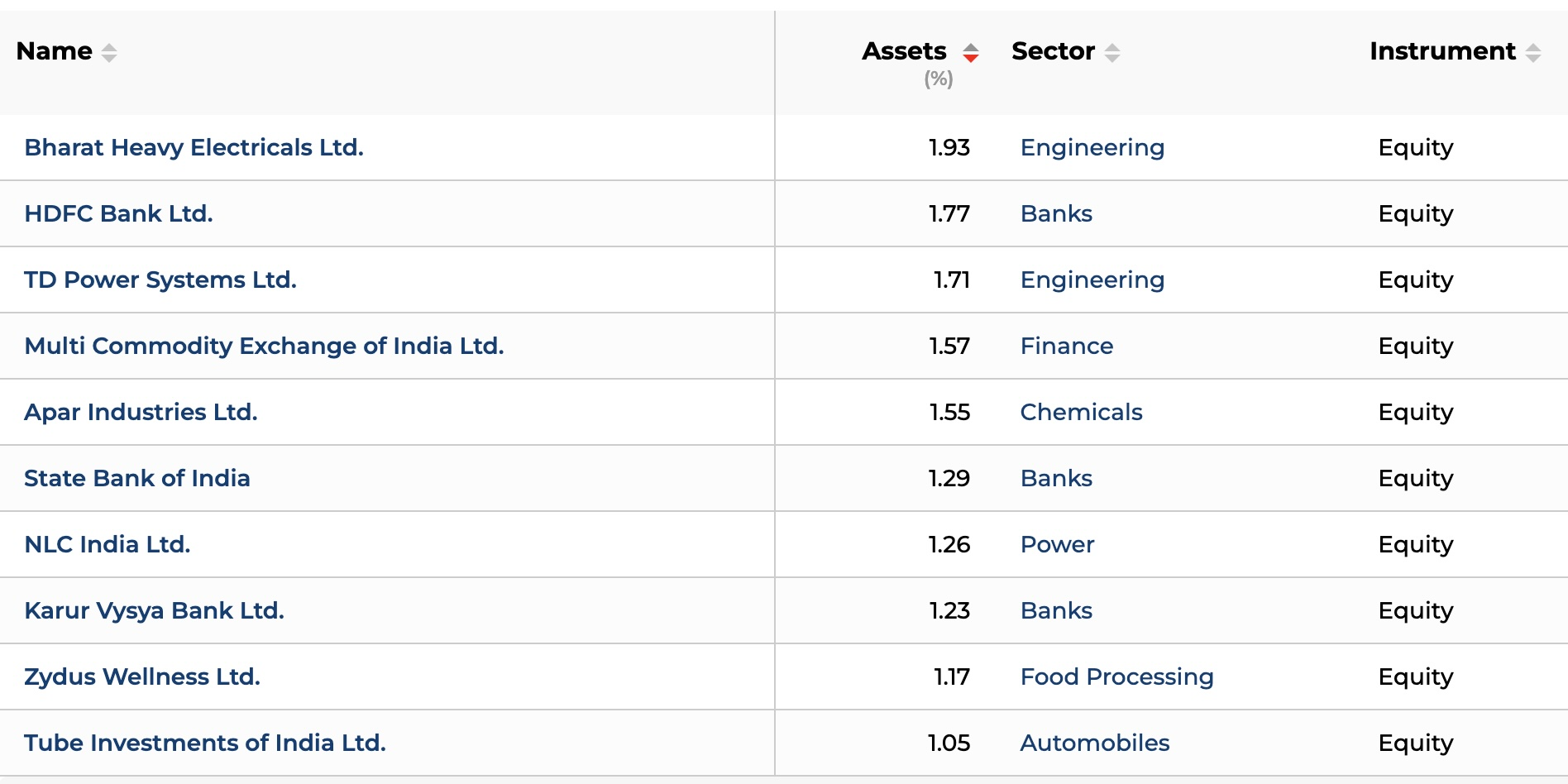
Given the diverse portfolio, the top 10 stocks account for 14.5% of the equity portfolio and include names such as BHEL, HDFC Bank, and TD Power Systems. In its top 10 holdings, the fund has allocated to 4 small-caps, 4 mid-caps, and 2 large-caps (HDFC Bank and State Bank of India).
Top Holdings of Nippon India Small Cap Fund
Source: Fund Factsheets
Stocks such as BHEL, TD Power Systems, MCX, and Apar Industries have been core drivers, compounding wealth over longer periods, while those such as HDFC Bank have underperformed.
Industrials, financial services, and consumer discretionary are the top 3 sectors of Nippon India Small Cap Fund, comprising 62.2% of the portfolio. The fund is overweight in industrials/engineering and consumer staples relative to its category peers, while underweight in financial services and the healthcare sector, among others.
The fund house is optimistic about the outlook for industrials and believes that a new wave of private capex is likely to be driven by manufacturing capex (Product Linked Incentives, China plus one strategy) and higher Environmental, Social, and Governance (ESG) compliance.
Moreover, the fund house believes that consumption themes, both discretionary and staples, may benefit from policy support such as income tax cuts, lower interest rates, and proposed lower GST rates.
The underweight stance on financials is primarily due to stock reallocation and a lack of quality names in the small-cap space.
Similarly, in healthcare, it is underweight as it faces a year of unprecedented transformation and challenges.
The valuation ratios – PE (27.8) and PB (3.5) – indicate that the fund is a bit aggressive and pursues a growth investment style.
A higher PE of the diversified portfolio of the fund indicates that the underlying stocks have already run up significantly and have baked in a lot of future earnings growth.
To realise the portfolio’s full growth potential of stocks, the fund follows a strict buy-and-hold strategy. This is indicated by the low equity portfolio turnover of 19%, which is significantly lower than that of some of its category peers.
As regards the Bandhan Small Cap Fund, it currently manages assets worth Rs 27,219 crore. Nearly 90% of its assets are in equities, 0.2% in REITs, and the remainder in cash & cash equivalents.
Like Nippon India Small Cap Fund, the Bandhan Small Cap Fund also holds a diverse portfolio of 251 stocks, of which 77% are small-caps, nearly 17% mid-caps, and 6% large-caps.
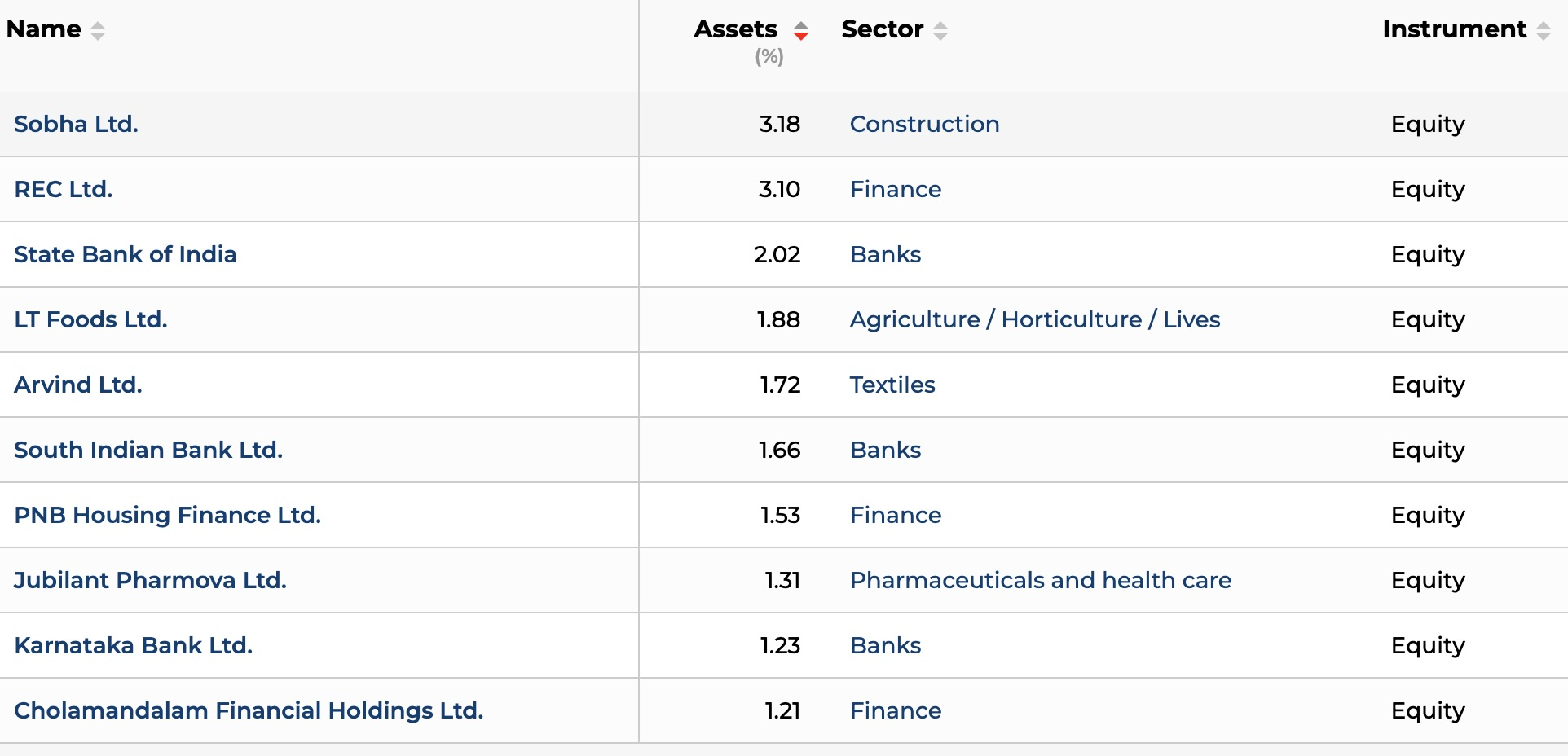
The top 10 stocks comprise 18.8% of the total equity holdings and include names such as Sobha, REC, State Bank of India, etc. Among the top 10 holdings, only 1 is a large-cap, while the others are small-caps and mid-caps.
Top Holdings of Bandhan Small Cap Fund
Source: Fund Factsheets
Stocks such as Sobha, SBI, REC, LT Foods, and Arvind, among others, have fared very well over the long term, generating wealth for their investors.
In May 2026, Afcom Holdings, Sirca Paints, Voltamp Transformers, and Petronet LNG were fresh entries in the portfolio of Bandhan Small Cap Fund, perceiving value and growth opportunities, while it completely exited from Vidya Wires, PB Fintech, Kirloskar Pneumatic, Vedanta, and Garware Hi-Tech Films, perhaps because their valuation target were hit and profit-booking made sense.
Financials, materials, and consumer discretionary are the top 3 sectors comprising 48.8% of the portfolio. The fund is overweight in banks & financial services, as it views this sector as the engine of economic growth for other sectors as well. Certain financial, banking, and non-banking financial companies (NBFCs) are offering a superior risk-reward profile, providing a better margin of safety. This aligns with the fund’s value-conscious approach.
The valuation ratios – PE (17.5) and PB (2.2) – indicate that the fund consciously avoids high-flying, hyper-growth small caps trading at bloated valuations. Instead, it targets undervalued companies where stock prices have not yet fully priced in corporate earnings growth.
In other words, the fund conforms to the strict value bias. And with this approach, Bandhan Small Cap Fund’s portfolio may have a greater cushion or margin of safety against market downturns.
The fund holds its portfolio with conviction. The fund’s portfolio turnover ratio is currently 22%, among the lowest in the category.
What Is the Investment Philosophy and Strategy Behind the Portfolio?
Both Nippon India Small Cap Fund and Bandhan Small Cap Fund have distinctive investment philosophies that shape their investment strategies.
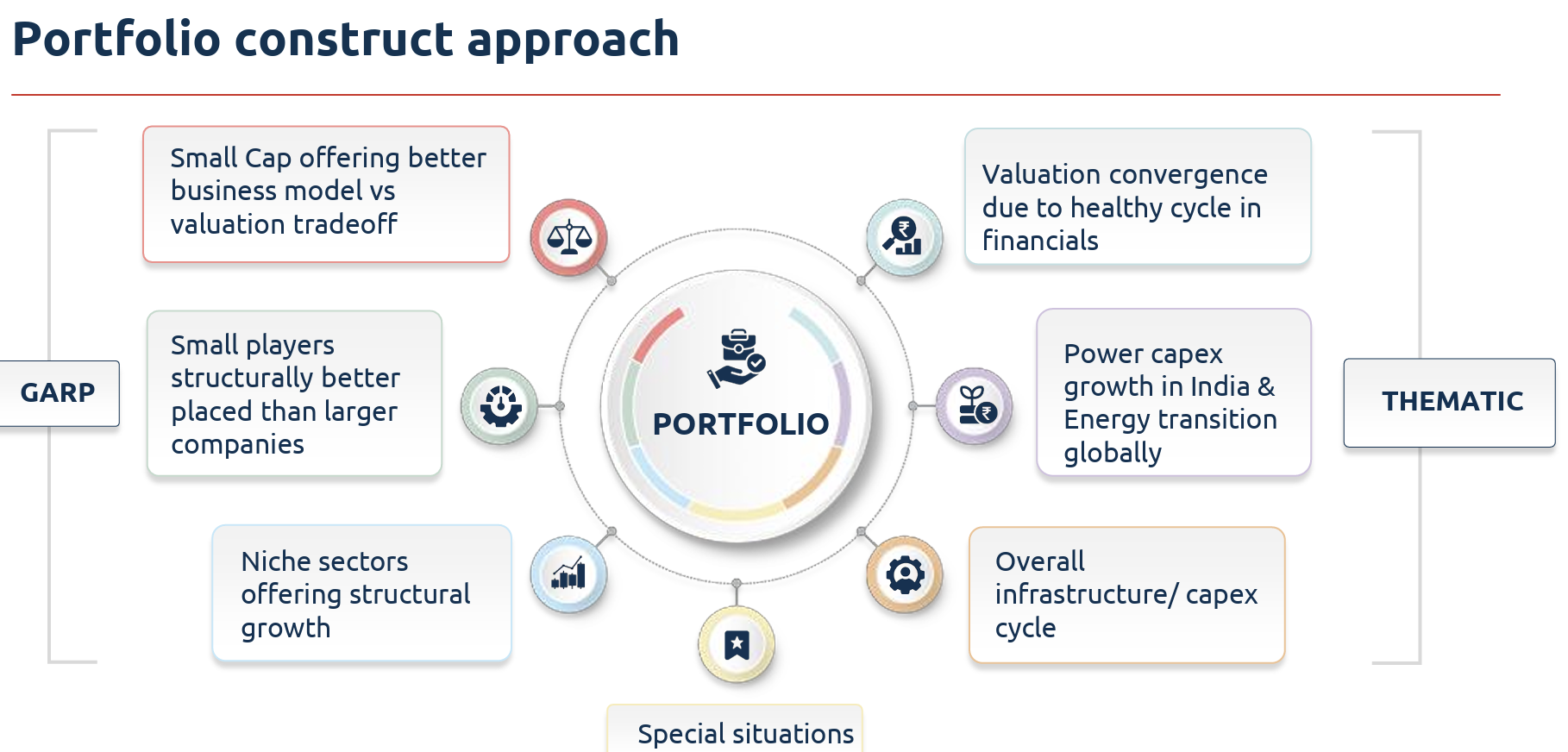
As regards Nippon India Small Cap Fund, its portfolio construction is guided by growth at a reasonable price (GARP).
The focus is on good quality companies with scalable businesses and strong managements, currently ignored due to non-fundamental reasons. i.e. ‘right risk’ without compromising on quality. It approaches stocks bottom-up across sectors and themes.
It looks for unique, high-conviction ideas backed by the fund house’s internal capabilities and also considers opportunistic investments to benefit from new or evolving trends.
In contrast, Bandhan Small Cap Fund, as seen by the portfolio ratios, is more value-conscious. It looks at reasonable valuations with re-rating potential. Reasonable valuations refer to companies providing a margin of safety.
The fund looks at companies with healthy balance sheets, profitability, cash flows, those whose market share is gaining and have a scope to scale, have visionary and passionate management, while avoiding highly leveraged businesses.
In other words, a three-pronged approach is followed: quality, growth, and reasonable valuations.
Now let’s talk about how the approaches of the two funds rewarded investors.
Performance
Well, both Nippon India Small Cap Fund and Bandhan Small Cap are among the top performers in the small-cap funds category over long periods – 3 years and 5 years.
Over 3-year and 5-year periods, Bandhan Small Cap Fund has outpaced Nippon India Small Cap and the category median, clocking CAGRs of 29.2% and 21.6%, respectively.
Bandhan’s smaller, medium-sized pool allows its fund manager, Manish Gunwani, to remain highly agile. Also, the fine balance between value and GARP, while being overweight on the banking & financial services sector, has rewarded its investors handsomely.
Returns and Risk Ratios: Nippon India Small Cap Fund vs. Bandhan Small Cap Fund
| Absolute | CAGR | Risk Ratios | |||||
| 1 Yr (%) | 3 Yr (%) | 5 Yr (%) | SI (%) | Std Dev (%) | Sharpe Ratio | Sortino Ratio | |
| Bandhan Small Cap Fund | 7.8 | 29.2 | 21.6 | 30.9 | 20.7 | 1.05 | 1.66 |
| Nippon India Small Cap Fund | 6.0 | 19.5 | 21.0 | 24.2 | 19.4 | 0.71 | 1.03 |
| Category Median | 8.4 | 18.9 | 18.5 | – | 19.7 | 0.68 | 1.02 |
| BSE SmallCap 250- TRI | 0.2 | 17.8 | 16.1 | – | 22.0 | 0.59 | 0.92 |
The Risk Measures have been calculated using calendar month returns for the last three years and are as of 30 June 2026.
The returns data is as of 30 June 2026.
Source: Value Research
Even on a since-inception basis, while Bandhan Small Cap Fund has over a 6-year track record, it has clocked a 30.9% CAGR compared to the 24.2% CAGR of the Nippon India Small Cap Fund, which has a 16-year track record.
Bandhan Small Cap Fund’s launch just before the bottom of the COVID-19 pandemic helped it pick stocks at attractive valuations and benefit from the subsequent rally.
In contrast, Nippon India Small Cap Fund, which was launched in September 2010, has gone through some gruelling market cycles, including the 2011 Eurozone crisis, the 2013 taper tantrum, and the brutal 2018–2019 small-cap crash, and has sort of averaged out in terms of its returns.
Risk and Risk-adjusted Returns
The risk ratios, calculated using calendar-month returns over the last three years, show that Nippon India Small Cap Fund has exposed investors to lower risk (standard deviation of 19.4%) than Bandhan Small Fund (20.7%), category peers, and the BSE SmallCap 250 – TRI.
In other words, the high returns of the Bandhan Small Cap Fund over 3 and 5-year periods have come with slightly higher risk. Yet this risk is not exceptionally high, the category median and the BSE SmallCap 250 -TRI.
On a risk-adjusted basis, Bandhan Small Cap Fund has justified the risk taken (Sharpe Ratio of 1.05), which is noticeably higher than that of Nippon India Small Cap Fund.
Also, on the Sortino ratio (which measures excess returns generated per unit of downside risk), Bandhan Small Cap Fund ranks higher (1.66) than Nippon India Small Cap Fund (1.03), indicating better downside risk management.
This is because the Bandhan Small Cap Fund chooses to take cash calls at times, rather than forcing capital into overvalued setups. In other words, the fund tactically keeps power dry. In comparison, the Nippon India Small Cap Fund has consistently made bare-minimum cash calls in the range of 2-3%. It has preferred to remain fully invested.
Fund Managers: Have They Influenced Performance?
While both these schemes are from established mutual fund houses that follow robust investment processes & systems, fund managers have played a pivotal role in driving their performance.
In the case of Nippon India Small Cap Fund, Samir Rachh has managed the portfolio for years (since January 2017). Before him, star fund manager Suni Singhania managed the fund from September 2010 until January 2017.
As regards the Bandhan Small Cap Fund, the portfolio is currently managed by Manish Gunwani, the Chief Investment Officer (CIO) – Equities at the fund house. He has been managing the fund since January 2023.
Before that, Anoop Bhaskar, also considered a star fund manager, managed the fund from February 2020 until January 2023.
Which Small Cap Fund Should You Add to Your Portfolio?
If you are looking for a small-cap scheme that strikes a fine balance between value and growth, takes tactical cash calls at times, and justifies the risk in the form of risk-adjusted returns, then Bandhan Small Cap Fund can be a worthwhile addition.
This small-cap fund is a clear alpha generator. The agile approach, with a relatively smaller AUM, has helped the fund in this regard.
In contrast, if you are looking for a scheme with a longer track record and large AUM, then Nippon India Small Cap Fund is the one.
| Nippon India Small Cap Fund | Bandhan Small Cap Fund | |
| Portfolio Positioning | Bit Aggressive | Value Conscious |
| Cash Calls | Low (Consistently 2-3%) | High (tactical approach) |
| Risk | Below Average | High |
| Returns | High | Very High |
But keep in mind that Nippon India Small Cap Fund, given its AUM size, is currently has investment limits imposed. The SIP and Systematic Transfer Plan (STP) registrations are capped at Rs 2 lakh per transaction/instalment, with an overall monthly limit of Rs 46 lakh per Permanent Account Number (PAN).
The existing or ongoing SIPs, however, are not subject to this limit. Lump-sum investment and switch-ins have been suspended since July 2023.
Whichever small-cap fund you consider, make sure your risk appetite and investment horizon of at least around 5 years.
In volatile markets, as we’re experiencing currently, making a staggered lump sum is advisable, or even better, taking the Systematic Investment Plan (SIP) route when planning for your envisioned financial goals. The inherent rupee cost-averaging feature shall help mitigate the impact of market volatility and potentially compound wealth over time.
Happy investing!
Note: We have relied on data from www.valueresearchonline.com, www.financialexpress.com, and the factsheets published by the respective fund houses throughout this article. Only in cases where the data was not available, have we used an alternate, but widely used and accepted source of information.
Returns data as of 2 July 2026. Direct Plan and Growth Option Considered. The Risk Measures have been calculated using calendar month returns for the last three years. The Risk Measures have been calculated using calendar month returns for the last three years and are as of 30 June 2026.
Standard Deviation is a measure of the total volatility of the fund. The Sharpe Ratio is a measure of risk-adjusted return that shows how much excess return an investment generates for each unit of risk taken.
Portfolio data as of 31 May 2026. The average of the price-to-book value ratios and price-to-equity ratios of all underlying stock holdings in proportion to their portfolio weights is considered.
Disclaimer: The above content is for informational purposes only. Mutual Fund investments are subject to market risks. Past returns are not indicative of future returns. Please consult your financial advisor before investing.
Rounaq Neroy has over 20 years of experience in the financial markets and investments. He is a close observer of the Indian economy and writes deeply on the capital markets, mutual funds, stocks, precious metals, asset allocation, wealth management, and investment strategy. His editorials provide interesting, actionable investment ideas to guide readers in the journey of wealth creation and make wise decisions. Rounaq was the Head of Content at PersonalFN (Quantum Information Services Pvt. Ltd.), which also owns Equitymaster.com – India’s oldest and trusted equity research house.