


Characters: Minori (34, sales assistant at a food manufacturer. In her 3rd year of investing in “All Country,” a mutual fund that allows for collective investment in stocks worldwide, via NISA. Since Part 3, she has also been investing in a global bond mutual fund) / Satoko-san (Minori’s senior at work, accounting manager) / Editor-in-Chief (Kurata-san, Editor-in-Chief of Kurakare). For details, see Part 0, “Nice to meet you. I’m Minori, in my 3rd year of All Country“.
Minori:
Satoko-san, please listen. I’ve decided to start a monthly investment plan for a global bond mutual fund.
Satoko-san:
Oh, that’s great. You were only doing All Country, so you’ve really thought this through.
Minori:
The Editor-in-Chief taught me that stocks and bonds move differently. I felt relieved thinking that it’s not just an ice cream shop that sells on sunny days, but also an umbrella shop that sells on rainy days.
*The ice cream shop and umbrella shop are metaphors for “diversification,” which combines things with different price movements. For details, see Part 1, “Just All Country, ‘Is this okay?’ What is the true nature of that anxiety?“.
Satoko-san:
Yeah, I think that’s a good step. …But, there is one thing I want to talk to you about.
The year when both stocks and bonds fell together
Satoko-san:
Do you remember 2022? Because of my work in accounting, I often look at news about pension management, and that year was a bit surprising.
Minori:
2022… what happened?
Satoko-san:
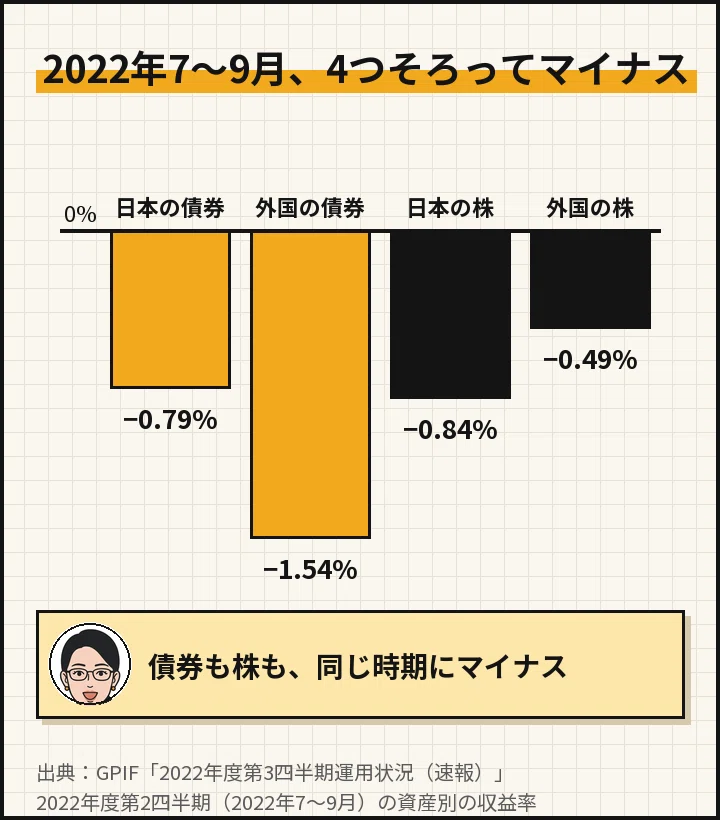
The GPIF, which manages the national pension, holds assets divided into four categories: Japanese bonds, foreign bonds, Japanese stocks, and foreign stocks, right? From July to September 2022, all four of those were in the negative.
-
Japanese bonds: minus 0.79%
-
Foreign bonds: minus 1.54%
-
Japanese stocks: minus 0.84%
-
Foreign stocks: minus 0.49%
Minori:
You’re right. All four were negative… Weren’t bonds supposed to be the umbrella shop for when stocks fall?
Satoko-san:
I thought so too. Looking at global stocks, in the year 2022, the global stock index (MSCI ACWI) fell by 18.36% in dollar terms.
Why did they fall together?
Editor-in-Chief:
(Joining later) Oh, Satoko-san, you’re talking about that year.
Satoko-san:
Editor-in-Chief, perfect timing. Please explain to Minori-chan why that happened.
Editor-in-Chief:
Last time, we talked about how “interest rates and bond prices are like a seesaw.”
Minori:
Yes. When interest rates rise, bond prices fall.
Editor-in-Chief:
That year, prices rose significantly around the world. To curb inflation, central banks in various countries raised interest rates aggressively.
When interest rates rise, bond prices fall. And when interest rates rise, it becomes harder for companies to borrow money, and the economy is seen as cooling down, so stocks also tend to fall.
Minori:
So, because of the same ‘weather’ of rising interest rates, both stocks and bonds fell together.
Editor-in-Chief:
That’s right. The correlation between stocks and bonds is not always low. During periods when prices and interest rates move significantly, they can move in the same direction.
*Correlation is the degree to which two things move together. The closer it is to plus 1, the more likely they are to move in the same direction; if it is negative, they tend to move in opposite directions. For more details, see Part 2, “Are you diversified with All Country? The effect of diversification is determined by ‘correlation’“.
Satoko-san:
So correlation isn’t always the same number, is it?
Editor-in-Chief:
Yes. Past correlation is just a guideline, and it is not guaranteed to remain the same in the future. This is one of the most important points to keep in mind when considering diversification.
Then, was adding bonds a mistake?
Minori:
…Was it a mistake for me to add bonds?
Editor-in-Chief:
No. For most periods, stocks and bonds have moved differently. Volatility is likely to be lower than with stocks alone. That remains true.
However, it means that ‘if you have stocks and bonds, you are safe in any weather’ is not true.
Satoko-san:
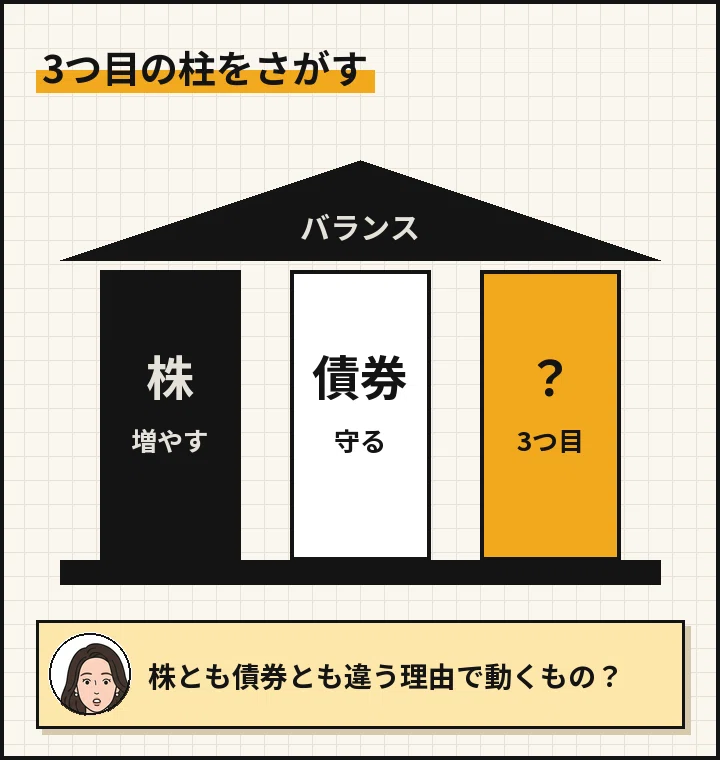
It would be good to have one more thing that moves for reasons different from both stocks and bonds, wouldn’t it?
Minori:
A third pillar…?
Editor-in-Chief:
Actually, people who manage large amounts of money over the long term, such as pension funds and university endowments, also hold things called ‘alternatives’ in addition to stocks and bonds.
Minori:
Alterna…tive? That’s a tongue twister.
Editor-in-Chief:
It means ‘substitute.’ Just think of it as assets other than stocks and bonds. Next time, let’s look at why professionals hold them.
Minori’s notes for today
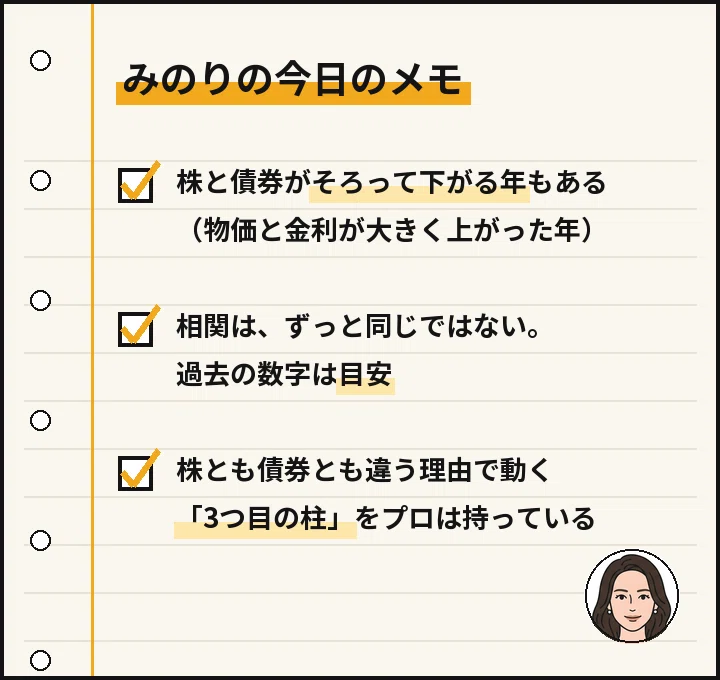
– There are years when both stocks and bonds fall together (years when prices and interest rates rose significantly)
– Correlation is not always the same. Past figures are just a guideline
– Professionals have a ‘third pillar’ that moves for reasons different from both stocks and bonds
Next time: “Why pension funds and university endowments hold ‘alternatives'”
Series “The Well-Balanced Working Investor”
Part 0 Nice to meet you / Part 1 What is the source of anxiety? / Part 2 The effect of diversification is determined by ‘correlation’ / Part 3 What are bonds? / Part 4 This article / Part 5 Why pension funds and university endowments hold ‘alternatives’ (next episode)
Source: GPIF “FY2022 Q3 Investment Status (Preliminary Report)” (Asset-specific return rates for FY2022 Q2 = July-September 2022), MSCI “MSCI ACWI Index (USD)” Factsheet (2022 annual rate of return, net, USD-denominated)
Real estate crowdfunding offerings can be viewed in date order on Kurakare.