
What REITs solved
The introduction of the REIT framework in 2014 marked the most consequential structural shift in India’s commercial real estate. Listed REITs allow investors to own incomeproducing commercial spaces like tech parks, retail malls, warehouses and data centres for a nominal sum. A REIT pools these assets together in a professionally run setup and fetches regular cash flows through rental yields, while also offering capital appreciation. For investors, REITs offer a structured way to invest in real estate assets. Rajani Tandale, Senior Vice President (Mutual Funds) undefined a REIT unit costs a few hundred rupees.”
So far, six REITs with combined gross asset value of Rs.3.1 trillion are listed. These include Embassy, Brookfield, Nexus, Mindspace, Knowledge Realty and Bagmane. A tight regulatory framework and institutional-grade discipline have ensured tenant quality across REITs remains impeccable. At least 80% of REIT assets, by value, must be completed and rent-generating property—not land or projects under construction.
In recent years, strong office and retail space absorption have provided healthy earnings visibility. All listed REITs boast occupancy levels in excess of 90%. “Further, their contractual rental escalations and rising replacement costs (new tenants pay higher) provide a natural hedge against inflation,” asserts Shravan Sreenivasula, Head – Investment Solutions, Avendus Wealth Management.
Before you continue reading
How financially free are you?
Most people overestimate their financial freedom. Discover your Financial Freedom score through a quick survey

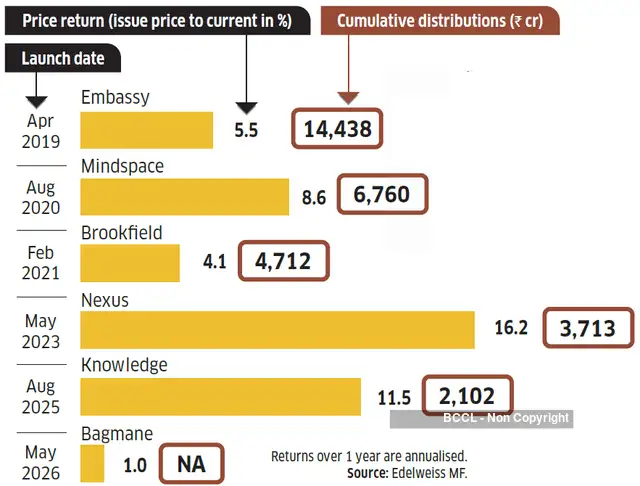
For investors seeking income with growth potential, REITs offer steady cash flows. They are required to distribute at least 90% of their income as cash payouts or dividends to unitholders. This offers a steady stream of income. In recent years, payouts have averaged 7-9% (including capital returned). The listed REITs have so far distributed over Rs.31,700 crore as payouts. Initially, returns from REITs mainly came through distributions. But in recent years, listed REITs have seen healthy capital appreciation, led by a fall in interest rates. When interest rates fall, REIT prices tend to rise, and vice versa. Capital gains in listed REITs have averaged around 8%.
Healthy payouts, decent gains
REITs initially earned by way of distributions, but have seen sizeable capital gains in recent years.
MF wrapper: Solving tax tangle
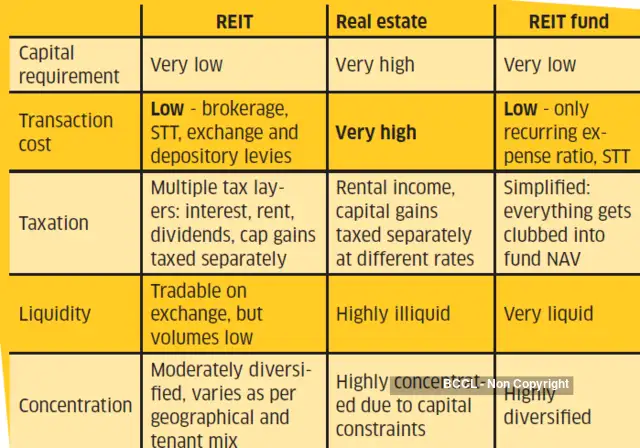
Despite their benefits, REITs have not found widespread acceptance. Tax treatment is a major hurdle. When investing directly in REITs, investors face multiple layers of taxes. Dividends and interest income are taxed at slab rates, in the hands of the investor. REITs also deduct 10% TDS on distributions. Capital gains are taxed separately. REITs were, until recently, classified as hybrid instruments, which made any tax treatment of capital gains unfavourable. Tax calculations are further complicated for REIT distributions in the form of capital repayment. It reduces the cost of acquisition of the REIT units and is considered while computing long-term capital gains (LTCG) at the time of sale.
But two things have now changed. From 1 January 2026, REITs are classified as equity for taxation purposes. This means gains on investments held for more than 12 months qualify as long-term capital gains (LTCG) and are taxed at 12.5%. Further, since July, REITs are eligible for inclusion in equity indices. This now opens the door for mutual fund houses to launch REITfocused schemes.
Putting REITs in a mutual fund wrapper addresses the problem of multiple tax layers. It allows distributions from underlying REITs to compound within the fund instead of being taxed as regular payouts. These are not taxed at the fund level, nor is any TDS levied on REIT mutual funds. Tax will only be levied on the NAV gains at the time of sale. This allows returns to compound without requiring investors to manually reinvest payouts.
Tandale remarks, “Direct REIT distributions come to investors as a mix of dividend and interest components, taxed on a quarterly basis largely at the investor’s slab rate, which is inefficient for anyone in a higher tax bracket. A REIT fund can offer a growth option with equity-like taxation instead, deferring tax to redemption and taxing gains at capital-gains rates rather than slab rates.”
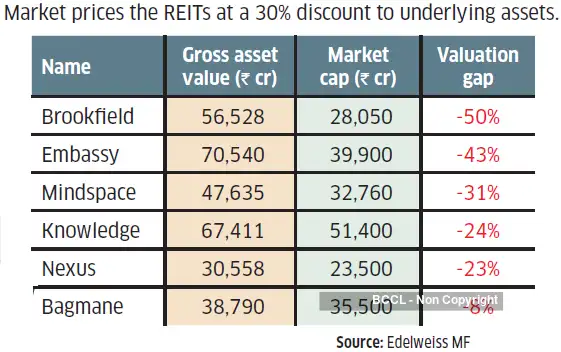
REITs are valued at a hefty discount
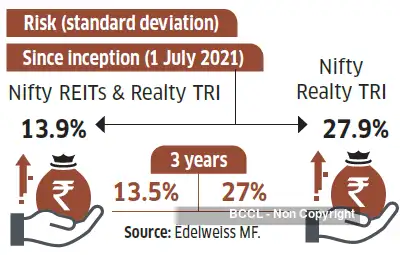
Healthy returns at lower volatility
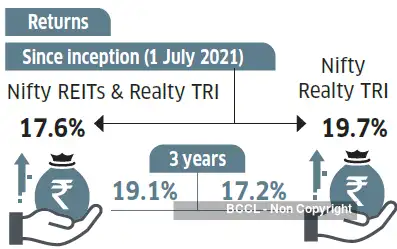
The REITs index has outperformed over the past three years, aided by falling interest rates.
REIT funds differ from listed REITs and physical property
Not the same risk profile
The new REIT-based offering is not a pureplay, dedicated REIT fund. The fund tracks the Nifty REITs & Realty Total Return Index, which houses a mix of listed REITs as well as listed real estate companies. While it comprises 15 securities, the minimum exposure to REITs is 60%, while the rest sits in realty stocks. Currently, the listed stocks in the index include real estate developers like DLF, Lodha Developers, Godrej Properties, Prestige Estates, Phoenix Mills and Oberoi Realty, among others.
India simply doesn’t have enough listed REITs yet to build a diversified REIT-only basket. With just six REITs listed versus roughly 196 listed equity REITs in the US, there are presently just not enough ingredients to build a pure-play REIT index. In India, the three biggest REITs by market cap account for a whopping 74% of the total universe, compared to 16% in the US. This makes any REIT-only basket a very concentrated proposition. So, a REITs-plus-stocks construct allows a midway path to offering exposure to REITs.
But this naturally changes the risk-construct of the fund. Tandale observes, “Realty developer stocks are cyclical, growthoriented businesses tied to launch cycles and leverage, which is a very different risk profile from REITs, which are contractually required to pay out steady, lease-backed income. So, a fund that’s 40% realty stocks will be meaningfully more volatile than a pure-REIT product, and investors should be prepared to hold through cycles rather than expect the low-volatility, bond-like behaviour that REITs alone would offer.”
However, this fund construct will not remain so forever. The underlying index itself is designed to allow for higher allocation to REITs as the listed universe expands. The index methodology currently allows room for the top 15 REITs ranked by free-float market cap. Only six are currently listed, so the remaining are currently occupied by listed realty stocks. As more REITs get listed, the index will replace the smaller realty stocks within the basket. Tandale points out, “As more REITs list in India, the design intent is for that realty-stock allocation to shrink and REIT weight to rise, so today’s 40:60 mix is better understood as a transitional construct than a permanent one.”
The share of REITs in the index will also increase on rising free float market cap of existing REITs, points out Radhika Gupta, MD & CEO at Edelweiss MF. “As price discovery in listed REITs improves, the freefloat market cap will increase. This will allow REITs to occupy bigger space in the index.”
Navigating illiquidity
Taxation is not the only problem in individual REITs. Even as these are traded on exchanges, liquidity in listed REITs remains very low. Tandale asserts, “REIT trading volumes are genuinely thin next to the broader market. Even Embassy REIT, India’s largest and most liquid REIT, trades at a fraction of what a single large-cap Nifty stock does on an average day.”
For a REITs-focused fund that promises daily redemptions, this underlying illiquidity can be an issue. However, experts maintain that this is sufficiently addressed by the index construct, with up to 40% exposure to listed realty stocks, that enjoy much higher liquidity. “That realty-stock sleeve effectively acts as a liquidity buffer for day-to-day redemptions, even while the REIT sleeve itself remains comparatively illiquid,” Tandale points out. However, even that buffer cannot be taken for granted, she maintains. The real test will come in a scenario where real estate sentiment turns broadly negative, and both sleeves get hit together. That’s when the liquidity assumption will come under stress.
Experts insist that liquidity in REITs is rising gradually and will improve going forward. The reclassification of REITs as equity and broader institutional participation will bring higher trading volumes. A REIT fund offers an additional layer of liquidity management, avers Sreenivasula. “The fund manager can manage cash flows and trading execution across multiple securities. Although ultimate liquidity is still linked to the underlying REIT market, a diversified fund structure generally provides a smoother investor experience than holding a single relatively less liquid REIT.”
Further, a REIT fund takes away the concentration risk associated with individual REITs. While REITs invest in a pool of real estate assets, these may be concentrated in a specific geography or asset type. For instance, Nexus Select is concentrated in retail mall assets, even as Mindspace is in office parks. Embassy is diversified across offices, hotels and solar parks, but geographically concentrated in Bengaluru. Gupta avers, “In individual REITs, investors may be exposed to risks associated with the distinct profile of underlying assets.”
Should you invest?
Experts maintain that REIT funds offer a compelling opportunity to diversify portfolios. The Nifty REITs & Realty Total Returns Index has generated an annualised return of 19.1% in the past three years, compared to 17.2% gains in the Nifty Realty TRI. This return has come at half the volatility of the pure-play realty index (see table).
Sreenivasula insists, “REITs offer portfolio diversification through their relatively lower volatility compared to equities, while still delivering superior long-term growth potential than traditional fixed income investments.”
However, these should not be considered a substitute for either equities or real estate. Tandale asserts, “REITs have historically shown low correlation with pure equities, since their cash flows are anchored in long-term leases rather than earnings cycles, which makes them a useful diversifier in a broader portfolio rather than a substitute for either equities or physical real estate.”
Experts insist that there is a lot of potential for value unlocking in REITs. Gupta observes, “Together the six trusts own Rs.3.1 trillion of property, but the market prices them at only Rs.2.1 trillion. This gap between gross asset value and market capitalisation suggests that REITs are priced at a hefty discount, even after accounting for borrowings as the LTV ( Loan to Value Ratio) is about 18-32%.” Besides, at 230 million sq ft, the footprint covered by existing REITs accounts for only a fraction of India’s total grade-A office stock. This is a significant addressable gap that leaves a lot of room for growth.
REITs-based mutual funds offer this opportunity in a convenient wrapper that brings added liquidity and diversification in a tax-efficient manner. These finally let you own a piece of the expanding commercial skyline with the same comfort as buying a diversified equity fund. Just keep in mind that these behave like market-linked investments, and not like physical property. Limit REIT exposure to around 10% of the portfolio.