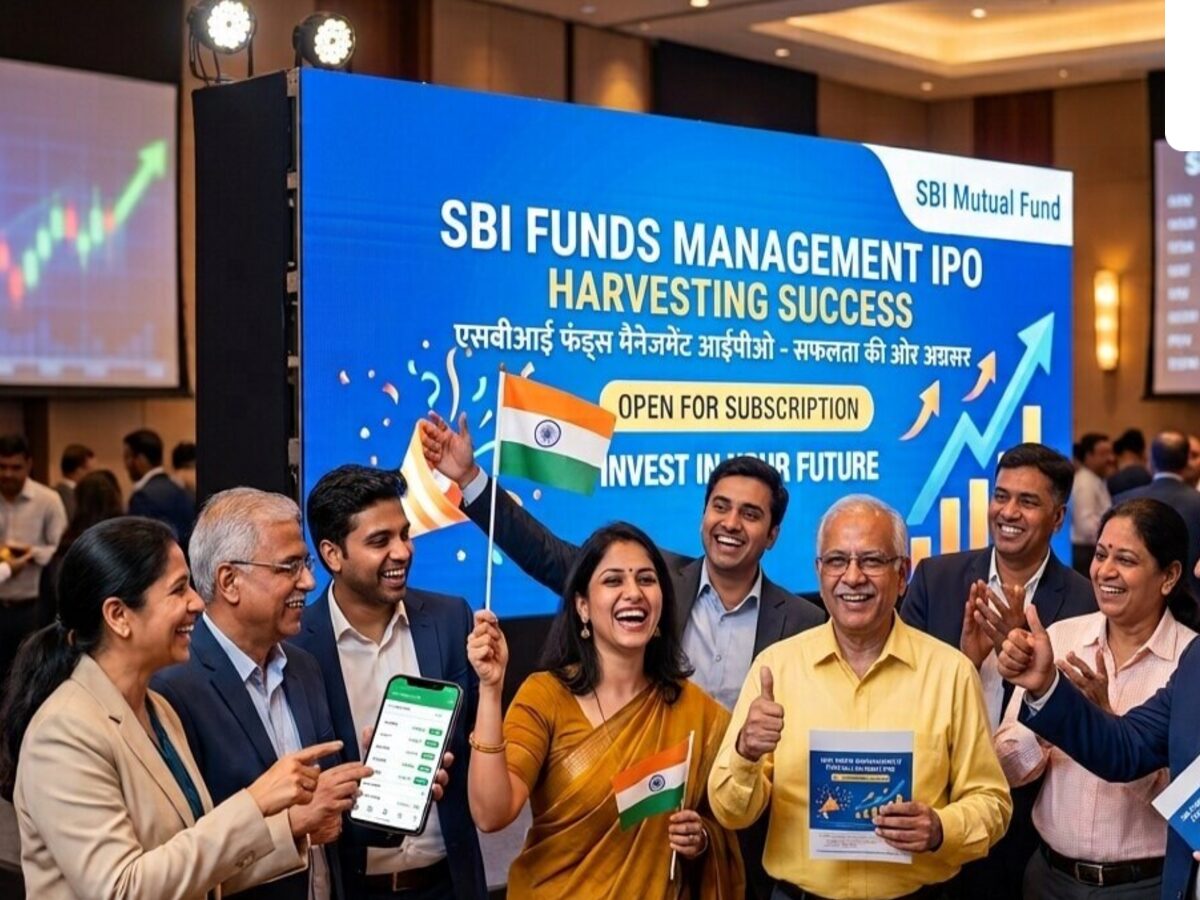
SBI Funds Management’s ₹9,795-crore IPO opened for public subscription on 14 July and will remain open until 16 July. The IPO is priced between ₹545 and ₹574 per equity share, with investors required to apply for a minimum of 26 shares and in multiples thereof.
Ahead of the issue opening, SBI Funds Management IPO garnered ₹2,663 crore from anchor investors, witnessing robust participation from leading global and domestic institutional investors.
The company allotted 4,63,93,095 equity shares to 129 anchor investors at ₹574 per share, the upper end of the price band, according to a stock exchange filing.
The anchor investor list featured prominent global names, including GIC, Abu Dhabi Investment Authority (ADIA), Capital World Investors, BlackRock, Fidelity Management & Research, Goldman Sachs Asset Management, and Norges Bank. Domestic institutional investors such as Life Insurance Corporation of India (LIC), HDFC Mutual Fund, ICICI Prudential Mutual Fund, Nippon India Mutual Fund, and HDFC Life Insurance also participated in the anchor book.
Under the issue structure, SBI Funds Management IPO has reserved up to 50% of the net offer for qualified institutional buyers (QIBs), at least 15% for non-institutional investors (NIIs), and at least 35% for retail investors. Eligible employees are being offered a ₹54 discount per equity share.
According to the tentative schedule, the SBI Funds Management IPO allotment is expected to be finalised on 17 July. Refunds are likely to be initiated on 20 July, with shares credited to successful applicants’ demat accounts on the same day. The SBI Funds Management share price is expected to debut on the BSE and NSE on 21 July.
Founded in 1987, SBI Funds Management is India’s largest asset management company (AMC) by quarterly average assets under management (QAAUM). As of 31 March 2026, it managed mutual fund QAAUM of ₹12.51 lakh crore, accounting for a 15.3% market share.
Including its portfolio management services (PMS) and alternative investment fund (AIF) mandates, the company’s total QAAUM stood at ₹29.46 lakh crore at the end of FY26.
SBI Funds Management IPO GMP today
SBI Funds Management IPO GMP today is +88. Considering the upper end of the IPO price band and the current premium in the grey market, the estimated listing price of the SBI Funds Management share was ₹662 apiece, which is 15.33% higher than the IPO price of ₹574.
According to grey market trends observed over the past 10 sessions, the present GMP of ₹88 signifies a pessimistic trend. Throughout this timeframe, the GMP fluctuated between ₹75 and ₹140, according to expert analysis.
SBI Funds Management IPO subscription status
SBI Funds IPO subscription status was 2.59x on day 2, so far. The retail portion is subscribed 1.54x, and NII portion has been booked 6.05x, QIBs portion received 1.42x bids. The employee portion was subscribed 2.16x, and the shareholder portion was booked 3.67x.
The company has received bids for 32,24,07,800 shares against 12,45,63,536 shares on offer at 16:00 IST, according to BSE data.
SBI Funds IPO subscription status was 68% on day 1. The retail portion is subscribed 62%, and NII portion has been booked 1.39x, QIBs portion received 8% bids. The employee portion was subscribed 1.02x, and the shareholder portion was booked 1.04x.
SBI Funds Management IPO review
Swastika Investmart has assigned a “Subscribe for Long Term” rating to the SBI Funds Management IPO. The brokerage cited the company’s leadership as India’s largest asset management company with ₹12.5 lakh crore in QAAUM, a strong SIP franchise and the extensive SBI-Amundi distribution network. It noted that the IPO is priced at 38.1x FY26 EPS, below the industry average of 41.6x, making valuations reasonable.
Swastika also highlighted the company’s robust profitability, with a 43.02% return on net worth (RoNW) and an 81.56% EBITDA margin, while cautioning that the issue is a 100% offer for sale (OFS) with no fresh capital infusion, making future earnings dependent on AUM growth and market performance.
Nirmal Bang Securities has recommended “Subscribe” from a medium- to long-term perspective. The brokerage believes SBI Mutual Fund is attractively valued relative to listed peers, backed by its ₹12.5 lakh crore QAAUM, 15.3% market share, diversified product portfolio and strong retail and institutional franchise.
It highlighted that active mutual fund QAAUM grew at a 22% CAGR during FY24-FY26, while the company maintained a 20% cost-to-income ratio, 79% EBITDA margin and 51% return on equity (ROE), outperforming peers such as HDFC AMC and Nippon Life AMC. At 33.6x EV/EBITDA and 38.1x P/E, the IPO is available at a discount to HDFC AMC and ICICI Prudential AMC, the brokerage said.
Anand Rathi has also assigned a “Subscribe” rating. The brokerage said that at the upper price band, the IPO is valued at 38.1x FY26 earnings and 33.6x EV/EBITDA, implying a post-issue market capitalisation of around ₹1.17 lakh crore. While it believes the issue is fully priced, Anand Rathi said the company’s strong business fundamentals justify a subscription.
Arihant Capital Markets has recommended “Subscribe for Long Term”, citing structural growth drivers such as rising financialisation, increasing SIP penetration and SBI’s extensive distribution network, which are expected to support sustained AUM growth and annuity-like fee income. The brokerage noted that earnings remain sensitive to market volatility and regulatory changes, particularly around total expense ratios (TER) and distribution norms. However, it believes the IPO valuation of 38.1x FY26 EPS and 19.6x price-to-book is in line with or at a discount to larger listed peers, supported by the company’s market leadership and superior return ratios.
BP Equities has given the IPO a “Subscribe” rating. The brokerage said the company’s lower profitability relative to some peers is largely a function of its product mix rather than franchise quality. It expects management’s strategy of increasing the share of higher-yield active equity, specialised investment products and alternative assets to improve fee realisations, profitability and return ratios over the medium term. Given SBI Funds Management’s market leadership, unmatched distribution franchise and valuation below the listed peer average, BP Equities sees scope for a valuation re-rating.
Kantilal Chhaganlal Securities has recommended investors apply for both listing gains and long-term investment. The brokerage highlighted the company’s strong return on equity of 43.02% in FY26, its dominant AMC franchise, strong parentage and favourable industry outlook. It expects the mutual fund industry to grow at a 16-17% CAGR and industry-wide SIP AUM to expand at 23-26% CAGR during FY26-FY29. Valued at 38.06x FY26 earnings, the brokerage believes SBI Funds Management is fairly valued compared with its listed peers.
SBI Funds Management IPO details
The SBI Funds Management IPO is entirely an OFS of up to 17.09 crore equity shares by existing shareholders State Bank of India (SBI) and Amundi, aggregating up to ₹9,795 crore at the upper end of the price band.
Under the OFS, SBI will offload a 6.3% stake, while Amundi will divest 3.7% of its holding in the asset management company.
Following the listing, SBI’s stake in SBI Funds Management will decline from 61.76% to 55.46%, while Amundi’s holding will reduce to 32.56%.
The IPO size was initially proposed at ₹11,693 crore, but was subsequently reduced after the company raised around ₹1,880 crore through a pre-IPO placement.
At the upper price band of ₹574 per share, SBI Funds Management commands an implied valuation of approximately ₹1.2 lakh crore.
The public issue is being managed by a syndicate of book-running lead managers comprising Kotak Mahindra Capital Company, Axis Capital, BofA Securities India, HSBC Securities and Capital Markets (India), ICICI Securities, Jefferies India, JM Financial, Motilal Oswal Investment Advisors, and SBI Capital Markets.
Disclaimer: This story is for educational purposes only. The views and recommendations above are those of individual analysts or broking companies, not Mint. We advise investors to check with certified experts before making any investment decisions.