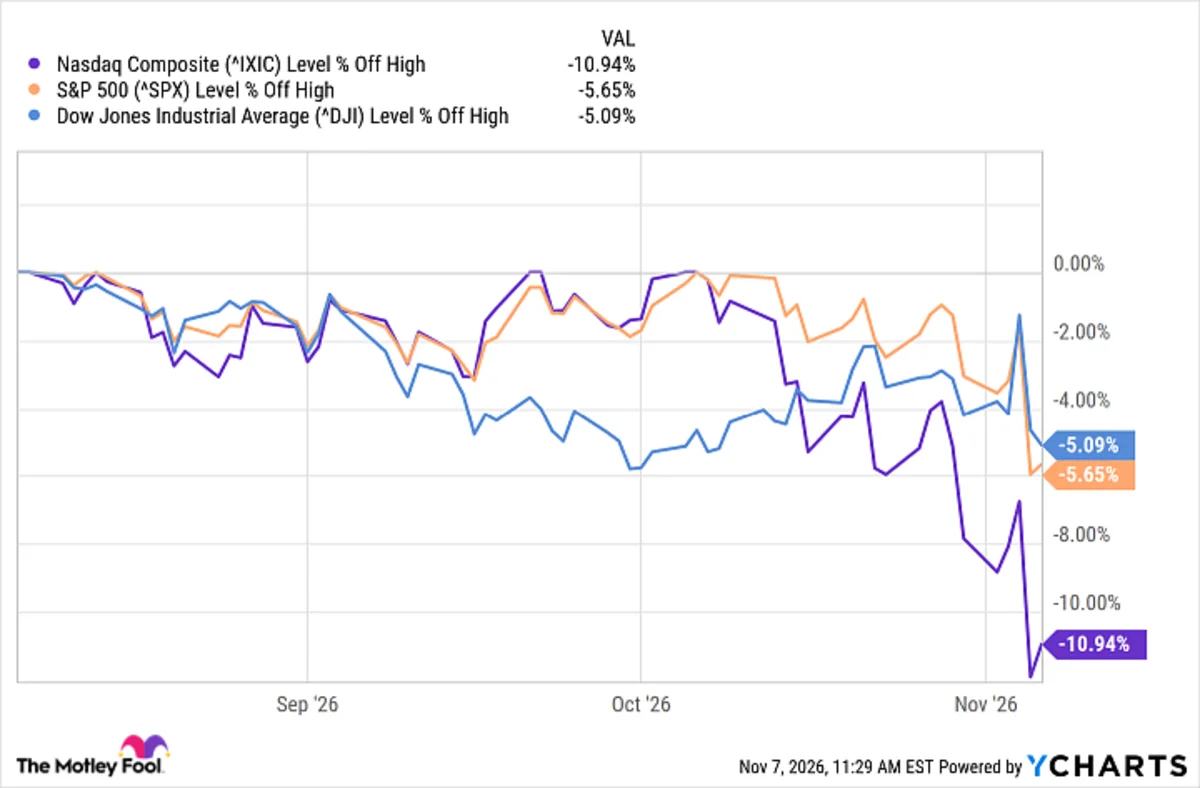
The Nasdaq Composite (NASDAQINDEX: ^IXIC) is one of the U.S. stock market’s big three indexes (along with the S&P 500 and Dow Jones Industrial Average), and the tech-leaning index has easily been the best performer of the bunch over the past couple of decades.
Unfortunately, the past month hasn’t been ideal. As of market close on Nov. 6, the index is down nearly 11% from its Oct. 6 high, officially entering correction territory after a 5.5% single-day plunge on Nov. 5.
Missed AI’s “Act 1”? Act 2 Could Be 16x Bigger. Most investors think they missed the AI boat because they didn’t buy Nvidia in 2005. But according to our analysts, we’re only at the end of “Act 1″—the R&D phase. “Act 2” is the global rollout. Continue »
Many popular ETFs have followed the Nasdaq Composite’s path, including the Vanguard Information Technology ETF (NYSEMKT: VGT) and the Invesco Nasdaq 100 ETF (NASDAQ: QQQM). If you have extra cash to buy the dip, now is a good time to start or add to your position.
The Vanguard Information Technology ETF is one of the more pure-play tech ETFs on the market. It holds 318 stocks across nearly every tech industry you can imagine, from semiconductors to software to hardware to internet services to IT consulting, and more.
VGT’s holdings are weighted by market capitalization, so larger companies account for more than smaller ones. This has made it very top-heavy, as megacap tech stocks have surged in valuation during the current AI boom. Nvidia, Apple, and Microsoft alone account for over 44% of VGT:
When the concentration works in VGT’s favor, it really works in its favor. When it works against it, it can be brutal. Nvidia being down over 21% in the past month has played a role in VGT being down nearly 13% in that time. However, Nvidia being up over 300% over the past three years also has a lot to do with VGT being up 75%.
One thing to note about VGT is that because it only holds stocks from the information technology (tech) sector, it misses some notable companies that are considered tech but technically fall into other sectors.
Amazon is in the consumer discretionary sector because most of its revenue comes from e-commerce, and Alphabet and Meta Platforms are in the communication services sector because the bulk of their revenue comes from digital advertising.
Missing those companies may not be ideal for an investor seeking broad tech exposure, but if you’re comfortable with the pure-play approach, VGT is a great long-term option. The tech sector will likely be one of the more volatile sectors during a market downturn, but its long-term growth potential is strong.
The Invesco Nasdaq 100 ETF isn’t a pure-play tech ETF like VGT, but the tech sector accounts for about 64% of it. It mirrors the Nasdaq-100, an index that tracks the largest 100 non-financial companies trading on the Nasdaq stock exchange.
Although QQQM is tech-heavy, it holds staples like Walmart, Costco Wholesale, PepsiCo, and dozens of others. This slight diversification lets you take advantage of tech growth while having other sectors that can act as a bit of a crutch. QQQM is also down over 10% in the past month, but it’s still slightly outperforming the Nasdaq Composite index.
QQQM has only been around since October 2020 (it’s the cheaper alternative to the Invesco QQQ Trust ETF), but the Nasdaq-100 has been around since 1985. Over the past decade, it has averaged 19.2% annual returns.
It may be overly optimistic to expect those same returns to continue over the next decade, but there’s no reason to believe the Nasdaq-100 (and therefore QQQM) won’t continue to perform well over the long term. Some investors fear an AI bubble, but the companies leading the way for QQQM are built to withstand, regardless of how the current AI boom plays out:
If you’re looking at both VGT and QQQM, note their overlap. QQQM holds plenty of non-tech stocks that VGT doesn’t, but there’s still a lot of overlap at the top, which could leave you overconcentrated in megacap tech companies.
Should you buy stock in Vanguard Information Technology ETF right now?
Before you buy stock in Vanguard Information Technology ETF, consider this:
The Motley Fool Stock Advisor analyst team just identified what they believe are the 10 best stocks for investors to buy now… and Vanguard Information Technology ETF wasn’t one of them. The 10 stocks that made the cut could produce monster returns in the coming years.
Consider when Netflix made this list on December 17, 2004… if you invested $1,000 at the time of our recommendation, you’d have $341,157!* Or when Nvidia made this list on April 15, 2005… if you invested $1,000 at the time of our recommendation, you’d have $1,037,753!*
Now, it’s worth noting Stock Advisor’s total average return is 834% — a market-crushing outperformance compared to 207% for the S&P 500. Don’t miss the latest top 10 list, available with Stock Advisor, and join an investing community built by individual investors for individual investors.
Stefon Walters has positions in Apple, Microsoft, and Walmart. The Motley Fool has positions in and recommends Advanced Micro Devices, Alphabet, Amazon, Apple, Broadcom, Cisco Systems, Costco Wholesale, Intel, Lam Research, Meta Platforms, Micron Technology, Microsoft, Nvidia, Palantir Technologies, and Walmart. The Motley Fool has a disclosure policy.