The yield on 10-year U.S. Treasury bonds is 5.24%. This is more than 2% higher than the level of Japanese 10-year government bonds (approximately 3%).
“If I’m going to buy government bonds anyway, wouldn’t it be better to buy U.S. Treasury bonds with higher yields?”
I think many people feel this way.
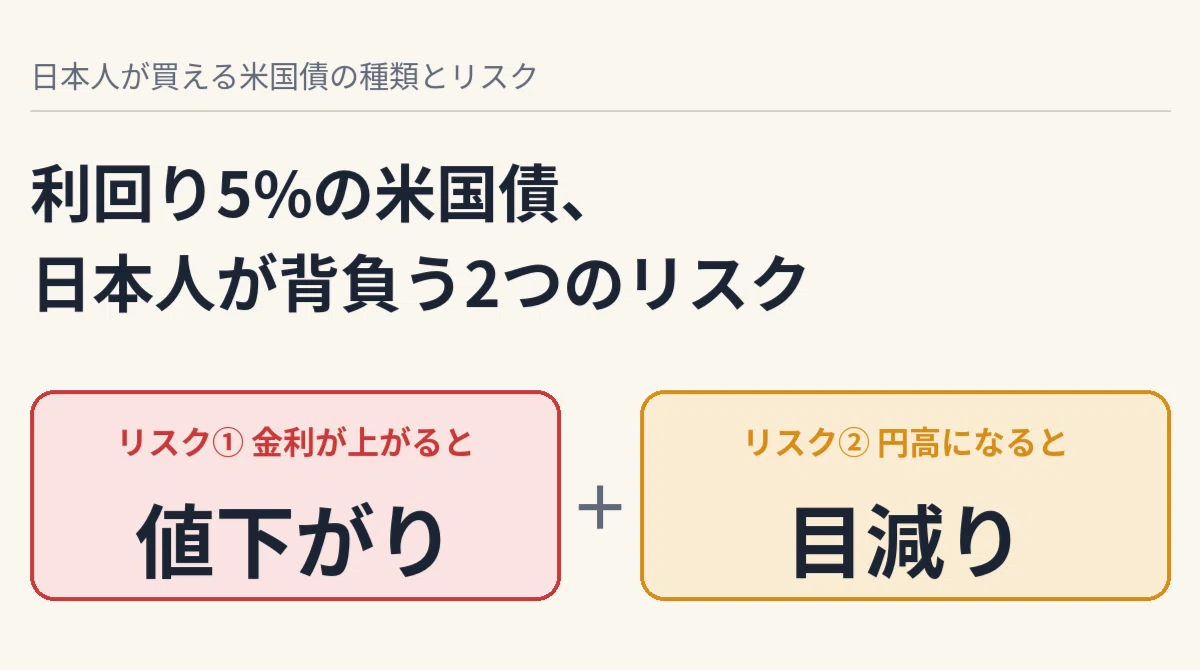
However, unlike the Japanese ‘government bonds for individuals’ introduced in the previous article, U.S. Treasury bonds that do not depreciate even when interest rates rise are almost impossible for Japanese people to buy. All U.S. Treasury bonds that Japanese people can buy carry two risks: the risk of price decline and the risk of loss due to exchange rate fluctuations.
In this article, after organizing the types of U.S. Treasury bonds available to Japanese people and the two risks with numbers, I will consider whether you should choose zero-coupon bonds or coupon-bearing bonds right now.
All U.S. Treasury bonds available to Japanese people are ‘market-traded government bonds’

There are mainly two types of U.S. Treasury bonds that can be purchased through Japanese securities companies.
1. Coupon-bearing bonds
These are standard U.S. Treasury bonds that pay interest every six months. Like Japan’s ‘new over-the-counter government bonds,’ they are traded on the market, and if you sell them midway, the price will be the market value at that time.
2. Zero-coupon bonds (STRIPS)
Instead of receiving interest along the way, these are U.S. Treasury bonds that can be bought for less than their face value and are redeemed at face value upon maturity. Because there is no interest, the price movement is greater than that of coupon-bearing bonds even for the same maturity.
In addition, there are U.S. Treasury bond investment trusts and ETFs, but since their contents are U.S. Treasury bonds traded on the market, their prices fluctuate daily.
By the way, the U.S. also has ‘savings bonds’ similar to Japan’s government bonds for individuals, but these are products for people living in the U.S., and Japanese people living in Japan basically cannot buy them.
Risk 1: Price decline when interest rates rise
The mechanism is the same as for Japanese government bonds. When interest rates rise, the interest rates on newly issued government bonds become higher, so existing government bonds with lower interest rates must lower their prices to be sold.

This is the rate of price decline if interest rates rise immediately after purchasing at the current yield.
-
2-year bond: approx. -1.9% with +1%
-
10-year bond: approx. -7.4% with +1%, approx. -14.1% with +2%
-
30-year bond: approx. -13.0% with +1%, approx. -23.5% with +2%
-
10-year zero-coupon bond: approx. -9.3% with +1%
-
30-year zero-coupon bond: +1% results in approx. -25.3%
A 30-year zero-coupon bond will drop in value by nearly a quarter if interest rates rise by just 1%. While you will get the face value back if you hold it until maturity, it poses a significant risk for those who might need to sell it midway.
How much can you withstand with interest?
It is true that because U.S. Treasury bonds have higher yields, they have a thicker ‘interest cushion’ than Japanese government bonds.
If you buy a 10-year bond and hold it for one year, you receive approximately 5.2% in interest. If interest rates rise by about 0.75%, one year’s worth of interest will be wiped out by the price decline. The range of tolerance is slightly wider than that of Japanese 10-year government bonds (which would be wiped out at about 0.4%).
Risk ②: Erosion due to exchange rates
For Japanese investors, this might be the bigger factor.
Both the interest and principal of U.S. Treasury bonds are paid in dollars. Even if the price of the U.S. Treasury bond does not change by a single yen, if the yen strengthens, the amount you receive when converted to yen will decrease.

Here is the profit and loss in yen (excluding interest) if interest rates and exchange rates move immediately after buying 1 million yen worth of 10-year bonds.
-
Interest rate unchanged: Exchange rate unchanged 0% / 5% yen appreciation -5.0% / 10% yen appreciation -10.0%
-
Interest rate +1%: Exchange rate unchanged -7.4% / 5% yen appreciation -12.0% / 10% yen appreciation -16.6%
It is not uncommon for the dollar-yen rate to move by about 10% in a year. Just a 5% appreciation of the yen will almost wipe out one year’s worth of interest (about 5%) from the U.S. Treasury bond. If interest rates rise, causing a price drop, and this is compounded by a stronger yen, your 1 million yen could effectively become about 830,000 yen.
Zero-coupon bonds vs. coupon-bearing bonds: Which should you choose now?
From here on, these are my thoughts as an investor.
In conclusion, which is best depends on ‘when you will use the money’ and ‘how you view future interest rates’. With that in mind, specifically for the current situation,
-
Money for which the usage time is fixed and can be held until maturity → Zero-coupon bonds are advantageous
-
Money that might be sold midway or for which you want to receive interest as income → Coupon-bearing bonds
is what I think.
Strength of zero-coupon bonds: Ability to lock in a high yield until maturity
Since zero-coupon bonds do not pay interest midway, they continue to grow with compound interest at the current yield until maturity.
-
If you buy a 10-year zero-coupon bond at 5.24%, at maturity you will have about 1.68 times
-
If you buy a 20-year zero-coupon bond at 5.65%, at maturity you will have about 3.05 times
On the other hand, with coupon-bearing bonds, you need to reinvest the interest you receive yourself, and the final result will vary depending on the interest rates at that time.

These are the amounts received after 10 years when reinvesting the interest from a 10-year coupon-bearing bond (5.24% coupon rate).
-
If interest rates fall to 3% case: about 1.61 times
-
If interest rates remain at 5.24%: about 1.68 times (same as zero-coupon bonds)
-
If interest rates rise to 7% case: about 1.74 times
In other words, if you think US interest rates will fall in the future, zero-coupon bonds are more advantageous. Not only can you lock in a high yield, but the price appreciation if you sell mid-term will also be greater. Now that US Treasury yields are in the 5% range, I believe this ‘value of locking in’ is significant.
People who should still choose coupon-bearing bonds
-
Those who think interest rates will rise further: If interest rates rise by 1%, a 30-year zero-coupon bond will fall in price by about 25%, while a 30-year coupon-bearing bond will fall by about 13%. With coupon-bearing bonds, you can reinvest the interest received at higher rates.
-
Those who might sell mid-term: Zero-coupon bonds have high price volatility, and selling at the wrong time can lead to significant losses. Also, the spread between the buy and sell prices at brokerage firms may be wider than for coupon-bearing bonds.
-
Those who want to receive interest as income: If you are using it for living expenses in retirement or to supplement your pension, coupon-bearing bonds that pay interest every six months are easier to use.
Issues specific to Japanese investors: Exchange rates and taxes
-
Exchange rates: With zero-coupon bonds, you receive the principal and interest in a lump sum in dollars at maturity. If the yen is strong at that time, the entire amount is affected. With coupon-bearing bonds, you receive dollars every six months, so you can stagger the timing of converting them to yen.
-
Taxes: Zero-coupon bonds are taxed in a lump sum at maturity (or upon sale). Since they are not taxed while they are growing, compound interest works more effectively. With coupon-bearing bonds, about 20% is taxed every time you receive interest.
Thinking by purpose

-
When the time to use the money is fixed 10-20 years from now (education expenses, retirement funds, etc.) → Zero-coupon bonds
-
I want regular income → Coupon-bearing bonds
-
I might sell midway / I think interest rates will rise further → Shorter-term coupon-bearing bonds
To summarize my thoughts, now that U.S. Treasury yields are in the 5% range, if you have money you can hold until maturity, there is significant value in locking in the yield with zero-coupon bonds. However, you must be prepared to accept the impact of price fluctuations and exchange rates all at once at maturity.
Summary: Differences in risk between Japanese Government Bonds and U.S. Treasury bonds

-
Japanese individual government bonds: Price decline risk: None / Exchange rate risk: None / Available to Japanese investors: Yes
-
Japanese over-the-counter government bonds: Price decline risk: Yes / Exchange rate risk: None / Available to Japanese investors: Yes
-
U.S. Treasury bonds (via securities companies): Price decline risk: Yes / Exchange rate risk: Yes / Available to Japanese investors: Yes
The fact that U.S. Treasury yields are higher than Japanese government bond yields can be said to be a premium for taking on exchange rate risk for Japanese investors.
Today’s takeaway
The high yields of U.S. Treasury bonds come as a set with two risks: ‘price decline’ and ‘exchange rates’.
With that in mind, how should you take advantage of the current 5% range yields? If you can hold until maturity, lock it in with zero-coupon bonds; if you might need the money sooner, hold flexibly with coupon-bearing bonds. Try choosing by working backward from ‘how many years from now, and for what purpose, will I use this money?’
Read more:
Note: This article is for informational purposes only and does not recommend buying or selling any specific security. U.S. Treasury yields are values published by the U.S. Department of the Treasury as of October 9, 2026. The price decline rate is a trial calculation based on purchasing a government bond with the same interest rate as the yield at face value (for zero-coupon bonds, purchased at the same yield). The impact of exchange rates is a trial calculation for the principal portion excluding interest, and the trial calculation for interest reinvestment does not account for taxes. Tax treatment varies depending on individual circumstances.