Hello, this is the editor-in-chief of Sirius.
Suddenly, do you have any of these things in your home?
・A gold necklace you bought a long time ago
・A ring inherited from your grandmother
・A single earring that lost its pair
・A broken bracelet
・A wedding ring you no longer use
・Accessories sleeping in the back of a drawer
“I don’t use it anymore, so maybe I’ll throw it away.”
If you are thinking that, please wait a moment.
Those accessories might actually be worth anywhere from tens of thousands to over 100,000 yen.
Of course, not all accessories have high value.
However, it is not rare for items to have value in the material itself, even if they look old, are broken, or are not brand-name products.
I have been involved in the reuse business for a long time and have learned about the value of various second-hand goods and precious metals.
There is something I feel strongly about through that experience.
That is,
“Not knowing the value of an item can lead to the biggest losses.”
That is what I mean.
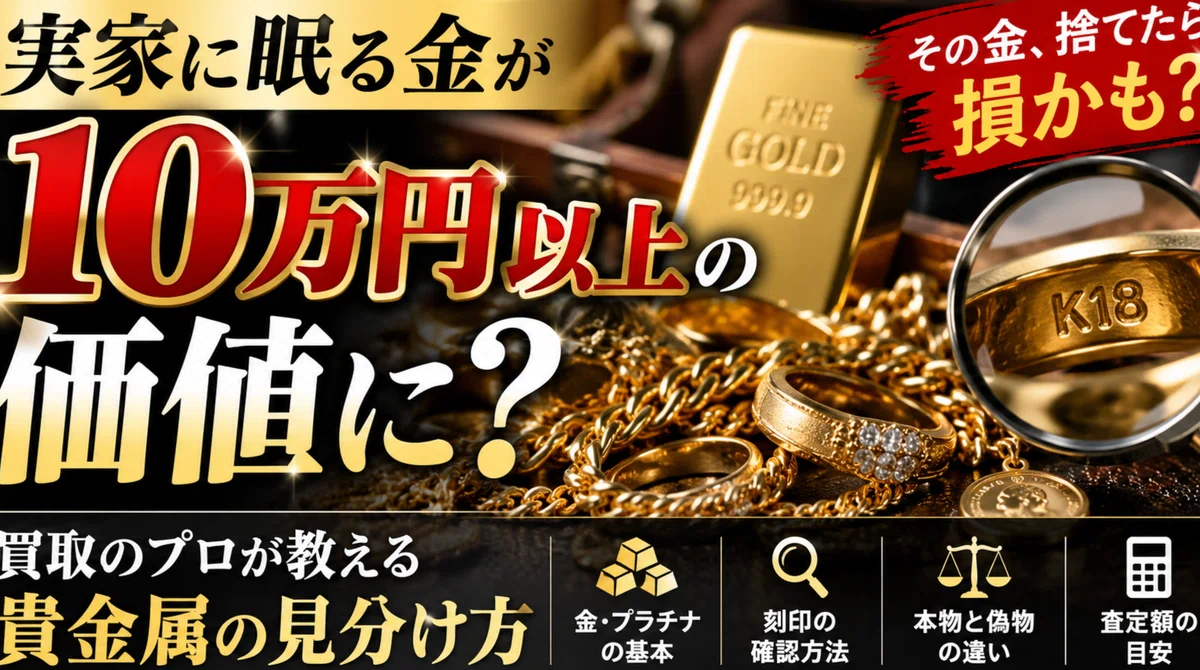
Starting today, for 14 days, I will explain knowledge about precious metals, brand bags, antiques, and more in a way that is easy for beginners to understand.
In this first installment, I will introduce the basic ways to identify gold and platinum.
You can read this article for free until the end.
Please read on while thinking about the accessories in your home.
1. Why do old accessories have high value?
First, you need to know that precious metals have “value in the material itself.”
For example, clothing and general home appliances are products whose value often decreases depending on their age and condition.
However, gold and platinum are a little different.
Even if a necklace is broken or a ring is deformed, the material value as a precious metal may still remain.
Gold, in particular, is in demand across a wide range of fields, not just for jewelry, but also for electronic components, industrial use, and asset holding.
Therefore, if the market price of gold rises, the material value of accessories purchased long ago may also increase.
For example, a gold necklace purchased 20 years ago.
Even if the purchase price at the time was 30,000 yen, depending on the current gold market price, weight, and purity, it may fetch a higher purchase price.
However, the purchase price and the purchase-back price are different things.
Because design fees, brand value, and retailer profits are included in the purchase price, it does not necessarily mean it will sell for more than the purchase price.
What is important is not the amount you paid, but
knowing ‘how much value that material has right now.’
is what you need to know.
2. The first step to knowing the value of gold is the ‘hallmark’
When identifying gold products, the first thing you want to check is the hallmark.
A hallmark is a small number or letter inscribed on accessories and the like.
For necklaces, it may be inscribed near the clasp, and for rings, it may be on the inside.
Here are some representative hallmarks.
K24, 999, 999.9
These indicate high-purity gold close to pure gold.
Generally, K24 means pure gold, 999 indicates a gold content of 99.9%, and 999.9 indicates 99.99%.
You may see these on ingots or gold coins.
K18 / 750
This indicates that the gold content is 75%.
The remaining 25% consists of metals such as silver or copper.
This is a material often seen in Japanese jewelry as well.
K14 / 585
This indicates that the gold content is approximately 58.5%.
It is also used in accessories made overseas.
K10 / 417
This indicates that the gold content is approximately 41.7%.
It is also seen in accessories in a relatively affordable price range.
The important point here is that even with the same weight, the gold content differs depending on the purity.
For example, in the case of a 10g accessory:
・Equivalent to K24: Gold content is almost 10g
・K18: Gold content is approximately 7.5g
・K14: Gold content is approximately 5.85g
・K10: Gold content is approximately 4.17g
In other words, even with the same 10g, there will be a difference in the appraisal price.
However, just because there is a hallmark does not necessarily mean it is genuine.
There are products with fake hallmarks, and products where the hallmark does not match the actual material.
A hallmark is an important clue, but you cannot determine authenticity based on that alone.
3. Is ‘K18GP’ not 18-karat gold?
This is a point I want you to be especially careful about.
When checking the hallmark on an accessory, there are cases where letters follow the K18.
For example,
・K18GP
・K24GP
・18KGP
・K18GF
These are the types of hallmarks.
In fact, these have a different meaning than typical solid K18 accessories.
What is GP?
GP stands for Gold Plated, which generally means gold-plated.
These are products with a layer of gold on the surface, and they are not made of 18-karat gold all the way through.
Therefore, they do not have the same material value as regular K18 products.
What is GF?
GF stands for Gold Filled, which generally means gold-filled.
While the manufacturing method and thickness of the gold layer differ from gold plating, these are also not made of gold all the way through.
The valuation of gold-filled products varies depending on the amount of the gold layer and the handling conditions of the buyer.
What I want you to remember here is that
‘K18’ and ‘K18GP’ do not mean the exact same thing
.
However, just because there is no GP or GF hallmark does not necessarily mean it is a solid gold product.
Checking the hallmark is merely the first step of an appraisal.
4. Five ways to check precious metals at home
From here, I will introduce points you can check without using specialized equipment.
However, these are not tests that determine whether something is genuine.
Please use this information only as a reference before submitting items for appraisal.
1. Check for hallmarks
First, check the inside of rings or the clasps of necklaces.
If the characters are small, using your smartphone’s zoom function will make them easier to see.
If you see markings like K18, 750, or Pt900, be sure to record them.
2. Check for magnetic reaction
Gold and platinum themselves are not metals that are strongly attracted to ordinary magnets.
Therefore, if an item reacts strongly to a magnet, it may contain magnetic metals such as iron.
However, some clasps may contain iron springs inside.
Also, there are fakes that do not react to magnets.
Not reacting to a magnet does not mean it is genuine.
3. Check the weight
Weight is important in the appraisal of precious metals.
If you have a digital kitchen scale at home, it is useful to check the weight.
However, if the item has gemstones or parts made of other materials, not all of that weight is gold or platinum.
4. Check the color and surface condition
Gold products come in various colors, such as yellow gold, pink gold, and white gold.
Also, accessories used for a long time may change in appearance due to scratches and dirt.
It is dangerous to judge purity or authenticity based on color alone.
If the surface is peeling and the base metal is visible, it is a clue to suspect that it is a plated product.
5. Look for accessories from the time of purchase
If you still have the warranty, purchase receipt, or certificate of authenticity, check them as well.
However, the presence of accessories does not in itself guarantee authenticity.
Conversely, there are precious metals that can be bought even without accessories.
Furthermore, please avoid scratching, applying chemicals to, or heating the jewelry with fire.
Doing so may damage the product or lead to injury.
5. How much is a 10g gold necklace actually worth?
Here, I will explain the mechanism of the appraisal amount in concrete terms.
For example, suppose you have a 10g K18 necklace.
If the purchase price for K18 on that day is 15,000 yen per gram.
10g × 15,000 yen = 150,000 yen
Under these conditions, the calculated purchase price would be 150,000 yen.
*15,000 yen is a hypothetical unit price used to explain the calculation and does not indicate the current actual market purchase price.
Also, in an actual appraisal, the amount will change depending on the following conditions:
・Gold market price on the day of appraisal
・Purity of the gold
・Net weight of the precious metal part
・Presence of gemstones or other materials
・Fees and pricing set by the buyer
・Brand value as a product
When comparing purchase prices, it is important not to just look at ‘what the gold market price is,’ but to confirm the final payment amount.
6. Don’t forget about platinum
In addition to gold, platinum is also a representative precious metal.
It is often used in wedding rings and engagement rings, so there is a possibility it is sleeping in your home.
Representative hallmarks are as follows.
・Pt999: Approx. 99.9% platinum
・Pt950: 95% platinum
・Pt900: 90% platinum
・Pt850: 85% platinum
What you should be careful about here is that platinum is not necessarily always more expensive than gold.
The price of precious metals fluctuates depending on supply and demand, market conditions, and other factors.
The price relationship between gold and platinum also varies depending on the time period.
Also, not all silver-colored accessories are platinum.
There are many materials that look similar, such as white gold, silver, and stainless steel.
We plan to explain the differences between these in detail on DAY 4.
7. In the world of purchasing, what matters is not ‘whether it looks expensive’
From here on, I will speak from the perspective of the reuse business.
When judging the value of second-hand goods, it is dangerous to judge based solely on appearance.
For example, suppose you have the following two items.
A: A gold-colored necklace with ornate decorations
B: A simple, scratched K18 ring
At first glance, A might look more expensive.
However, if A is gold-plated and B is genuine K18, B may have a higher material value.
Conversely, even if it is a gold-plated accessory, if it is a rare product from a famous brand, its value as a brand item may be recognized.
In other words, in an appraisal,
you need to consider ‘material value’ and ‘value as a product’ separately
.
This is a concept common not only to precious metals but also to brand bags, watches, and antiques.
Just because it uses expensive materials does not mean it will always be high-priced, nor does it mean that inexpensive materials have no value.
It is important to make a comprehensive judgment based on demand, rarity, condition, authenticity, and sales channels.
8. Three things you must check before selling precious metals
Finally, I would like to share three points with those who are thinking of selling precious metals.
1. Check the purchase price for the day
The prices of gold and platinum fluctuate daily.
Before selling, please check the purchase price for that day.
In particular, since the unit price differs between K24 and K18, it is important to compare them by purity.
2. If possible, get appraisals from multiple dealers
Even for the same item, the appraisal price may vary depending on the dealer.
Check appraisal fees, handling charges, and cancellation conditions as well.
Also, not just the appraisal amount, but the clarity of the explanation and the terms of the transaction are important factors in your decision.
3. Check the details before selling
When selling precious metals, check the weight, purity, unit price, deducted fees, and the final purchase amount.
If there is anything you do not understand, please ask on the spot.
If you are not satisfied, there is no need to force a sale.
Especially with door-to-door purchasing, the legal cooling-off system may apply depending on the transaction details.
To ensure peace of mind in your transaction, it is important to understand the conditions in advance.
9. With knowledge, your perspective on things changes
What I wanted to convey this time is not just techniques for selling gold at a high price.
What I really want to convey is,
“Depending on whether you have the knowledge, the perceived value of the same item can change.”
That is what this is about.
A ring casually sitting in a drawer.
A necklace you no longer use.
Accessories inherited from your grandparents.
Among them, there might be items with unexpected value sleeping away.
Of course, not everything is a high-value item.
However, if you throw them away without checking their value, you will never realize that potential.
I believe one of the charms of the reuse business is this ability to ‘discover unknown value’.
And this knowledge is a great weapon not only for those selling items, but also for those who want to start a reuse business.
Next time preview | DAY 2
[What is the difference between K18 and K24? The world of gold that cannot be judged by hallmarks alone]
Next time, we will dig deeper into the purity of gold.
・The difference between K24 and K18 ・Why price changes based on gold purity ・Hallmarks on overseas accessories ・The existence of fake hallmarks that look real ・Points to check during appraisal
“If it says K18, is it definitely real?”
I will answer that question as well.
If you found this article even slightly helpful, please be sure to ‘like’ and follow.
In this series, we will be releasing practical knowledge about the value and authenticity of precious metals, brand bags, and antiques for free over 14 days.
Whether you want to challenge yourself in the reuse business or just want to know the value of things in your home, let’s learn together.
Thank you for reading until the end.
Sirius Editor-in-Chief