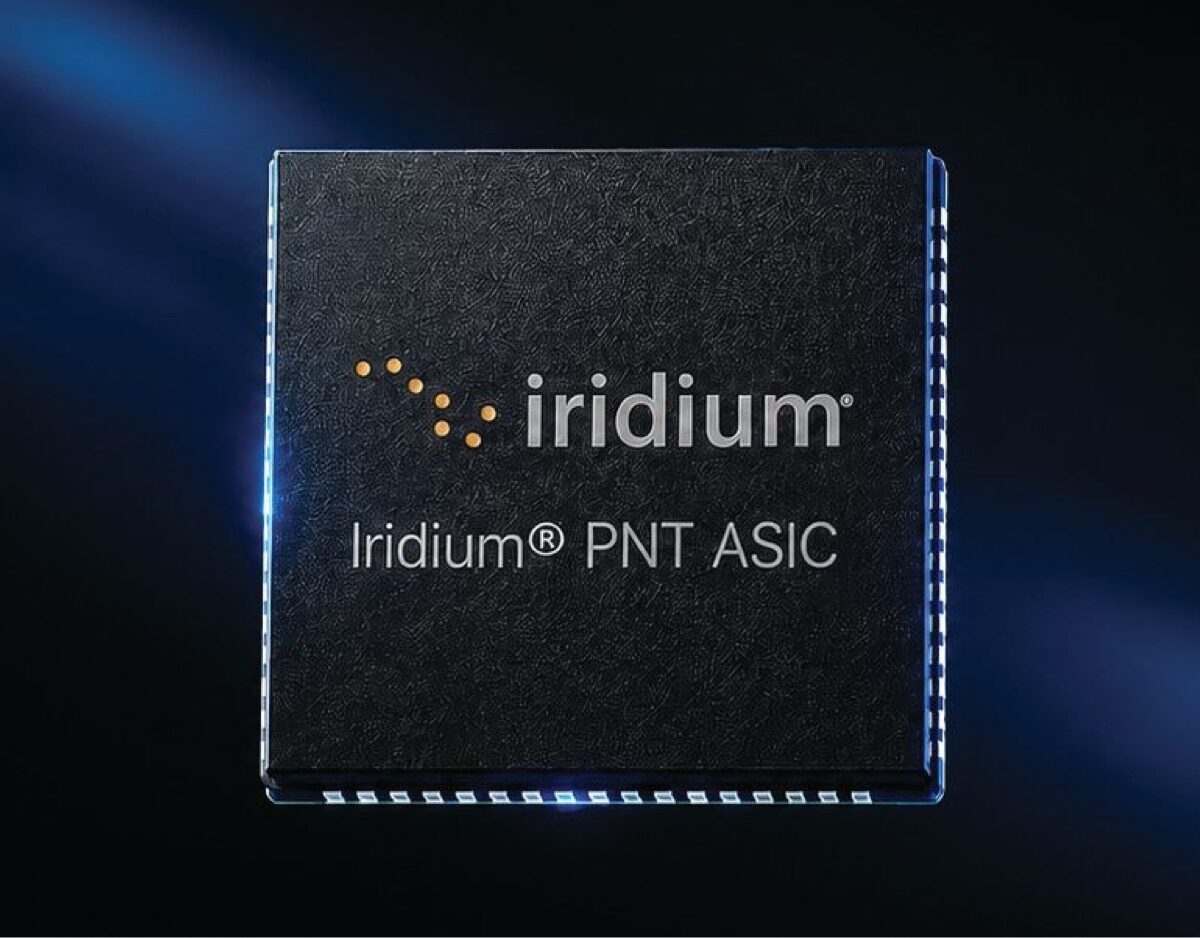
Less than a year after unveiling its PNT ASIC, Iridium has moved the technology into commercial production. Early integration experience suggests resilient positioning and timing can be added to GNSS-dependent systems with farless complexity than many OEMs expected—potentially changing when and how engineers address GNSS risk.
When Iridium first introduced its PNT ASIC in late 2025, the proposition was straightforward but ambitious: move resilient positioning, navigation and timing out of the realm of specialized external hardware and into silicon that OEMs could design directly into products.
At the time, the question was whether the idea could translate into a production-ready component that engineers would actually adopt.
That question has now changed.
The ASIC is commercially available, shipments have begun, and Iridium says more than 150 organizations worldwide expressed interest following the original announcement. Those conversations span maritime, aviation, critical infrastructure, telecom, unmanned systems and other GNSS-dependent applications.
For Iridium VP of PNT Rohit Braggs, the significance is less about another product milestone than the transition from interest to implementation.
“We wanted to put a stake in the ground that this is real,” Braggs said. “You can deploy it, and it works.”
The challenge for resilient PNT has never been awareness alone. Engineers increasingly understand the vulnerability of GNSS to interference, jamming and spoofing. The harder problem has been fitting additional resilience into product architectures without creating unacceptable penalties in complexity, antenna design, qualification or development time.
Iridium designed the ASIC specifically to lower that barrier.
And one of the most important lessons learned from early partner evaluations is that integration proved easier than many expected, Braggs said.
“One of the consistent pieces of feedback was that the RF story was simpler than expected,” he said. “If you’re familiar with integrating a GPS chip, this should feel familiar.”
In some cases, he said, partners were able to move from receiving the technology to successful evaluation in days rather than weeks or months.
“They came back and said, ‘We put it in. It works. What’s next?’”
That is a consequential shift. It moves the discussion from whether resilient PNT can be added to a product to how quickly a manufacturer can make it part of the customer value proposition.
“The conversation moved away from technical evaluation and more toward how they could start promising it to their end customers,” Braggs said.
AVAILABLE NOW
For OEM engineering teams, the Iridium PNT ASIC is no longer a roadmap item. Evaluation kits, development packs and production ASICs are available now, along with integration guidance and reference-design support.
The ASIC is intended to fit alongside existing GNSS receivers, inertial sensors and timing components rather than replace them. It can provide PNT and timing outputs that can be incorporated into a broader navigation architecture.
Braggs emphasized that complementary role.
“It’s not a replacement,” he said. “GPS and GNSS are critical. In normal operation, this is a complementary add-on.”
The value changes as the operating environment changes.
Under normal conditions, Iridium PNT can provide an independent reference alongside GNSS. In degraded or potentially spoofed conditions, that independent source becomes a means of comparison and risk management. In a denied environment, it can become part of the architecture used to maintain continuity when GNSS is unavailable or cannot be trusted.
That framing is important because resilience is increasingly less about finding a single replacement for GNSS and more about building systems capable of comparing, validating and combining multiple sources.
A DIFFERENT KIND OF SECOND SOURCE
Braggs points to three characteristics that define Iridium’s proposition: global coverage, higher-power L-band signals and cryptographic protection.
The service runs over Iridium’s 66-satellite low Earth orbit (LEO) constellation, providing global reach independent of terrestrial infrastructure. Because the satellites operate much closer to Earth than GNSS constellations, Iridium’s PNT signal reaches the user at substantially higher power.
For integrators, L-band also brings a level of familiarity.
“People who are familiar with GPS just get it,” Braggs said. “They know L-band and they understand the benefits.”
Those benefits include practical antenna form factors and improved usability in environments such as urban canyons, foliage and some indoor settings, where conventional GNSS can be more difficult to receive reliably.
The other element is trust.
Iridium PNT uses a cryptographically protected signal, providing an independent authenticated reference that can help a system identify when GNSS-derived information may be unreliable or deceptive.
Braggs reduces the technical case to a simple comparison.
“It’s global, it’s higher-power L-band, and it’s cryptographically encoded,” he said. “Those are the big pieces people need to take away.”
NEW SILICON, MATURE INFRASTRUCTURE
The ASIC itself is new. The infrastructure behind it is not.
Iridium has operated its satellite network for more than two decades, while its satellite time and location capability has more than 10 years of operational history behind it. That matters because the engineering team evaluating the ASIC is not relying on a service that still exists primarily as a future architecture.
Accumulated operating experience has helped shape both the technical roadmap and the infrastructure supporting the service, Braggs said.
“There is a decade of data that has helped reinforce the technical roadmap,” he said. “This isn’t an engineering evaluation prototype.”
Iridium’s Associate Director, PNT Market Intelligence Kirk Vespestad, who has been closely involved with the Iridium PNT effort, put the point more bluntly.
“This is not a science experiment,” he said. “This is a fully productionized service.”
There is another layer to that maturity. Vespestad noted the service has already transitioned across generations of Iridium’s satellite constellation—a largely invisible change to users, but one that demonstrates the difference between an operational service and a promising future capability.
That heritage may become increasingly important as OEMs compare complementary PNT technologies. A chip can be evaluated on a bench. A resilient PNT service must also be judged by the constellation, ground segment, signal availability, operating history and support ecosystem behind it.
THE ROADMAP DECISION
The larger issue for OEMs has become less technical than strategic.
Every engineering organization works against a product roadmap. Adding another receiver, sensor or silicon component affects board design, sourcing, software, testing, qualification and production. The decision to add resilient PNT competes with every other feature and requirement already in the development cycle.
But the calculus changes when the threat is increasing while the integration burden is falling.
GNSS interference is becoming more visible across aviation, maritime, critical infrastructure and autonomous systems. At the same time, Iridium is attempting to make an independent PNT source easier to incorporate at the component level.
That was part of the original design objective.
“Lowering the bar of access was a design goal from the beginning,” Braggs told Inside GNSS when the ASIC was first announced.
Commercial availability now puts that premise to a practical test.
The first integrations are already beginning to show what can happen when engineers have that additional source available. Solace Communications is incorporating the ASIC into a multi-source assured PNT architecture combining Iridium PNT, GNSS and inertial sensing. Skyband Systems is integrating it with onboard inertial sensing in an aviation system designed to provide crews with additional awareness when GNSS is jammed or spoofed.
The significance is not simply that two companies have adopted a new component. It is what becomes possible when engineers gain another authenticated PNT input they can combine, compare and adjudicate with the sensors already in their systems.
A year ago, moving resilient PNT into silicon was still a promise. Today, it is a production decision.
The ASIC is available. The service is operational. The integration path is familiar. Iridium has placed another authenticated PNT source within reach of the engineers designing the next generation of aviation, maritime, timing, critical infrastructure and autonomous systems.
That creates an immediate opportunity. OEMs can build resilience into products now—while their next-generation systems are still being designed—rather than waiting until GNSS interference forces them to act. They can give engineering teams a new source to combine, compare and validate, opening the door to more reliable products and entirely new capabilities.
That may be the real significance of Iridium moving resilience into silicon: putting it into the hands of engineers at precisely the moment the market is ready to use it.