

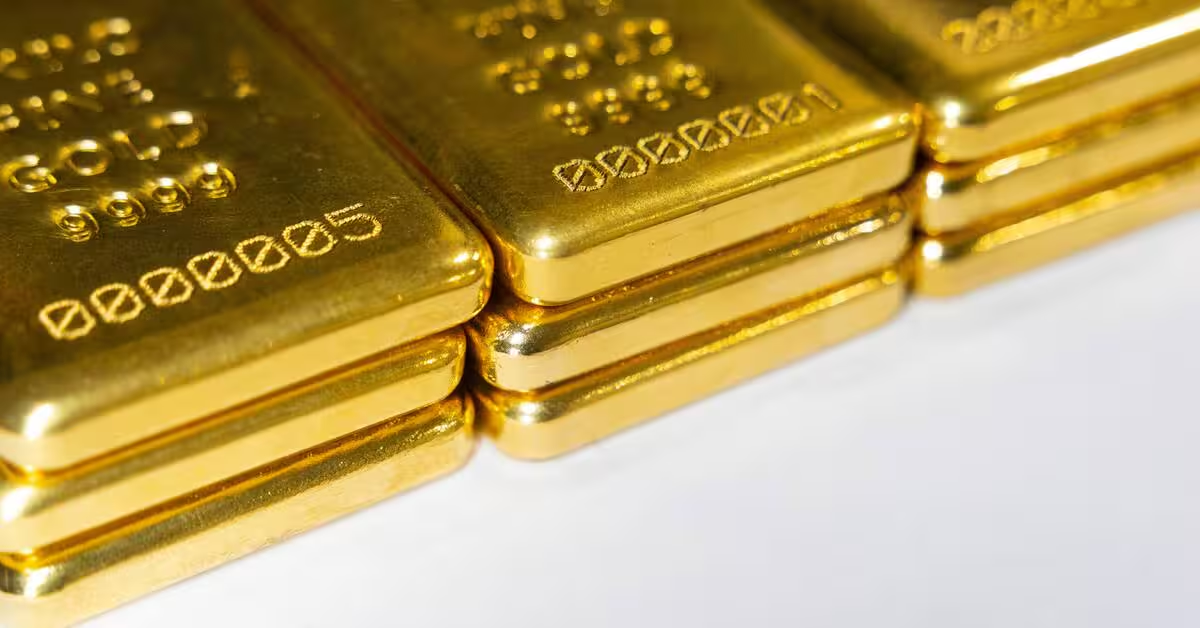
DSP Mutual Fund is preparing to increase its exposure to gold and silver through its DSP Multi Asset Omni Fund of Funds, setting staggered buying levels to accumulate the metals if international prices decline further.
The fund, which has maintained an exposure of around 10% to gold and almost no exposure to silver against a benchmark allocation of 20% to precious metals, has started reducing this underweight position. Its benchmark allocation comprises 15% gold and 5% silver.
Decide the allocation rules in advance. Execute when prices reach predefined levels. This removes the need to make fresh decisions during market volatility.
For silver, the fund has started with an allocation addition of 0.5% of the portfolio at prices just below $47 an ounce. It plans to add another 0.5 percentage point for every $2 per ounce decline. Once silver falls below $42, it intends to accelerate purchases to 1% tranches, along with an additional one-time 0.5 percentage point purchase.
According to the fund’s illustration, a decline in silver prices from $47 to $37 an ounce would result in cumulative additions of 5% to the portfolio.
For gold, the fund plans to add 0.5 percentage point of portfolio exposure at prices close to $3,850 an ounce, followed by another 0.5 percentage point for every $100 per ounce decline. The subsequent buying levels are $3,800, $3,700, $3,600 and so on.
The fund said the objective was not to predict the bottom of the market but to accumulate systematically as prices decline. It may slow down or accelerate purchases depending on market conditions. If prices do not fall further, it may not add aggressively or could reconsider the strategy.
Why is the fund changing its stance?
DSP said it had maintained a significant underweight position in precious metals since the fund’s launch, even as several comparable multi-asset strategies remained neutral or overweight.
Its exposure stood at approximately 10% in gold exchange-traded funds (ETFs), with almost no silver exposure, against the benchmark’s 20% allocation. The fund had briefly held 0.5% in a silver ETF, bought in June 2026 when international silver prices were around $56 an ounce and sold near $70.
The fund now believes valuations offer a more attractive entry point, although it would prefer a larger discount to its estimated fair value before making substantial additions.
According to DSP’s valuation framework, gold was trading at approximately $3,799.8 an ounce against its estimated fair value of $4,484, implying a discount of 15.3%. Silver was trading at around $46 an ounce against an estimated fair value of $64, a discount of 28.4%.
The framework uses factors including the stock of above-ground gold, US and European money supply, and the historical gold-to-silver ratio. For silver, it uses a gold-to-silver ratio of 60 to derive a theoretical price range of $53-$75 an ounce, with a midpoint of $64.
The fund said it would ideally like to see a discount of more than 20% to its theoretical fair-value estimates. Its staggered buying plan is designed to build exposure at progressively lower prices rather than make a large allocation at current levels.
Gold prices are at a 15% discount to our framework prices, while Silver is at a 28% discount.
Five factors shaping the precious metals strategy
DSP has outlined five broad considerations behind its decision to begin accumulating precious metals.
First, it is looking for a meaningful discount to its estimated fair value. While silver’s discount was already around 28%, gold’s was approximately 15% in the fund’s calculations.
Second, it is watching whether at least one of three major sources of demand — jewellery buyers, central banks or ETFs — becomes a stronger incremental buyer. The fund said central-bank purchases were stable but not rising, ETF demand remained strong, and jewellery demand was weak. It expects jewellery demand could stabilise following a correction in prices.
Third, it is tracking the US dollar index (DXY). A stronger dollar could put pressure on precious metals prices and create opportunities for the fund to add at lower levels. DSP described dollar strength as a short-term headwind and one of the factors that could help its accumulation strategy.
Fourth, for silver, it is monitoring the gold-to-silver ratio. The fund began its additions when the ratio was close to 82 and said it would prefer levels above the 80-85 range, alongside the other conditions in its framework.
Finally, it is looking for signs of rapid selling followed by lower participation in futures and ETF markets. DSP said gold and silver were showing some of their most oversold readings, although prices could become even more oversold.
Import duty changes could alter buying pace
The fund has also identified changes in India’s import duty on precious metals as a factor that could influence its purchases.
According to DSP, the effective import duty on gold and silver was increased from 6% to 15% on May 13, 2026. The nine-percentage-point increase raised domestic landed costs by approximately 8.5%, assuming international prices and exchange rates remained unchanged.
A reduction or removal of the duty could lower domestic gold and silver prices, including the net asset values (NAVs) of ETFs holding these metals. DSP said such a move could create more attractive entry points for fresh purchases and may prompt it to accelerate accumulation, depending on valuations and market conditions.
The fund said the additional allocation to gold and silver would largely be funded by reducing debt exposure and rebalancing some equity-sector allocations.
For investors, the shift is significant because it marks a change in the fund’s asset-allocation stance after an extended period of underweight exposure to precious metals. However, the proposed purchases are conditional on prices and market signals. The fund has not announced an immediate move to its full benchmark allocation or a fixed timeline for completing the process.
The strategy is specific to DSP Multi Asset Omni Fund of Funds and should not be interpreted as a recommendation for investors to increase their own gold or silver holdings.