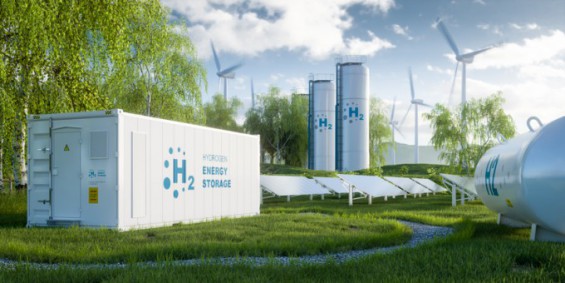
The KIST research team has opened a path to reducing green hydrogen production costs with a mesh nanotube electrode that uses one-tenth the amount of iridium. Credit: Getty Images Bank
A Korean research team has developed a technology that uses only one-tenth the amount of the rare metal iridium in water electrolysis electrodes, a key component for green hydrogen production, while securing equivalent performance and long-term durability. This is drawing attention as a clue to solving the iridium supply shortage, a chronic bottleneck in the commercialization of green hydrogen.
The Korea Institute of Science and Technology (KIST) announced on the 3rd that a joint research team, led by Dr. Hyun-seo Park, a principal researcher at the Hydrogen and Fuel Cell Research Center, and Professor Young-eun Sung of Seoul National University’s School of Chemical and Biological Engineering, has created a water electrolysis electrode that maintains an uninterrupted current flow with significantly less iridium by arranging iridium nanotubes (IrNTs) in a mesh structure. The research results were recently published in the international journal ‘Applied Catalysis B: Environment and Energy’.
Green hydrogen is considered a key energy source for carbon neutrality because it is produced by splitting water with electricity generated from renewable energy, emitting no carbon at all. Iridium is essential for the water electrolysis electrodes that separate water into hydrogen and oxygen, but it is more expensive than platinum and its global annual production is only a few tens of tons, which has been an obstacle to large-scale facility expansion.
Conventionally, iridium was used by spraying it in nanoparticle form onto the electrode. For the particles to conduct electricity, they had to be packed densely together, requiring a large amount of iridium. Reducing the amount of iridium created gaps between the particles, which interrupted the current path and caused a sharp drop in performance.
The research team shifted its thinking from particles to tubes. Using silver nanowires as a template, they coated them with a thin layer of iridium and then dissolved the silver inside to create hollow iridium nanotubes. When the nanotubes are stacked on a support, they form a mesh structure, much like entangled tree branches. Because their long bodies connect with each other, an uninterrupted current can flow with a much smaller amount of material.
The advantages were clearly confirmed in experiments. While conventional nanoparticle electrodes required more than 350 micrograms (㎍, 1 ㎍ is one-millionth of a gram) of iridium per square centimeter (cm²), the nanotube electrode achieved equivalent electrical connectivity with just 31.3 ㎍.
Experiments starkly revealed the advantages of this structure. While conventional nanoparticle electrodes needed over 350 micrograms of iridium per 1 cm² to function properly, the nanotube electrode achieved the same level of electrical connection with just 31.3 micrograms. In other words, it delivered equivalent performance with less than one-tenth the amount.
The research team verified not only the performance but also the durability. Through a 40-day long-term operation test, they identified the stages of electrode degradation and presented a specific figure for the optimal amount of iridium that satisfies both performance and lifespan. Under these conditions, the electrode maintained 98.3% of its initial performance even after 30 days of operation.
“Beyond achieving high performance with less iridium, we have quantitatively presented the structural conditions necessary for long-term operation,” said Principal Researcher Hyun-seo Park. “We expect this to be used as a commercial design standard for low-precious-metal water electrolysis electrodes.”
doi.org/10.1016/j.apcatb.2026.126744
Copyright ⓒ DongA Science. All rights reserved.