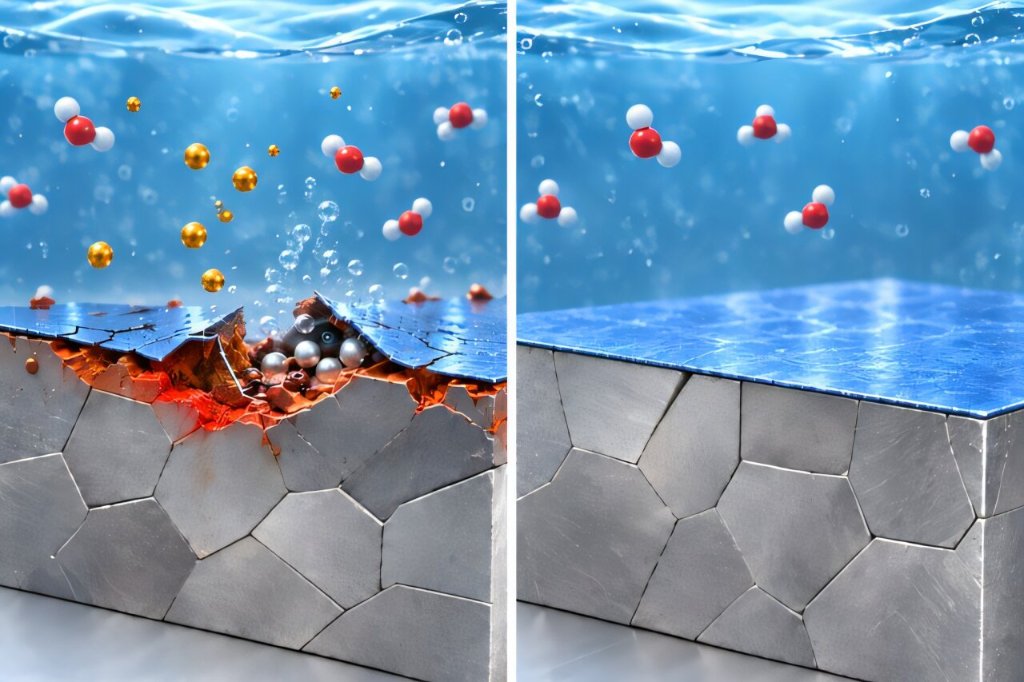

A protective platinum coating much thinner than those commonly used in industry performed well in laboratory tests of hydrogen-production components.
Researchers found that a 24-nanometer layer could protect titanium while maintaining electrical conductivity under the conditions studied.
Compared with a 200-nanometer coating, that thickness could reduce platinum use in the protective layer by about 88%. Because platinum is costly, the finding points to a possible way to make water-splitting equipment less expensive.
Researchers at Vienna University of Technology examined how thin coatings respond to electrochemical stress. Their study, published in ACS Applied Materials & Interfaces, focused on protective surfaces rather than demonstrating an 88% reduction in the cost of an entire hydrogen plant.
Water electrolysis uses electricity to split water into hydrogen and oxygen. In one common design, a membrane allows positively charged hydrogen particles to move between electrodes, where hydrogen gas is produced.
Inside this equipment, metal components face a corrosive environment. They must remain mechanically sound and conduct electricity efficiently, even as chemical reactions threaten to dissolve metal or create insulating layers on its surface.
Components called bipolar plates help support the system, carry electrical current and guide the flow of water and gases. They can account for up to 30% of system costs, making their materials and protective coatings an important target for improvement.
Titanium resists corrosion well, but it develops an oxide layer that obstructs electrical current. A platinum coating provides a conductive, corrosion-resistant surface that protects the underlying titanium.
The researchers compared very thin platinum layers and analyzed the material before and after exposure to demanding electrochemical conditions. They wanted to determine whether a coating that worked initially would remain intact after stress.
An eight-nanometer coating showed substantial problems. Defects grew, and more titanium and platinum entered the surrounding liquid, indicating that the protective layer was breaking down.
Once a defect exposes titanium, oxidation and small oxygen bubbles at the interface can create mechanical stress. That stress can damage or detach more platinum, exposing additional titanium and allowing deterioration to accelerate.
The 24-nanometer coating remained largely intact in the tests and retained good conductivity, with very low release of metal ions. This shows that adding much more platinum is not always necessary to obtain useful protection.
The optimum thickness still depends on manufacturing methods, coating uniformity and operating conditions. The work identifies substantial potential savings in a specific protective layer, but longer-term performance and manufacturing requirements must be considered before thinner coatings can be adopted broadly in commercial electrolyzers.
If you are interested in this topic, please read articles about Scientists Make Clean Hydrogen from Sunlight and Water No Platinum Needed, and Scientists Create Powerful Water Splitting Catalyst for Clean Hydrogen Fuel.
For more information, please see articles about Scientists Find an Unexpected Metal That Could Make Hydrogen Fuel Cheaper, and A New Low Cost Catalyst Could Make Clean Hydrogen Much Cheaper.
Source: Vienna University of Technology.