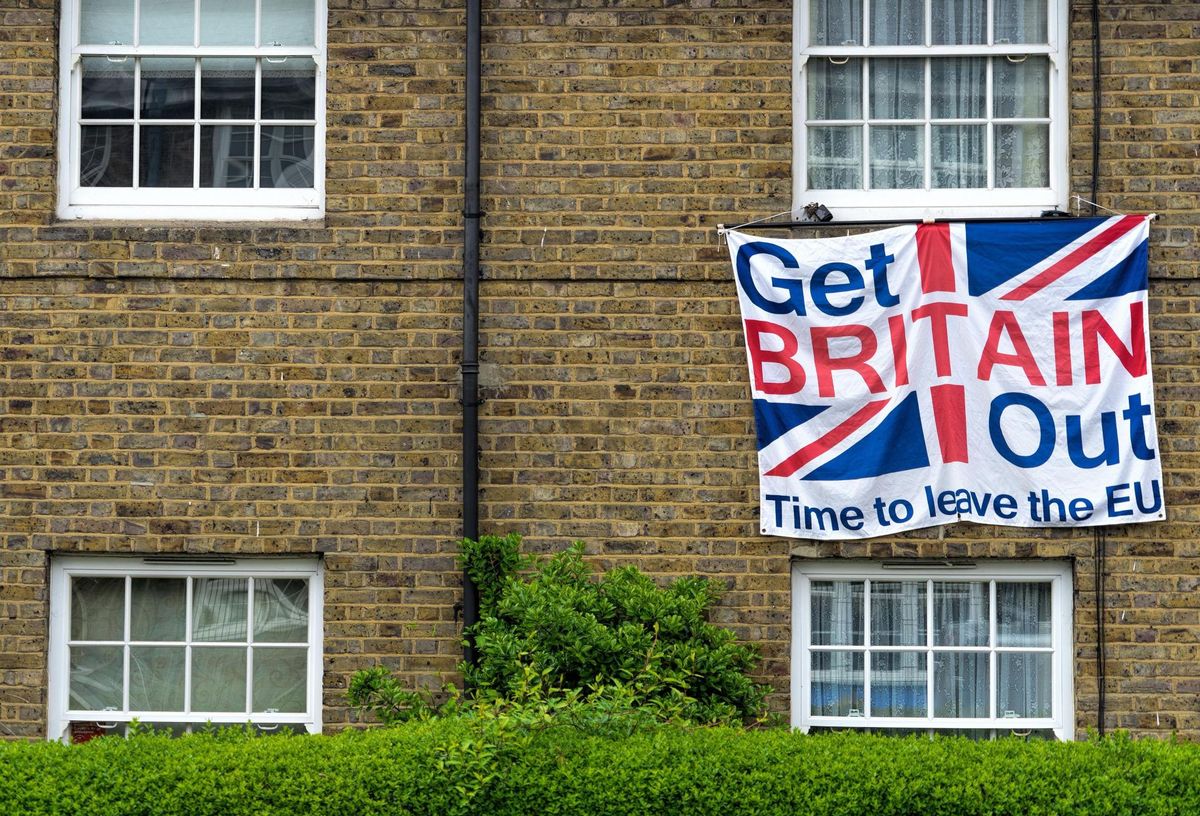
On the morning of Friday, 24 June 2016, London real estate awoke to a new reality — the UK had voted to leave the European Union.
The certainties of half a century were wiped away in an instant, and the stability the property sector enjoyed as London became the financial capital of Europe was suddenly at risk.
Today, the impact of Brexit has become clear. But as the UK navigates a moment that may be even more volatile than that morning a decade ago, the future for London real estate remains deeply uncertain.

Ten years on, central London investment volumes have never returned to pre-Brexit levels, nor has leasing, and the vote fundamentally changed the makeup of investors in London commercial property. The vote kicked off an era of instability in UK politics that has made buyers wary, and continental Europe in many ways wrested the UK’s crown and never returned it.
With multiple geopolitical and macroeconomic shocks following hot on the heels of the 2016 vote, London never got the chance to recover from the uncertainty Brexit created.
UK politics is still heavily influenced by the forces that began building in the wake of the 2008 financial crisis and that Brexit unleashed from the shadows.
And with interest rates higher than similar economies in Europe and growth slow, the rationale for investing in London and the UK is far from compelling.
London is not alone in a world of uncertainty, and it retains the appeal that has attracted investors and businesses for centuries.
Rents for good London offices are an order of magnitude higher than they were in 2015, the city is increasingly looking like a beneficiary of artificial intelligence job creation, and in 2025, the UK saw more foreign investment in real estate than the U.S.
But Brexit shook the foundations of UK property and left the country vulnerable to the blows that have come since.
Property Still Waiting On A Brexit Bounce Back
A lot of the focus for real estate in the run-up to the Brexit vote focused on the occupier market and the prospect of jobs and companies leaving the UK capital. But the bigger impact was ultimately on investment.
Both London office prices and investment volumes peaked in 2015, MSCI data showed — the £20B invested in London that year has never been bettered, even as rates continued to remain low through to 2021. The figure was £8.2B in 2025.
At the same time, London office pricing has essentially flatlined, whereas in Paris and the biggest German cities, prices are on average 50% higher than in 2015.

London office investment and leasing peaked in 2015, the year before the Brexit vote.
“The market has been in something of a long-term slowdown,” MSCI Head of EMEA Real Estate Research Tom Leahy said.
There is some nuance in those figures. London office values had risen 80% in the five years before 2015 — in some ways, Paris, Berlin and Munich were just playing catch-up with a quantitative easing-fuelled boom that began in London a few years earlier, Leahy said.
It is impossible to say the difference in fortune is entirely down to Brexit, especially as shocks like the pandemic and rate rises have consistently cut the legs out from under any market recovery.
But Brexit also changed the nature of who invested in London real estate, Leahy said. Institutional buyers dropped from an average of about 70% of all London commercial buyers to about 50% since then, MSCI data showed.
Institutional investors shied away from the volatility of London, to be replaced in some but not all cases by high net worth investors from the Far East buying big buildings on an infrequent basis.
The fact that there were buyers willing to step in when institutions stepped back from the market can be seen as a sign of its strength.
“The fact that even on the day after Lehman Brothers collapsed, you could sell London — at a price, but your market will be made — that is not true of probably any other market in Europe,” CBRE Investment Management Chief Economist and Head of Insights and Intelligence Sabina Reeves said.
But as the calendar turned over to 2016, a golden era for London office investment was ending.
“In 2015, for overseas investors, the UK was an investable place with relative ease, and London was the capital of the world,” Great Portland Estates CEO Toby Courtauld told Bisnow. “I think it’s more complicated than that now.”
Leasing volumes also peaked in 2015, with firms taking 14M SF of office space, according to data from CBRE. The highest figure since then was 12.6M SF in 2019, and the figure for 2025 was 11.5M SF.

Office prices in Paris and other continental European cities have far outpaced London prices in the last decade.
Reeves said those leasing figures were padded by the rise of WeWork in the late 2010s — the coworking giant took almost 2M SF between 2016 and 2019, before handing a big slug of that back following its 2023 bankruptcy.
But other data points to the resilience of the London market in the face of a wider UK economic slowdown. Brexit slowed the UK economy by about 6% to 8% a year on average, according to the UK Office for Budget Responsibility.
There are now more than half a million additional office jobs in London than in 2015, Courtauld said, citing figures from Oxford Economics: 2.5 million versus 2 million. And Oxford predicts that figure will grow by another 150,000 by 2030.
That has kept demand for London offices robust, even if companies aren’t taking as much space as a decade ago.
With office construction declining sharply after Brexit and staying suppressed amid the shocks of the pandemic, inflation and a spike in the cost of money, rents for the best London offices have skyrocketed in recent years. Grade A rents in Mayfair are up 73% in the past five years, DeVono data shows, while those in the City core are up 46%. That has dragged Grade B rents in their wake, pushing them up 38% and 50% in the two districts, respectively.
For Courtauld, London is a separate entity from the wider UK economy, with its own momentum and drivers of growth, hence the continued job creation when wider UK unemployment has ticked up.
Courtauld said he is a “big bull” on the impact AI can have on job creation and employment in London — not just from the AI companies themselves that are leasing big chunks of space in the capital but also from the impact the technology will have on corporate growth more generally.
“That bubble of innovation and entrepreneurship tends to aggregate in and around centres of deep talent and economic impact,” he said. “London is clearly making a play as the ex-U.S. capital of this topic.”
The Ripple Effect Of Instability

Chancellor Rachel Reeves, Prime Minister Kier Starmer and Secretary of State for Levelling Up, Housing and Communities Angela Rayner
Ten years on from Brexit, London and the UK are in an even more politically and economically complex moment, which continues to suppress property investment.
“For all the potential negatives of a shock like Brexit, there are perhaps bigger forces at play today,” Courtauld said.
Partly that is external. Inflation has skyrocketed as a result of a pandemic and two wars started by foreign powers and in which the UK is not involved.
But those exogenous jolts have highlighted the fragility of the UK economy. And while the UK is not alone among European countries in facing a newly fractured political landscape driven by populism and public anger, the situation is creating caution among international investors.
When elected in 2024, Labour and Keir Starmer promised an end to the “psychodrama” of constant leadership changes that characterised the end of the Conservatives’ 14 years in power. But a change of Labour leader is on the horizon, and bond markets — and thus real estate markets — are wary of a shift to the left and subsequent increase in public debt.
CBRE IM’s Reeves said the company’s house view is that continental Europe will outperform the UK over the next few years. It has similar economic and political issues, but interest rates of 2.25% rather than 3.75% make mainland Europe more appealing for investors.
Reeves said long-term trends like the growth of AI or the number of young people going into tertiary education have bigger impacts on an industry like real estate than more short-term political factors do.
“I’d be looking at the signals, not the noise,” she said. “So, who’s the prime minister of England, that can have an impact on bond yields, but I think actually it’s more or less noise.”

Courtesy of Cain International
Cain International CEO Jonathan Goldstein speaks at the Milken Global Conference.
That being said, politics does have an inevitable impact on investor sentiment by setting the mood music around the country and through the decisions politicians take that influence how an economy performs.
“Britain is in need of a focus and a direction, and when you look across the political spectrum today, who do you have confidence can give that to you?” Cain International CEO Jonathan Goldstein asked. “I don’t know the answer to that question.”
Investment in UK real estate dropped 7% in the first quarter, data from MSCI showed. That is a smaller decline than in France and Germany, but not the pickup in volumes that owners were hoping for.
Reeves pointed to the example of Spain, which, in the wake of the financial crisis, took painful decisions on public spending and business regulation. Today it is seeing high levels of real estate investment because it has U.S.-style economic growth coupled with low interest rates.
Goldstein said Cain is still positive on the UK student accommodation sector — the quality of UK universities remains a draw for international students, and those students will continue to need more rooms.
But more broadly, he said the lack of core capital in the market has made the company wary about investing in the UK. With a majority of investors looking for an opportunistic return, investors like Cain can’t underwrite liabilities assuming that assets will be bought at a yield of 5% or 6%, because everybody is looking for 10 to 12%, he said.
“We had many, many wasted years in the British political and economic worlds. That’s led us through a number of crises without any clear strategy or focus on what this country should be and where it should be going,” Goldstein said.
“Ultimately, this country needs to decide what it is and what it wants to be.”