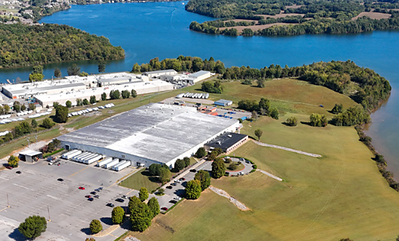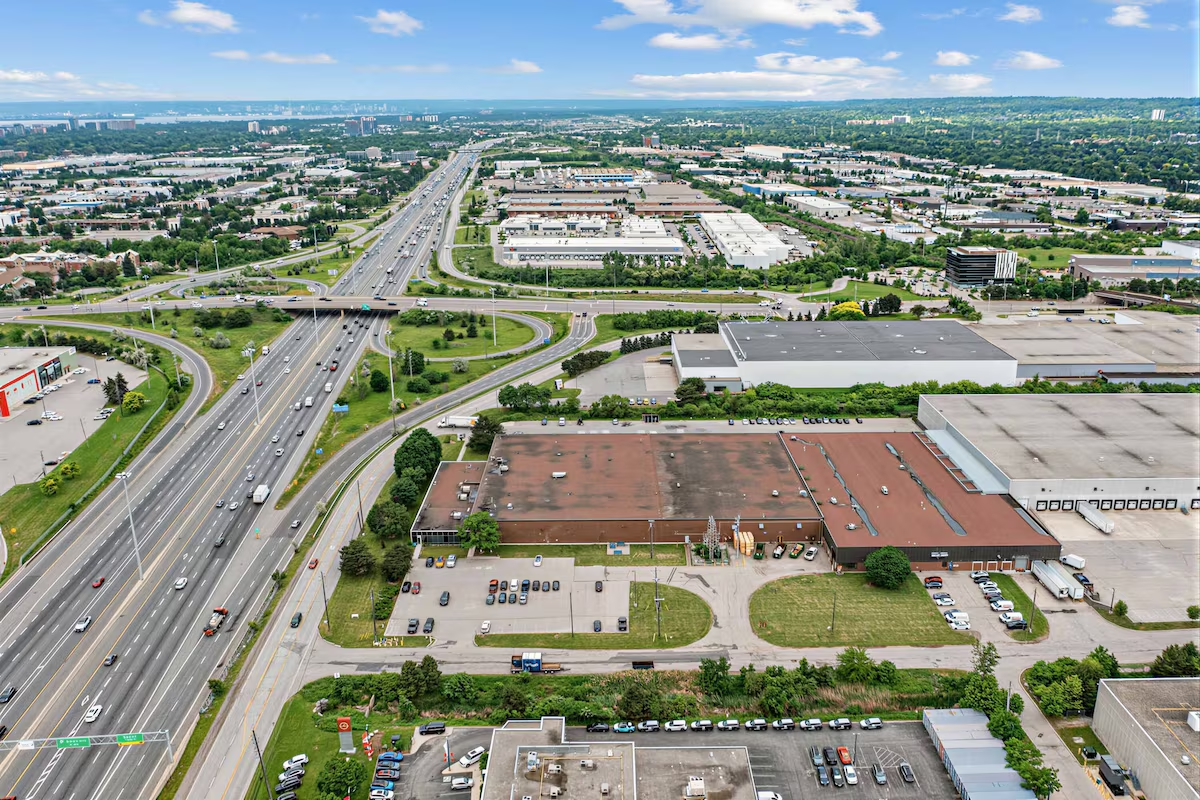
JLL’s new industrial brokerage team recently launched its first listing: a 95,692-square-foot industrial unit in Burlington, Ont., owned by Concert Properties. The property comes to market as higher vacancy rates and greater choice give tenants more leverage.Supplied/JLL
Global commercial real estate firm Jones Lang LaSalle (JLL) marked a milestone this summer with the debut of an all-female industrial brokerage team, believed to be the first of its kind in Canada.
But being the first all-women team in the space was practical rather than intentional. JLL wanted to offer several different services from one central team and move away from a “siloed, one-broker” service model, says Kathy Kolodziej, executive vice-president of JLL’s industrial group.
“We’re trying to offer more of a service portfolio,” says Lyndsay Hopps, senior vice-president of JLL’s industrial team. “That would include tenant and buyer representation, agency representation for property owners, design-build facilitation and strategic portfolio management.”
In addition to Ms. Kolodziej and Ms. Hopps, JLL’s industrial team is made up of associate vice-president Kennedy Banks and sales co-ordinator Celeste Rattray. The four recently launched their first listing: A heavy-powered, 95,692-square-foot industrial unit in Burlington, owned by Concert Properties.
When it comes to industrial leasing, offering a mix of services helps the JLL team holistically approach the market, which has since balanced out following the scarcity of industrial real estate listings during the pandemic.
In 2021, national absorption rates – the speed in which available space is rented or bought over a set time – peaked at nearly 46-million square feet and vacancies hovered well below the historical norm at 1.2 to 1.3 per cent, according to real estate firm Avison Young. Now, those numbers are levelling out across the country and providing industrial tenants with greater choice, which means brokers are increasingly being called to work harder to differentiate the properties they represent.
JLL’s new industrial team is composed of executive vice-president Kathy Kolodziej, senior vice-president Lyndsay Hopps, associate vice-president Kennedy Banks and sales coordinator. The first all-women industrial team in Canada was launched this summer to bring several services under one roof.Supplied/JLL
A market finding its footing
Warren D’Souza, senior manager and industrial lead of market intelligence at Avison Young Canada, says the market conditions experienced during the pandemic were some of the tightest conditions on record. He acknowledges these were largely driven by pre-COVID population growth and the increase in consumer consumption that came along with the pandemic.
“When the pandemic hit. . . that started up a lot of e-commerce growth because bricks and mortar stores were closed,” says Mr. D’Souza. “You saw companies like Amazon and Walmart growing tremendously quickly.” As more conglomerates needed warehouse space, rental rates rose, climbing from $10.98 per square foot at the beginning of 2021 to a peak of $17 per square foot in 2023.
“Historically, we haven’t really seen that ramp-up in rents, and the rents gave the developers confidence to build,” says Mr. D’Souza. “That momentum carried on until we had an oversupply issue.”
In 2023, industrial real estate completions crested at around 43-million square feet, up from 25-million square feet in 2021. There was also a steady climb in vacancies, which peaked at 4.3 per cent in 2025 before landing at four per cent in the second quarter of this year – up from 1.2 to 1.3 per cent five years ago.
“It’s just a normalization. Commercial real estate, industrial real estate, is cyclical,” says Mr. D’Souza, referencing the oversupply following the tightening market. “It happened so rapidly this time that we were caught off guard.”
What today’s tenants are after
The industrial market in the Greater Toronto Area, where JLL’s new Burlington listing is located, is not so different from the national picture. Regional data from Avison Young shows a similar trajectory over the past four to five years.
According to Lindsay Brand, chief investment officer at Concert Properties, the industrial market has “come back to reality.” She sees that as a good thing.
“Before the pandemic, industrial was a stable, disciplined asset class,” says Ms. Brand. “It’s become a much more balanced market, where success comes down to the quality of the asset and the strength of the leasing strategy, not just timing.”
The JLL industrial team’s first listing in Burlington is a lesson in some of what today’s industrial tenants are after.
For example, the location has access to a strong local labour pool and is rich with amenities. It also features upgraded LED lighting and heavy power, giving it the electrical capacity to accommodate energy-intensive manufacturing equipment without requiring a major electrical upgrade.
“As operations become more technology-driven and energy-intensive, access to sufficient power has become a critical requirement, and it’s increasingly difficult to deliver,” says Ms. Brand. “That tells us the next generation of industrial real estate will be defined not just by location but by functionality and infrastructure.”
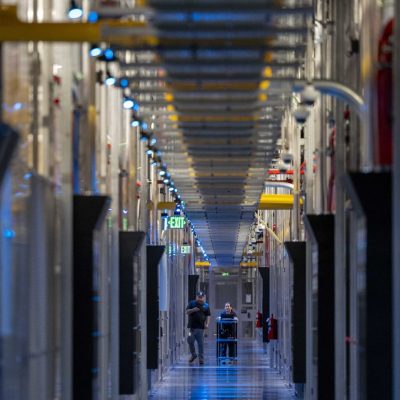
The Burlington property features heavy power and upgraded LED lighting, allowing it to accommodate energy-intensive manufacturing equipment without requiring a major electrical upgrade.Supplied/JLL
The women shaping the future
JLL’s new team may not have been assembled to achieve a milestone, but it has. And it underscores a long-running lack of diversity in the industry that’s not talked about as much as market metrics and property specs.
Last fall, the Commercial Real Estate Women Network released its latest benchmark study, which measures the representation of women in commercial real estate every five years. The report found 43 per cent of women in commercial real estate globally are in the industrial segment, down from 48 per cent in 2020.
In Canada, the story is similar. CREW Network CEO Alison Beddard says 47 per cent of Canadian women in commercial real estate work in the industrial class, down from 53 per cent in 2020.
“While our 2025 benchmark study data saw a decrease in the percentage of women doing business in industrial real estate, I have seen an increase in women’s interest in the sector and in industrial’s interest in recruiting, supporting and retaining women,” says Ms. Beddard.
She adds that CREW Network has partnered with industrial real estate firms and groups such as Link Logistics, LXP Industrial Trust and SIOR to advance more women in the industry.
In Toronto, Ms. Hopps of JLL says she’s also seeing more young women interested in the industrial sector through CRE8, a networking and mentorship group she co-founded in 2018. Her hope is her team will add to the impetus.
“In 2026, it doesn’t feel like [our team] should be such a novelty, but in the industrial sector, it is,” she says. “I think it’s a very exciting thing for women to see other females enter the industrial industry as a unified group.”