



Selling, buying, renting, or leasing a home. For many people, real estate transactions are not something they experience many times in their lives. On the other hand, there are a vast number of real estate companies nationwide to consult with. According to the latest statistics released by the Ministry of Land, Infrastructure, Transport and Tourism on October 2, 2026, the number of real estate brokerage firms at the end of fiscal year 2025 reached 133,727, marking the 12th consecutive year of growth. In the same fiscal year, there were 163 supervisory actions and 768 instances of administrative guidance, both of which increased from the previous fiscal year. However, it is not correct to conclude that the real estate industry has become dangerous just by looking at these figures. What is important is what criteria consumers should use to choose a company as the number of firms increases and options expand. Working in the real estate industry, I feel that the differences that are not visible just by looking at company size or brand recognition are quite significant in actual transactions.
The “Era of 130,000 Real Estate Companies” as Shown by the Latest Statistics

According to the Ministry of Land, Infrastructure, Transport and Tourism’s “Survey on the Implementation Status of the Real Estate Brokerage Act for Fiscal Year 2025,” the number of real estate brokerage firms as of the end of March 2026 was 133,727. This is an increase of 1,436 firms, or 1.1%, from the previous fiscal year, marking the 12th consecutive year of growth. It is not just that there are many companies; both firms licensed by the Minister and those licensed by prefectural governors have increased, showing that the number of providers of real estate services continues to grow. While an increase in options is not a bad thing for consumers, the importance of identifying each company’s areas of expertise, research capabilities, and thoroughness in explanation—rather than assuming “it’s the same wherever you go”—has actually increased.
Number of Firms Increases for 12 Consecutive Years, Surpassing Levels from 20 Years Ago

In the latest count, there are 3,238 firms with Minister licenses and 130,489 with prefectural governor licenses, for a total of 133,727 firms. Twenty years ago, in fiscal year 2006, there were 130,647 firms; after a temporary decline, the trend has been upward since fiscal year 2014, and the current number exceeds the level of 20 years ago. In particular, the number of Minister-licensed firms, which have offices in multiple prefectures, has increased to 143.4 in fiscal year 2025, using fiscal year 2006 as a base of 100. Meanwhile, the number of governor-licensed firms has also increased recently. What can be read from this is that the real estate industry has become a multi-layered market, consisting of neither just “small, community-based companies” nor just “large, nationwide firms.” The skills required for sales, purchases, rentals, management, investment, inheritance, and vacant houses differ significantly, even within the same real estate sector. Rather than focusing on the number of companies, it is necessary to see if your specific case matches the company’s area of expertise.
Administrative Guidance Increased by 29.7%, but Caution is Needed in Interpreting the Numbers
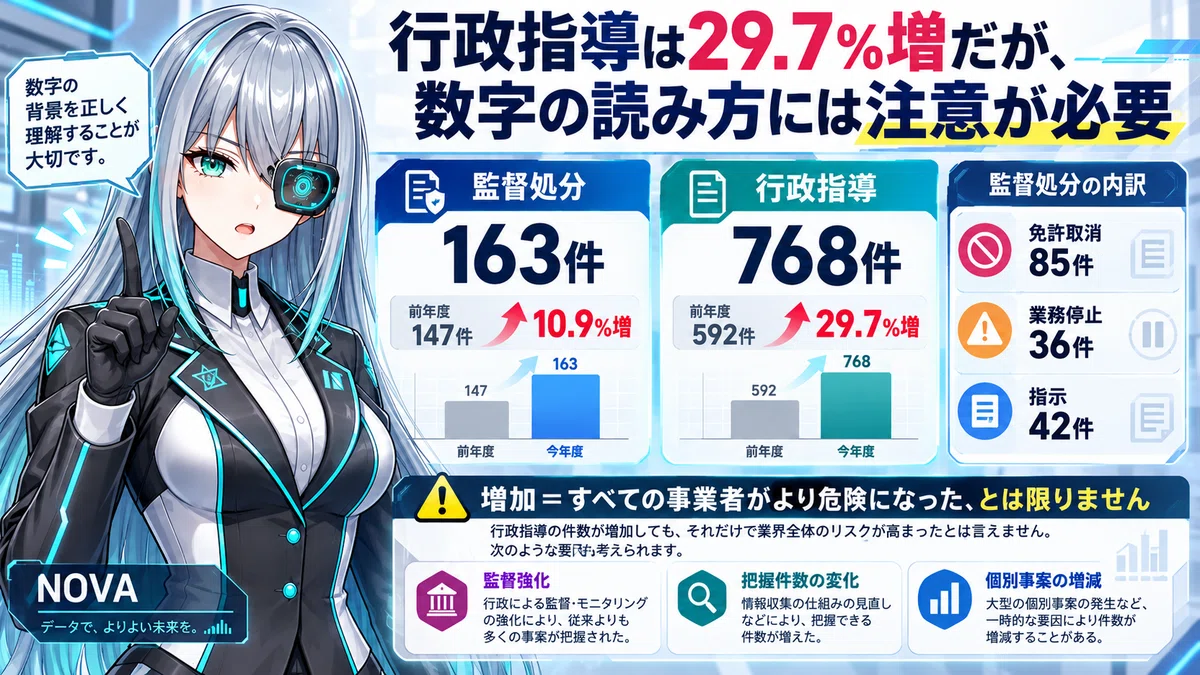
Supervisory actions in fiscal year 2025 included 85 license revocations, 36 business suspensions, and 42 directives, for a total of 163 cases. The total increased by 10.9% from 147 cases in the previous fiscal year. Furthermore, administrative guidance, which consists of written guidance, advice, and recommendations based on Article 71 of the Real Estate Brokerage Act, reached 768 cases, a 29.7% increase from 592 cases in the previous fiscal year. Violations related to explanations of important matters, brokerage contracts, and the placement of full-time real estate notaries are also cited as subjects for supervisory action. However, the reason for the increase in the number of actions and guidance cannot be determined solely from these statistics. There could be multiple factors, such as strengthened supervision, changes in the number of cases identified, and fluctuations in individual cases. Therefore, it is more practical to interpret this not as “increased administrative guidance means all real estate companies are more dangerous than before,” but rather that it is increasingly important for consumers to verify license information and the content of explanations themselves.
“Having a License” is the Starting Line, Not the Goal of Choosing a Company

To engage in the real estate brokerage business, a license from the Minister of Land, Infrastructure, Transport and Tourism or a prefectural governor is required. Therefore, checking for the presence of a license is a natural starting point. However, having a license and being strong in the specific case you want to request are different issues. Just as doctors have medical specialties, real estate companies have practical areas of expertise. Experience levels vary significantly, such as companies strong in sales brokerage, those strong in rental management, those specializing in investment properties, or those accustomed to inheritance and vacant house clearing.
First, Check “Existence” and “Basic Information” Using Official Data
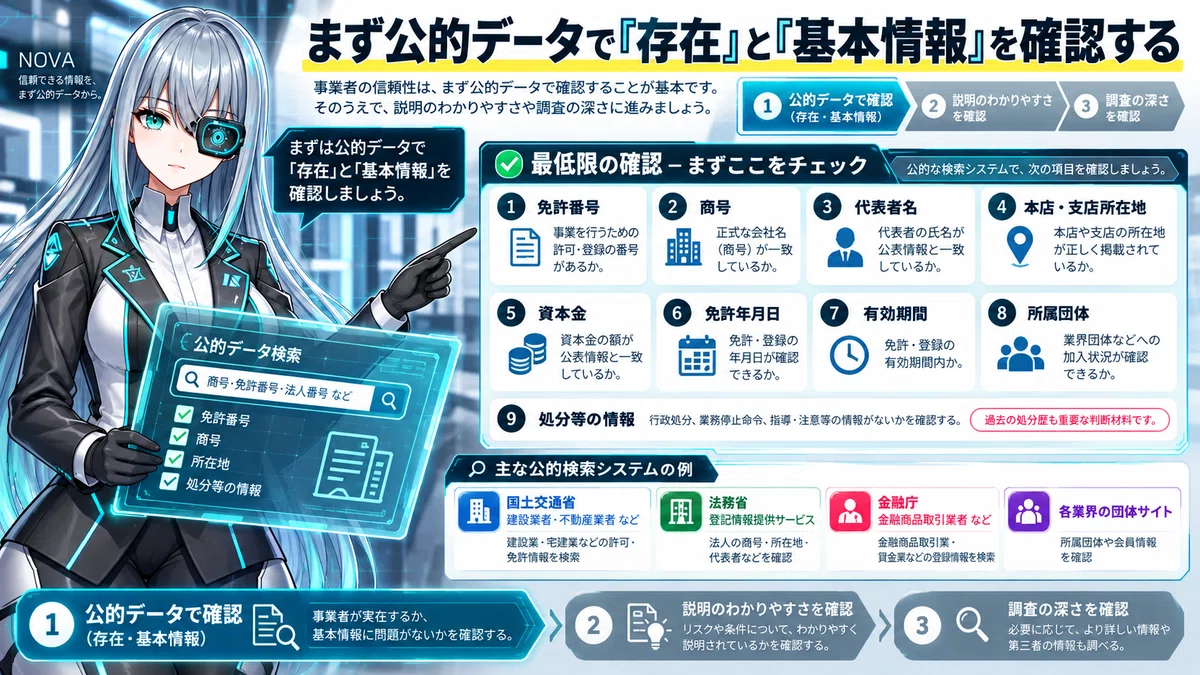
The Ministry of Land, Infrastructure, Transport and Tourism publishes a “Corporate Information Search System for Construction and Real Estate Brokers,” where you can check basic information about real estate brokerage firms, such as license numbers, trade names, representative names, head office/branch locations, capital, license dates, validity periods, and affiliated organizations. Additionally, there is a mechanism to check information on disciplinary actions through the Ministry’s negative information search site. Before looking at reviews, it is more appropriate to first check the company’s license and registration status using official information. However, you cannot conclude that a company is “good” just because it has no history of disciplinary action. Official information is the minimum requirement, and after that, you need to look at the staff’s explanations, the content of their research, and their attitude toward documentation.
“What They Research and What They Explain” Makes the Difference

What really makes a difference in real estate transactions is the quality of research and explanation, rather than the number of property introductions. For example, for land, how far do they check road access, boundaries, water and sewage, encroachments, urban planning, building regulations, and land history? For used homes, can they foresee the condition of the building, repair history, equipment, legal compliance, and future renovation costs? For sales, it is important whether they can explain the basis for the appraisal price, the assumed buyer, the sales period, the judgment for price reductions, and contract conditions. In the long run, a company that explains the basis for its conclusions and even the disadvantages is more reassuring than a company that only gives conclusions like “It will sell at this price” or “This property is fine.”
The Conditions for a “Good Real Estate Company” Differ Slightly Between Urban and Rural Areas

Looking at the number of real estate brokerage firms nationwide by head office location, there are 27,939 firms in Tokyo and 15,234 in Osaka, which is very high, while there are 315 in Tottori Prefecture and 403 in Shimane Prefecture, showing large regional differences. While these are figures based on head office location and do not directly represent sales areas or the number of stores, they serve as material to show that the “difficulty of choosing a company” faced by consumers differs between urban and rural areas. This is because urban areas have the problem of too many options, while in rural areas, understanding regional circumstances is often more important than the number of options.
In Urban Areas, Distinguish Between “Expertise” and “Staff Quality”

In urban areas, there are a vast number of options ranging from large companies to small specialized firms, and even within the same company, experience levels can vary depending on the staff member. It is better to check expertise for each target property, such as strength in apartment sales, investment studio apartments, land for detached houses, or inheritance cases. When getting an appraisal, it is important not to just choose the company that presents a high price, but to ask about transaction examples, competing properties, the assumed sales period, and the criteria for price reductions. Also, when receiving explanations from multiple companies, seeing if they explain not only the convenient parts but also scenarios and costs if it doesn’t sell will make the company’s attitude easier to understand.
In Rural Areas, “Knowing the Details of the Region” Often Becomes Value

For detached houses and land in rural areas, issues that cannot be solved by price appraisal alone increase. Regional practicalities often dictate the transaction, such as whether the frontage road is public or private, how snow removal and waterways are handled, whether water and sewage are connected, whether it is in a septic tank area, whether boundary markers remain, whether farmland or forests are mixed in, and how to proceed with vacant house management or disposal of remaining items. In areas with small market sizes, coordination with local government offices, land and house investigators, judicial scriveners, architects, and demolition contractors can sometimes be more important than advertising power. When choosing a real estate company in a rural area, asking “how they have handled difficult cases in this region” is a better basis for judgment than “whether they are famous nationwide.”
7 Items to Check When Choosing a Real Estate Company
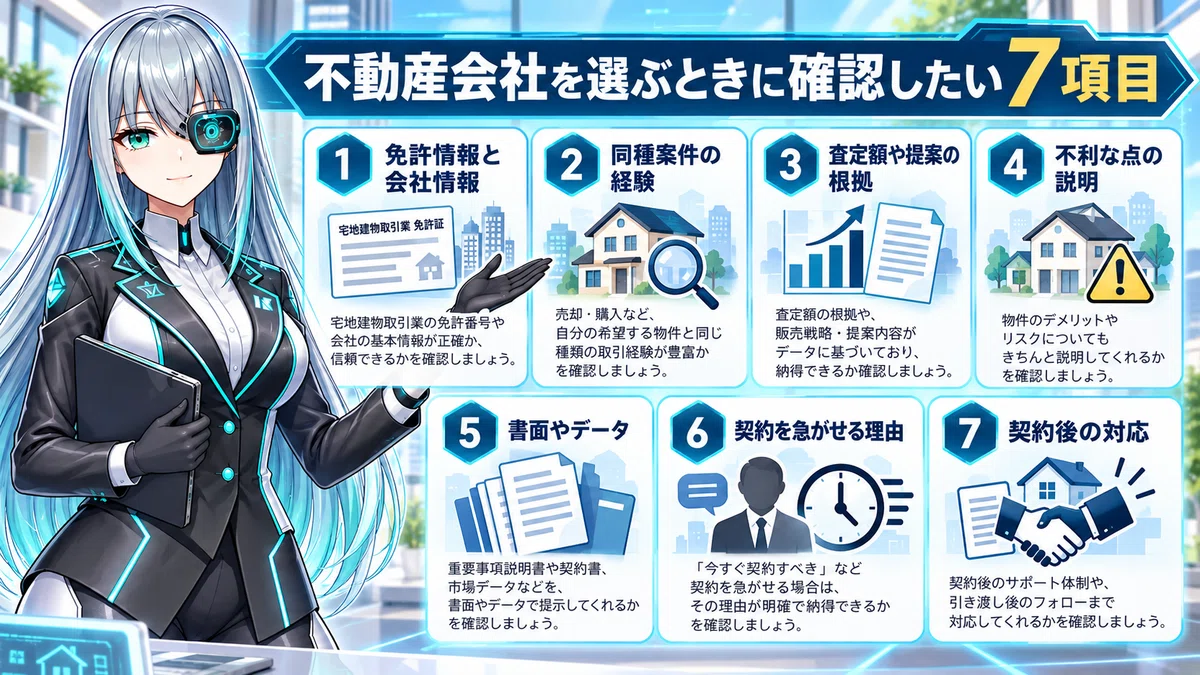
To avoid relying solely on intuition when choosing a real estate company, it is effective to decide on comparison criteria in advance. If you choose based only on website impressions, reviews, or brand recognition, you are more likely to overlook whether the company is a good fit for your specific case. Real estate transactions, especially sales, involve large sums of money and issues that are difficult to rectify after a contract is signed, so it is safer to have a minimum set of verification items ready before making a request. The following seven items can be applied to both sellers and buyers.
1. Verify license information and company details using public data

First, check basic company information such as the trade name, license number, head office location, representative, and license validity period using a public search system. Even if the license number is listed on advertisements or business cards, it is reassuring to verify it yourself. There is no simple hierarchy where a Minister of Land, Infrastructure, Transport and Tourism license is superior and a Prefectural Governor license is small; the difference mainly relates to the range of prefectures where offices are established. The number of license renewals is also reference information, but the number of renewals alone does not guarantee service quality. You must evaluate the facts—such as whether the company is long-established or new—separately from the capabilities required for your specific case.
2. Ask about their experience handling cases similar to yours

You cannot judge a company based solely on the explanation that they can do anything related to real estate. For example, if you are selling an inherited vacant house, check their experience with cases involving co-owners, large amounts of remaining items, unclear boundaries, or cases where a decision on whether to demolish the building is required. For investment properties, perspectives on yield, repairs, rental management, financing, and exit strategies are necessary. For pre-owned homes, an understanding of construction and equipment is also important. Asking specifically how they handled similar cases makes it easier to see the company’s true areas of expertise.
3. See if they can explain the ‘basis’ for their appraisal value and proposals

The company that provides the highest appraisal value for a sale is not necessarily the company that will sell it for the highest price. What is important is whether the basis for the appraisal value is explained. Check if they provide an explanation based on surrounding transaction examples, current competing properties, individual land and building conditions, assumed buyer demographics, and the sales period. The same applies to purchasing; rather than just hearing that a property is a ‘good deal,’ you should look for whether they can explain why the price is reasonable and what kind of buyer is expected when you sell it in the future. A representative who can verbalize the background of the numbers, rather than just presenting them, is easier to compare and provides lasting material for your decision-making.
4. Do they explain the ‘disadvantages’ upfront, not just the good points?

One characteristic of a trustworthy company is that they explain information that could be disadvantageous to the contract process without hiding it. For sales, this includes the possibility that a higher price might lead to a longer sales period, the potential costs for surveying or demolition, and how the scope of responsibility changes depending on contract conditions. For purchases, this includes repair history, disaster risks, road access, boundary encroachments, future management fee burdens, and surrounding supply. There is almost no property in a real estate transaction that has absolutely no flaws. A representative who can help you organize the ‘reasons to buy or sell despite the flaws’ after pointing out the disadvantages is more useful for decision-making than one who only talks about the benefits.
5. Do they provide written documents and data rather than just verbal explanations?
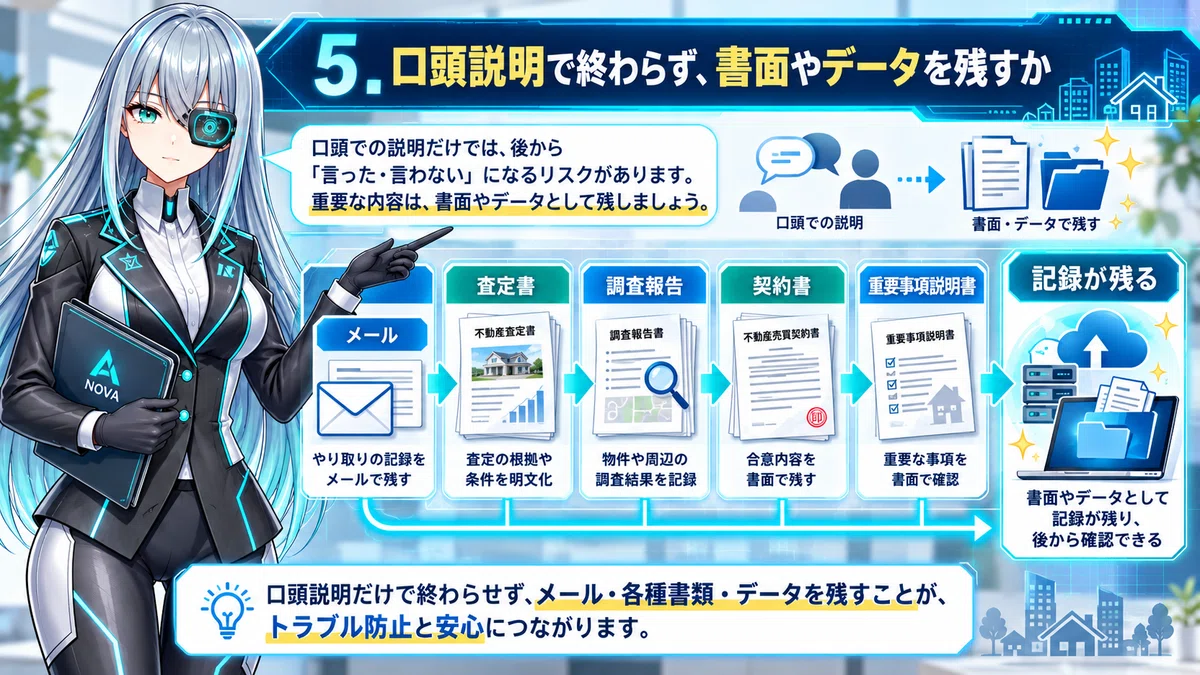
If important matters such as contract conditions, appraisal grounds, repair details, and handover conditions are handled only verbally, misunderstandings are likely to occur later. Look to see if items to be confirmed are recorded in emails, appraisal reports, survey reports, contracts, or important matter explanation documents. In particular, phrases like ‘it’s fine’ or ‘there are no problems’ are ambiguous unless the basis for why it is fine is left in writing. Sometimes the representative changes during the transaction. A company that keeps things in a state where anyone can trace the history makes it easier to judge their management standards as an organization.
6. Confirm if the reason for rushing a contract is rational

There are situations in real estate where there are genuine time constraints, such as applications for popular properties, loan approval deadlines, settlement dates, or deadlines for inheritance tax and tax incentives. However, when you hear phrases like ‘you’ll lose out if you don’t decide today’ or ‘please just sign an exclusive brokerage agreement for now,’ it is better to confirm the basis for that deadline. If the deadline is rational, they can explain the reason. Conversely, be careful if the act of rushing your judgment without giving you time to consider is itself their sales technique. In transactions involving large sums of money, it is important to have time to think overnight or room to consult with a third party.
7. Check what they will do ‘after the contract’

When choosing a real estate company, people tend to focus on the response until the contract is signed, but in reality, the work after the contract is more important. For sales, this includes reporting on sales activities, analyzing feedback, reviewing prices, and adjusting conditions with the buyer. For purchases, this includes loans, surveys, contract conditions, handover, and renovations. For rental management, it centers on handling post-move-in troubles and repairs. If you ask ‘who will be the representative after the contract,’ ‘how frequent will the reports be,’ and ‘who makes the decisions when problems arise,’ it becomes easier to distinguish between companies that only focus on winning the contract and those that are designed to see the transaction through to completion.
Reviews are helpful, but do not use them for your ‘final decision’

Nowadays, you can easily check reputations on Google Maps, social media, and review sites. While this is convenient, it is dangerous to decide on a company based solely on reviews in real estate transactions. This is because the transaction content is complex, and the experience can vary depending on whether it is a sale, rental, management, or the specific representative, even within the same company. Also, having many good reviews is not the same as having a high ability to handle difficult cases. It is realistic to use reviews to ‘find candidates to consult with’ and ultimately verify public information, expertise, the basis for explanations, documentation, and the post-contract structure.
Read the ‘content of cases similar to yours’ rather than the star rating

If you are going to look at reviews, read the content rather than the average score. For example, if you want to sell an inherited vacant house, look for specific experiences regarding inheritance, boundaries, remaining items, or demolition. If you are selling a condominium, look for descriptions regarding appraisals, sales periods, and price negotiations. If it is rental management, it is more helpful to look at descriptions regarding repairs or tenant relations. Conversely, comments like ‘they were kind’ or ‘the response was fast’ do not allow you to judge their ability to handle complex surveys or contract practices. It is important to read what they actually did in situations similar to your own case.
Do not decide based on just one company; compare the differences in their explanations
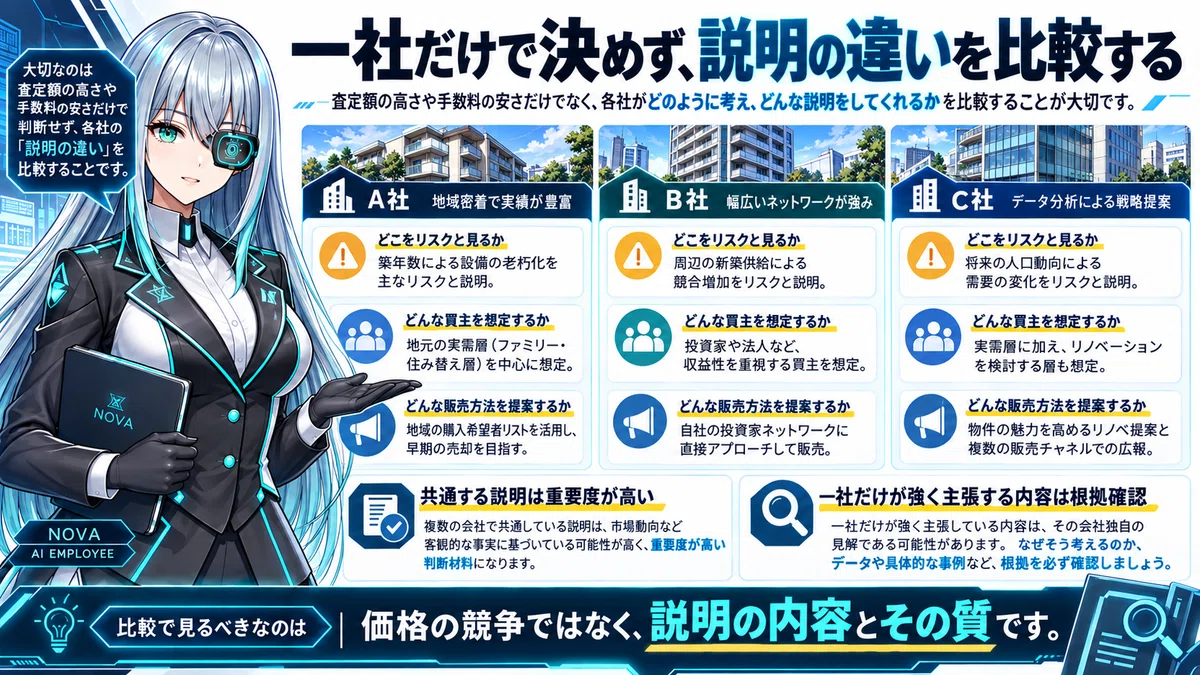
When seeking sales appraisals or purchase consultations, it is easier to make a decision if you listen to explanations from multiple companies whenever possible. However, the purpose of comparing them is not just to find the “highest appraisal price” or the “lowest commission.” There is value in seeing the differences in how they view risks for the same property, what kind of buyers they envision, and what sales methods they propose. Points common to multiple companies’ explanations may be of high importance, while you can verify the basis for claims made strongly by only one company. If you consider comparison to be a task of improving the accuracy of information rather than a price war, the quality of your company selection will improve.
Summary | Look at the “Decision-Making Process” Rather Than the Company Name

As of the end of March 2026, there were 133,727 real estate brokerage firms, an increase for the 12th consecutive year. At the same time, supervisory actions and administrative guidance also increased compared to the previous fiscal year. However, the essence of this statistic is not simply that “real estate companies have become dangerous.” Because it is a market with many options, consumers also need criteria to evaluate companies. Check license information, ask about experience with cases similar to yours, verify the basis for appraisals and proposals, have them explain even the disadvantages, and ensure important matters are documented in writing. Whether in urban or rural areas, these basics remain the same. Ultimately, what you should look at is not the size of the company or the amount of advertising, but whether they can explain “what they investigated, what the basis is, and how they make decisions” regarding your property.
Simple Checklist for Choosing a Real Estate Company
-
Did you verify the license number and company information using official sources?
-
Did you specifically ask about their experience with cases similar to yours?
-
Did you confirm the basis for the appraisal price and proposals?
-
Were disadvantages and failure scenarios also explained?
-
Will important matters be documented in writing or via email?
-
Did you confirm if the reason for urgency is reasonable?
-
Did you confirm the process for contact, reporting, and problem resolution after the contract?