“Interest rates are rising, is the real estate market finally going to crash?”
“The gap between listing prices and transaction prices – The open crocodile mouth -“
I often hear such talk. However, one should not look at the current real estate market in a simplistic way.
To examine the value (asset quality) of real estate—specifically, “whether the price is unlikely to fall or, conversely, likely to rise in the future”—the concept of the “CoAMer Theory (Condominium Asset Manager Theory)” is useful. This is a method of analyzing how much value a property has by dividing real estate into three elements: “land (=city),” “building,” and “management,” and then using rent as a “yardstick.”
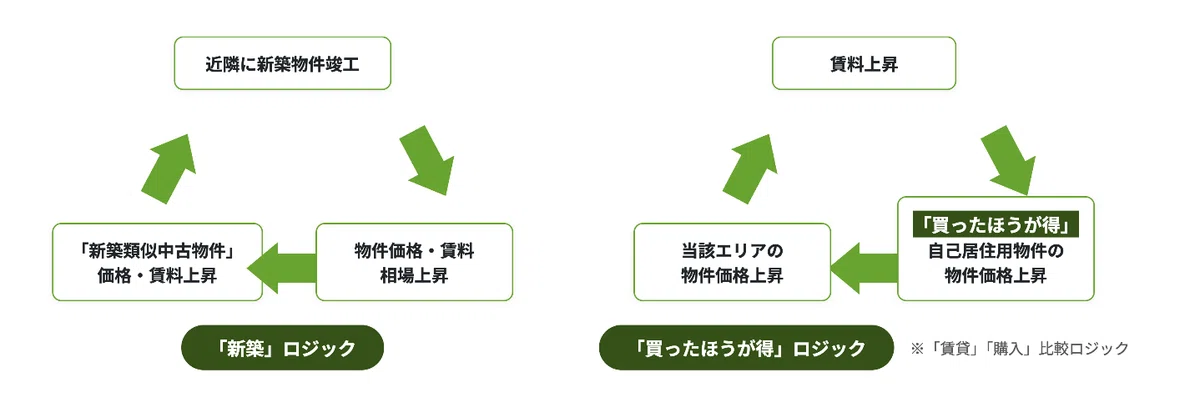
For the CoAMer theory to function properly in a market (region), two important relationships must be established.
The first is the “new construction property logic”:
The relationship where, when a new condominium is built, the prices of other properties in the vicinity also rise in tandem.
The second is the “rental vs. purchase comparison logic”: The relationship where rent and price are linked, such that areas with high rents also have high purchase prices for properties.
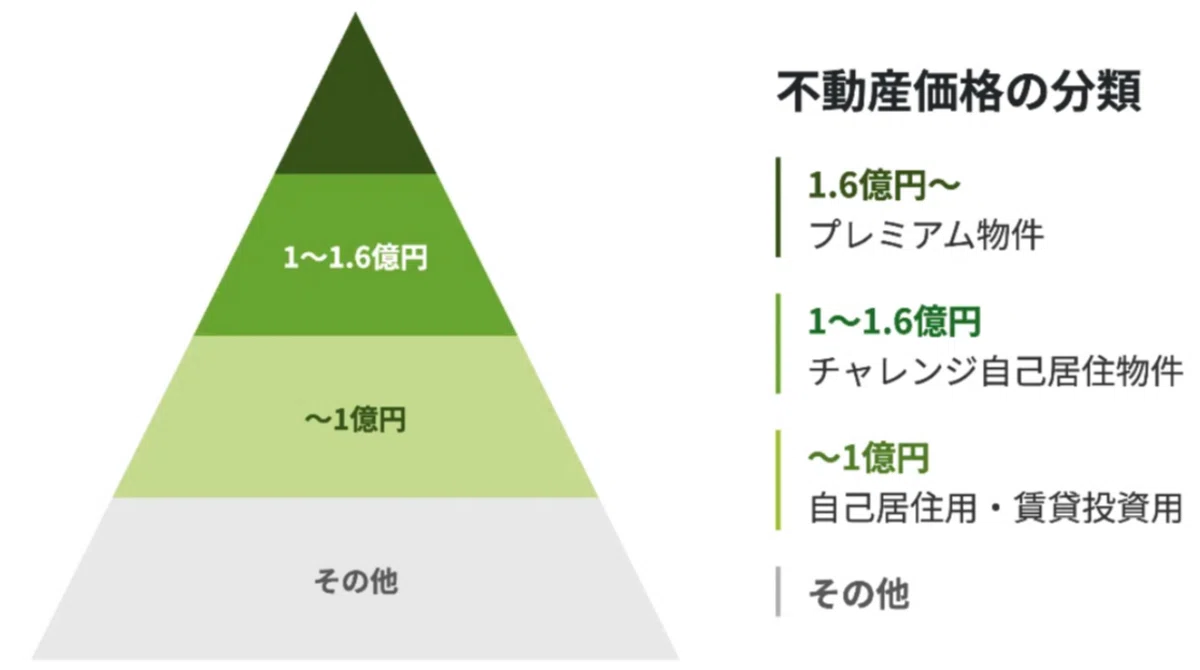
In markets where these two relationships are working properly, it is considered that there are broadly three types (or four, if viewed in detail) of different market types.
This is because even for the same condominium, the people buying, the reasons for buying, and the reasons for price fluctuations are completely different between properties under 100 million yen and properties worth 500 million yen.
To organize this clearly, it looks like this.
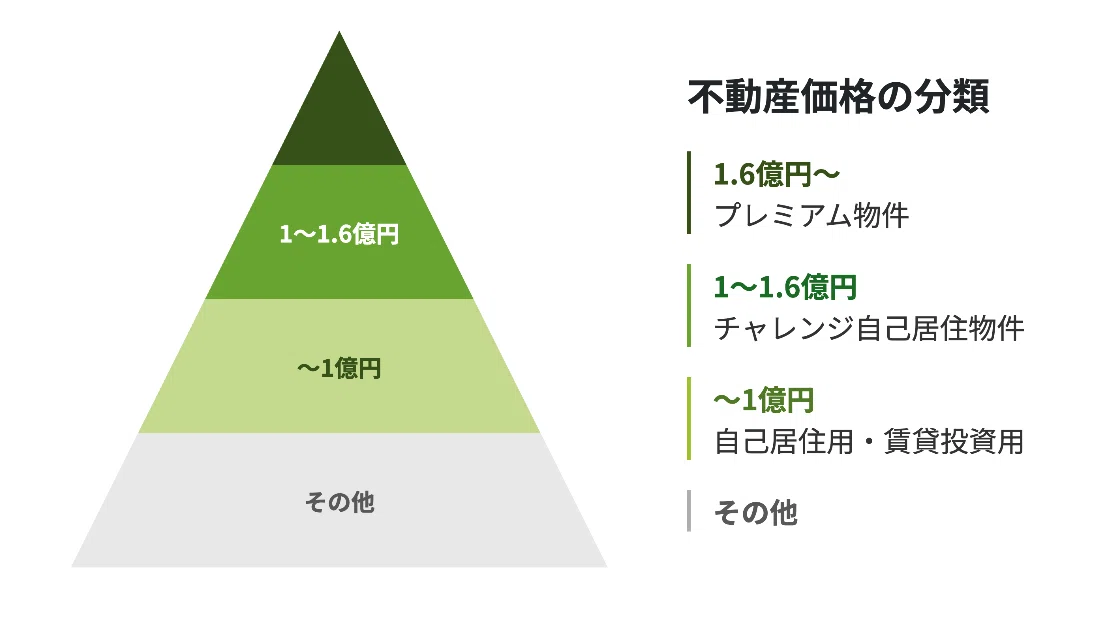
1. 160 million yen or more: “The premium market for the so-called ‘affluent'”
First, there are properties exceeding 160 million yen.
Once you reach this price range,
“buying a home by paying off a mortgage from your monthly salary”
—the world of home buying changes a little.
For example,
People who have made large profits from selling real estate in the past.
Wealthy individuals such as company executives.
Investors buying Japanese real estate from overseas.
These types of people become more common.
While there is a purpose of living in it yourself, “this property might become even more expensive in the future”—the expectation of resale investment is also factored into the price.
Since there are cases where one can use a mortgage for properties up to around 300 million yen, they are still relatively easy to buy and sell. However, once you enter the world of 500 million or 1 billion yen, the number of people who can actually afford to buy them decreases.
In other words,
the price is high, but it is not always easy to sell at any time.
That is what it means.
As a side note, overseas investors also look at not just Japanese condominium prices, but also the value of the yen. Even if condominium prices rise, there is a possibility of losing money due to exchange rates. Therefore, if the exchange rate environment changes, funds may suddenly flow in or, conversely, pull out all at once.
Therefore, it is difficult to think of this premium market as a ‘high price equals safe market’. Rather, because the prices are high, one must also be careful about instability.
② 100 million to 160 million yen: ‘A challenge market where you buy by stretching a little’
Next is the range of about 100 million to 160 million yen.
In areas like the waterfront, this is a price range where many condominiums are traded for actual owner-occupancy. However, something has changed significantly here compared to the past. Previously, it was a market that was relatively easy to consider for so-called traditional power couples, such as:
‘Husband 7 million yen + Wife 7 million yen = Household income 14 million yen’
which was a market that was relatively easy to consider for so-called traditional power couples.
However, now that real estate prices have risen, it is not that simple with just that. For example, if you sell a condominium you bought previously and make a profit, you can use that money as a down payment for your next home. For such people, it becomes easier to purchase.
Conversely, if a first-time homebuyer relies solely on their income to challenge a purchase of over 100 million yen, they will be ‘stretching’ quite a bit.
That is why I view this price range as
‘challenge owner-occupied properties’
as I see it.
What is particularly important here is the mortgage interest rate. The larger the loan amount, the greater the impact of even a small interest rate hike on the monthly repayment amount.
Therefore, in a phase where mortgage interest rates will rise in the future, this is a zone to watch with particular caution among the three markets.
③ 100 million yen or less: ‘The real demand and investment market that ordinary people can actually buy’
And 100 million yen or less.
I play the game in this price range a lot.
The reason is simple.
Because it is supported by the owner-occupied market while also being suitable for the rental investment market, meaning in a broad sense, ‘there are many people who can actually afford to buy’.
In the owner-occupied mortgage market, even if a household’s annual income does not reach 14 million yen, more people can purchase by using methods like a pair loan that combines the couple’s incomes.
For those with an annual income of 15 million yen or more, there are many cases where they can participate in the rental investment game once they have exceeded their available mortgage capacity.
In other words,
there are many people who can actually ‘buy,’ not just those who ‘want’ to.
This depth is extremely important in the real estate market.
CoAMer Theory also considers ‘liquidity,’ the existence of a wide range of buyers when selling, as an important evaluation axis.
And what is interesting is that this price range is not just for owner-occupancy.
Major changes are also occurring in rental investment.
If more people commute to offices in the city center, the number of people who ‘want to live close to the office’ will also increase.
If companies hire new talent, those people will also need a place to live. This strengthens the rental demand for housing that is easy to commute to from office districts. When demand strengthens, rents rise. And when rents rise, the value of real estate as an investment target also tends to rise.
In the CoAMer Theory that I advocate, we emphasize the idea of ‘looking at rent as a benchmark, not just the sales price’.
The places to target are not just the ’23 Wards of Tokyo’
This is also very important. For example, it is not as simple as saying, ‘If it’s real estate, you should just buy in Minato, Chiyoda, or Chuo Wards.’
By the way, one standard I look at is 30 to 40 minutes door-to-door. In other words, instead of just looking at the walking distance to the station,
how many minutes it takes from leaving your front door to arriving at the door of your company in a major office district.
is the way of thinking.
Furthermore, even in the CoAMer Theory, we emphasize actual ‘time distance’ rather than just walking distance to the station. If this condition is met, there is no need to limit yourself to the 23 wards. There is room for growth in markets where people gather, there is actual demand, and a wide range of people can buy for under 100 million yen, such as around major suburban stations or the central stations of regional cities.
So what happens to ‘other’ properties?
When you organize it this far, you can see that just because real estate prices are rising, it does not mean that every property will rise.Properties in markets where the correlation between rent and property price is not functioning normally are classified here as ‘other’.
Furthermore, in the CoAMer theory, the following two cycles can mainly be established in urban areas and popular regional locations, but these are areas and properties where this does not work. To summarize, what I am focusing on is
the correlation between rent and property prices is functioning normally
1. Premium market where money from the wealthy flows in
2. Challenge market where there are people who want to live there even if they have to stretch their budget
3. Market under 100 million yen with a deep pool of actual buyers and renters
.
Conversely, properties that do not clearly fit into any of these categories require caution.
“Who will buy it?”
“Who will rent it?”
“Why is the price rising?”
This is because the answers to these questions are ambiguous. The reproducibility of real estate investment tends to be low.
However,
there is reproducibility in the logic of thinking about “why the price is at this level.”
This is a way of thinking that I have consistently valued in the CoAMer theory.
“I’ll buy it because it’s in Tokyo”
“I’ll buy it because it’s a famous condominium”
“I’ll buy it because the price has been rising recently”
Instead of that,
Whose money is supporting the price? Will those people still be able to buy in 5 or 10 years? And are there people who want to live there?
I believe that only by thinking this far can you see the “asset value” of real estate.
How will this classification shift, coupled with rising interest rates…
The reality is that I cannot take my eyes off it.