
Series: “What Real Estate Companies Need to Know About Supervisory Dispositions in the Real Estate Brokerage Business,” Part 5
“Please let me resign at the end of this month.”
If a full-time real estate notary suddenly tells you this, what should the company confirm? Real estate brokers are obligated to have a certain number of full-time real estate notaries at each office.
If the number of staff falls below the requirement due to a resignation, measures such as finding a replacement within two weeks and filing a change notification within 30 days are required.
【Fictional Case Study】
A company operates a store with 8 employees. There were 2 full-time real estate notaries at the store, but one of them decided to resign at the end of the month due to family circumstances.
The HR representative proceeded with the resignation procedures, but no one paid attention to the requirements under the Real Estate Brokerage Act.
What you will learn in this article
-
The obligation to appoint full-time real estate notaries (1 for every 5 people) and how to count them
-
The “2 weeks” for when a shortage occurs and the “30 days” for the change notification
-
Points easily overlooked during resignations, hiring, and changes in officers

The obligation to appoint full-time real estate notaries is “at least 1 for every 5 people”
Real estate brokers must appoint at least one-fifth of the people engaged in business as full-time real estate notaries who are adults at each office (Article 31-3 of the Real Estate Brokerage Act, Article 15-5-3 of the Enforcement Regulations). At locations where applications for contracts are accepted, such as information centers, at least one person is required.

“People engaged in business” generally includes not only sales staff but also receptionists and administrative staff. Also, “full-time” refers to a state where the person is, in principle, working full-time at that office and is exclusively engaged in real estate brokerage business.
A real estate notary who holds a concurrent position at another company is generally not recognized as full-time, and a real estate notary who only lends their name is not recognized as full-time either.
The required number is calculated by dividing the number of people engaged in business by 5 and rounding up any fractions. If there are up to 5 employees, 1 person is required; if there are 6 to 10, 2 are required; and if there are 11 to 15, 3 are required. Note that if a representative or officer is a real estate notary and is primarily engaged in business at that office, they are considered a full-time real estate notary (Article 31-3, Paragraph 2).
The store mentioned at the beginning has 8 employees, so 2 full-time real estate notaries are required. If one resigns, the required number will no longer be met.
If there is a shortage, replace within “2 weeks” and file a change notification within “30 days”
If there is a shortage of full-time real estate notaries, the company must take necessary measures, such as appointing a new full-time real estate notary, within 2 weeks (Article 31-3, Paragraph 3). Since the name of a full-time real estate notary is a matter that requires a change notification, if there is a replacement, a change notification must be filed within 30 days (Article 9).
If measures are not taken within 2 weeks, the company may be subject to business suspension (the standard is 7 days of business suspension under the criteria for dispositions; under Osaka Prefecture’s criteria, it is 30 days if the company does not correct the issue after being pointed out), and a fine of up to 1 million yen is also stipulated (Article 82, Item 2). Failure to file a change notification is also subject to a fine of up to 500,000 yen (Article 83, Paragraph 1, Item 1).
In Osaka Prefecture, in June 2025, a 7-day business suspension was imposed because it took more than two months from the resignation of a full-time real estate notary until a new one was appointed, and the necessary measures were not taken within two weeks.
On the other hand, in Hyogo Prefecture, there was a case where the disposition was limited to an instruction because no business such as contracts was conducted during the absence period, and the issue had already been corrected without any damages.
Note that, in principle, a company cannot unilaterally refuse a resignation request.
The Civil Code stipulates that for employment without a fixed term, the employment ends two weeks after the notice of termination (Article 627, Paragraph 1). It is realistic to proceed with finding a replacement while discussing the handover and resignation date with the individual.
Turning points in personnel management seen through cases

Case 1: Resignation notice shared immediately and replaced within the deadline [Less likely to cause problems]
On the day the resignation notice was received, the HR department contacted the person in charge of real estate business notifications. We reassigned a real estate notary from another office to serve as a full-time notary, established the structure within 2 weeks, and completed the change notification within 30 days. When handling this via reassignment, also confirm that the office from which the person is moving still has sufficient staff.
Case 2: Store expansion increased the number of employees, and the required number of staff increased [Caution required]
We hired 3 new employees, including sales and administrative staff, bringing the total number of store employees from 10 to 13. The required number of full-time real estate notaries increased from 2 to 3, but we continued operations with only 2.
It is easy to overlook not only resignations but also the fact that the required number of staff increases due to hiring. Note that administrative staff are also included in the headcount.
Case 3: Continued operations without a replacement and failed to file notifications [Likely to cause problems]
A full-time real estate notary resigned suddenly, and we continued operations without finding a replacement. Additionally, it was later discovered that we had not filed a change notification regarding a change in officers that occurred six months prior.
The longer the period of operation with insufficient staff, the greater the potential for problems. If multiple notification omissions accumulate, the management system itself may be called into question.
Three things the company should confirm
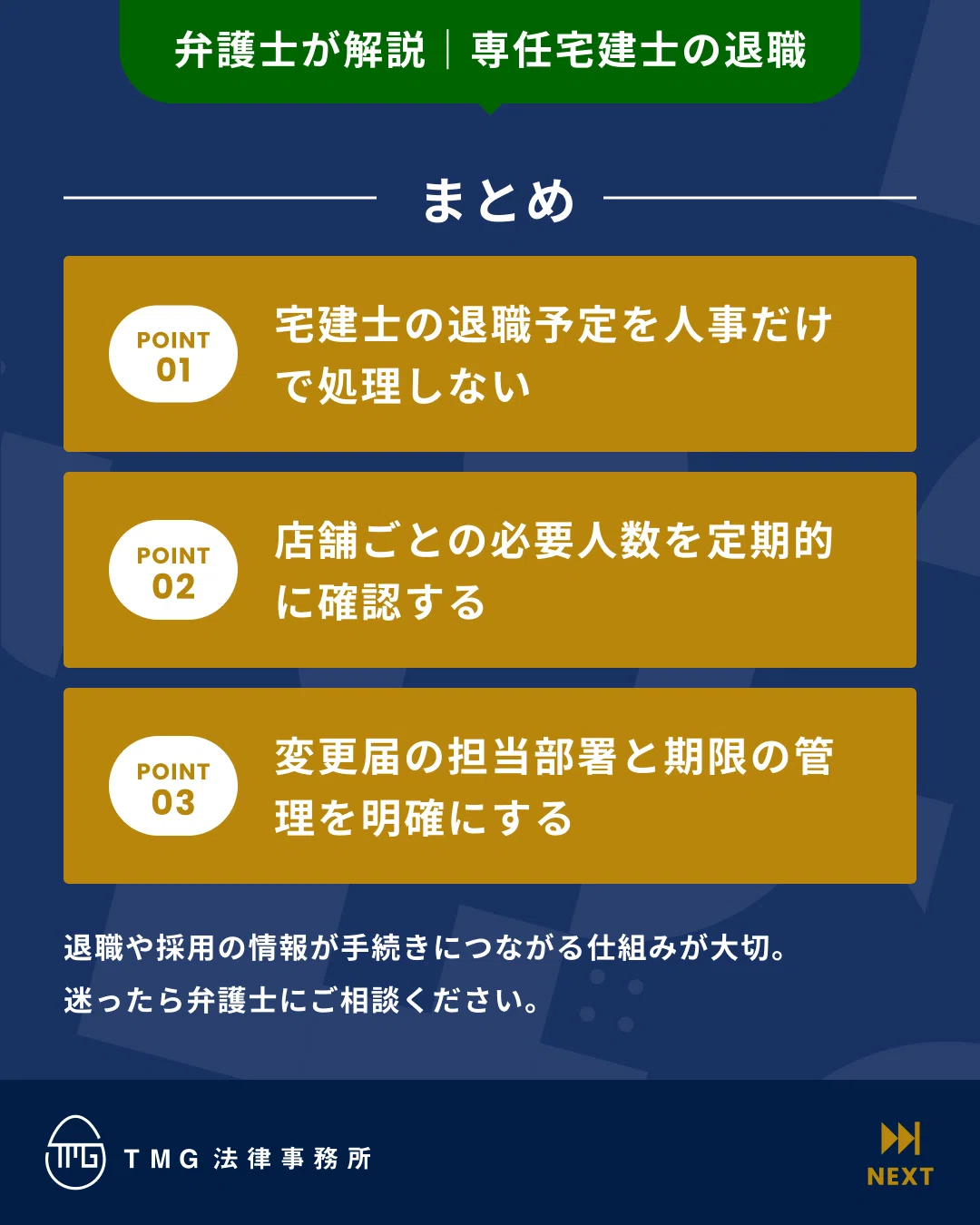
Do not let HR handle resignation plans alone
Share notices of resignation or transfer of real estate notaries with the notification manager and store manager on the same day.
Regularly confirm the required number of staff for each store
Compare the number of employees and the number of full-time real estate notaries every time there is a hire or transfer.
Clarify the department in charge of change notifications and the management of deadlines
Changes to full-time real estate notaries, officers, trade names, or office names and locations require notification within 30 days. Manage the person in charge and deadlines in a list.
Personnel turnover is unavoidable in any company. It is important to create a workflow where information about resignations and hiring also leads to procedures under the Real Estate Brokerage Act.
The next installment (Part 6) will be ‘What if you are asked for an on-site inspection or document submission for your real estate business? Actions to avoid and procedures’.
Regarding consultations on the Real Estate Brokerage Act
TMG Law Office, based in Kita-ku, Osaka, provides advisory services for real estate companies and handles consultations regarding real estate transactions.
Please feel free to contact us even at the stage of wanting to
confirm whether your company’s operations comply with current laws and regulations
or organize your personnel structure and notification management for each store.
*This article is intended to provide general information based on laws, regulations, and published materials as of October 2026 and does not constitute legal advice for individual cases. Actual judgments depend on the facts of the case, so please consult with a professional regarding specific matters.
Author and Supervisor of this Article
Koji Yoshida
Representative Attorney, TMG Law Office (Member of the Osaka Bar Association, Registration No. 33866)
[Background and Achievements]
1999: Graduated from the Department of Philosophy (Sociology), Faculty of Letters, Kobe University
2004: Passed the (former) Bar Examination
2006: Registered as an attorney (Osaka Bar Association)
2010: Established TMG Law Office
[Specialized Fields and Activities]
Since registering as an attorney, he has been at the forefront of corporate legal affairs for approximately 20 years. As a “trusted advisor to management,” he focuses on labor management, trouble prevention, and compliance measures for small and medium-sized enterprises.
He has a reputation for his style of breaking down difficult legal terms and proposing “solutions” tailored to actual business conditions.


▼ The following magazines are also recommended for those who read this article
#CorporateNote #TMGLawOffice #AttorneyExplanation #CorporateLegalAffairs #RealEstateBrokerageAct #RealEstateCompany #RealEstateNotary #RealEstateTransactionSpecialist #FullTimeRealEstateNotary #LaborShortage #Resignation #Handover #LaborManagement #SMEManagement