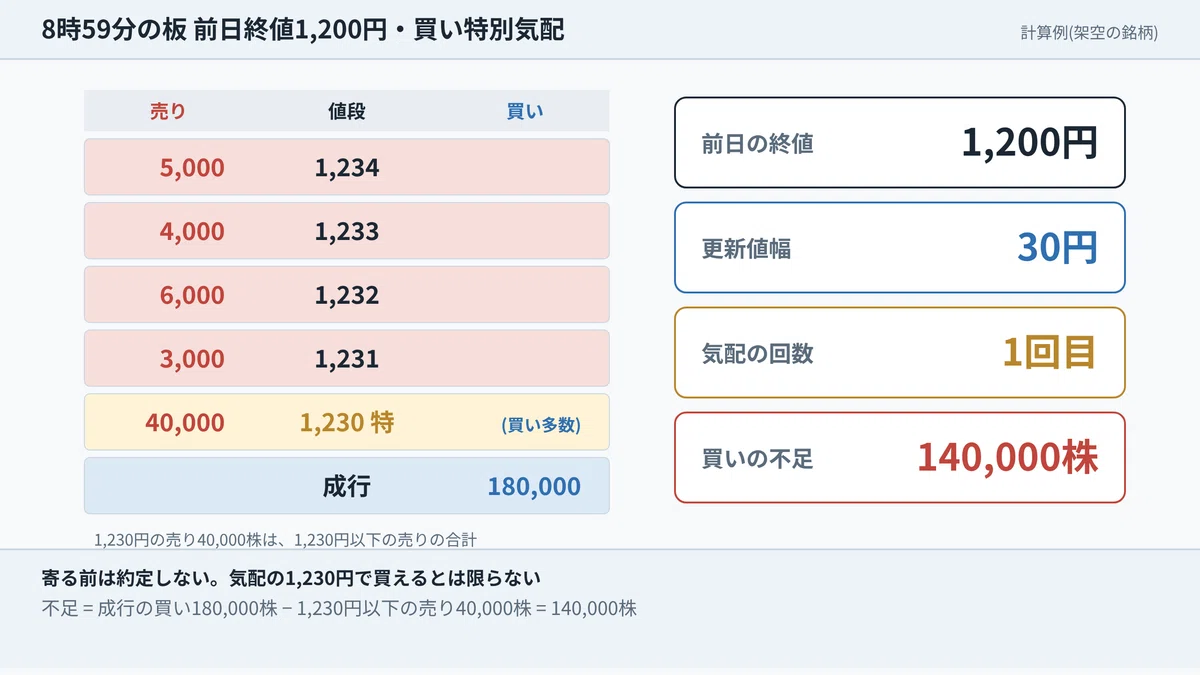
At 8:59 AM, the price remains stuck at 1,230 yen with a “Special” mark next to the quote. The previous day’s closing price was 1,200 yen. It is a stock with good earnings results released yesterday at 3:30 PM, and there are 180,000 shares in market buy orders lined up. Will it open at 9:00 AM? If it doesn’t open, at what time and at what price will it open?
Should I place a market buy order now, or wait until it opens? On the morning you first see a stock with a special quote, you usually freeze right here.
A special quote is a quote displayed while the exchange decides that “it will not set a price with the current orders.” Once you understand the mechanism, you can calculate the time until it opens and the range of the likely opening price yourself from the numbers on the screen.
In this article, you will be able to determine the following three things: how many yen the quote moves every 3 minutes, which update number the current quote is at and how many more times until the daily limit high, and which numerical changes to watch on the board before it opens.
As an example, we will follow the numbers for Person A, who has 3 million yen in capital and is watching a stock with a previous day’s closing price of 1,200 yen on a Wednesday morning. The stock is fictional, and we assume a price tick of 1 yen.
To be honest from the start, even if you read this article, you cannot precisely predict “what time it will open.” This is because orders can be canceled at any time before the market opens. All you can determine is the lower bound, such as when it might open at the earliest or at what price at the lowest.
Chapter 1: What is a Special Quote?
A special quote is a quote issued without immediately executing a trade when it seems that a transaction will occur beyond a set range from the previous price.
Background: The Tokyo Stock Exchange only executes trades immediately when the difference from the previous price is within a certain range. This is because if a trade is executed at a price outside that range, the price would jump significantly with a single order. When a trade is likely to occur at a price outside the range, a special quote is issued at the edge of the range, and the exchange waits for orders on the opposite side to accumulate. This range is called the “quote update price range.”
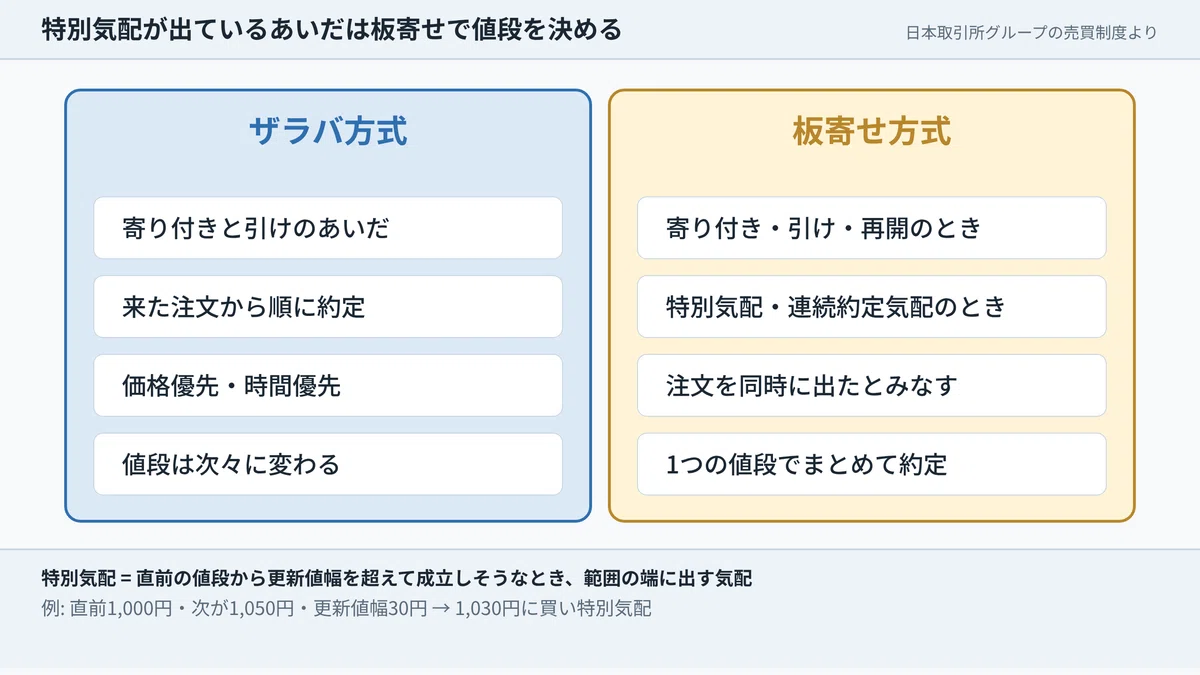
The Japan Exchange Group’s explanation of the trading system includes the following example: If the previous execution price was 1,000 yen and the next trade is likely to be executed at 1,050 yen, and the update price range is 30 yen, the trade is not executed immediately at 1,050 yen, but a special buy quote is issued at 1,030 yen.
When a trade is likely to be executed at a price higher than the previous one, it is a “special buy quote,” and when it is likely to be executed at a lower price, it is a “special sell quote.” A special buy quote is a state where there are too many buy orders compared to sell orders and no price can be set; a special sell quote is the opposite.
While a special quote is displayed, prices are determined using a method called order matching, rather than executing orders in the order they arrive as in continuous trading. Order matching is a method used at the start and end of a session and when trading resumes after an interruption, where accumulated orders are treated as if they were placed simultaneously and executed together at a single price.
At the opening, there have been no trades for the day yet. Therefore, a reference price such as the previous day’s closing price becomes the starting point. For Person A’s stock, the starting point is 1,200 yen, and if it only balances at a price exceeding 1,230 yen at the time of the opening, a special buy quote is issued at 1,230 yen. The opening scene is in this state.
On securities company screens, a “Special” mark often appears next to the quote price, but the way it is displayed varies depending on the company and tool. Some screens show the mark from the 8:00 AM hour before the market opens. Checking how it looks on your own screen once will prevent confusion in the morning.
Chapter 2: The Update Price Range Table and the Numbers for Person A’s Stock
The update price range for Person A’s stock is 30 yen. Since the price range is determined by the stock price level, find the row for your stock in the table.
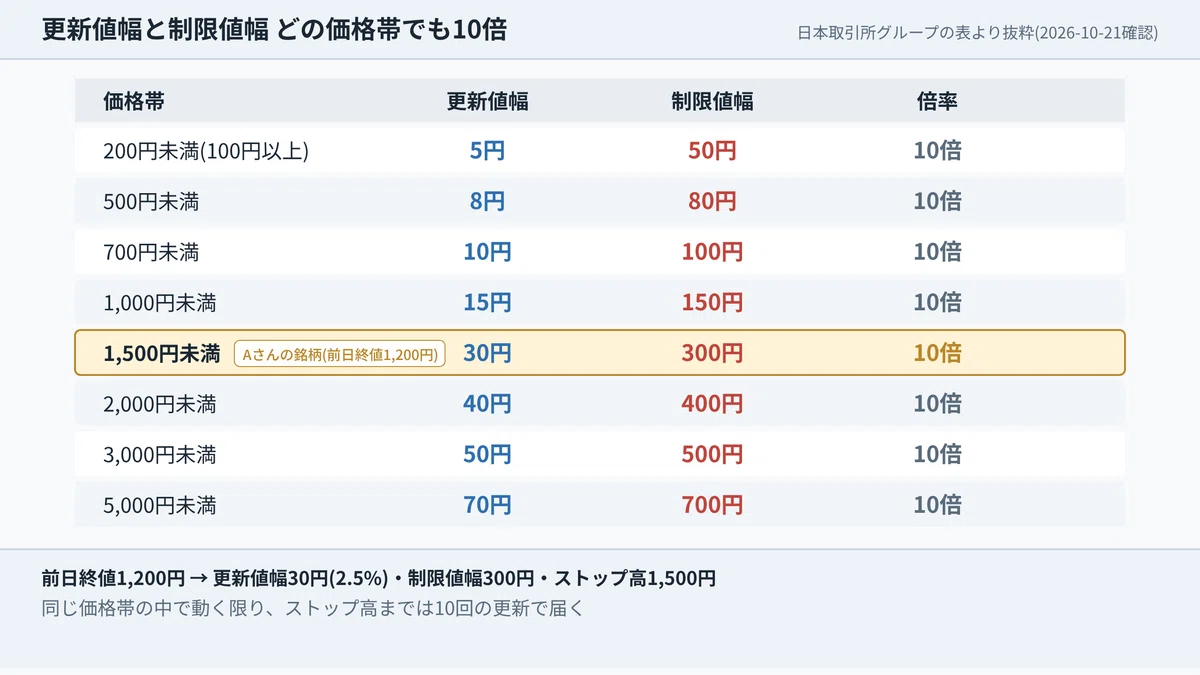
Extracting the price ranges often seen in day trading from the update price range table published by the Japan Exchange Group, it is as follows. Prices are viewed based on the previous price or the quote price.
Under 200 yen is 5 yen, under 500 yen is 8 yen, under 700 yen is 10 yen, under 1,000 yen is 15 yen, under 1,500 yen is 30 yen, under 2,000 yen is 40 yen, under 3,000 yen is 50 yen, and under 5,000 yen is 70 yen. Above this, price ranges are also set for each price bracket of 5,000 yen or more.
Since the previous day’s closing price of Person A’s stock is 1,200 yen, it falls into the row of 1,000 yen or more and under 1,500 yen, so the update price range is 30 yen. Converting this to a rate, 30 divided by 1,200 is 2.5%. This means the quote only moves by 2.5% per update.
This table is easier to remember when placed alongside the table for daily price limits (daily limit high and daily limit low). The daily limit for 1,000 yen or more and under 1,500 yen is 300 yen, which is exactly 10 times the 30 yen update price range.
When you calculate it, you will find that in any price range from 100 yen to under 5,000 yen, the daily price limit is 10 times the tick size. For under 500 yen, the tick size is 8 yen and the daily price limit is 80 yen; for under 2,000 yen, it is 40 yen and 400 yen; and for under 3,000 yen, it is 50 yen and 500 yen.
From this 10-fold relationship, you can see that as long as the quote moves within the same price range as the previous day’s closing price, it will take exactly 10 updates to reach the daily price limit. In the case of Person A’s stock, it rises by 30 yen at a time—1,230 yen, 1,260 yen—and the 10th update is the daily price limit of 1,500 yen.
However, when crossing the boundary between price ranges, the increments change along the way. This topic will be calculated in Chapter 7 using an example of a special sell quote.
Chapter 3: The Mechanism of Quotes Moving Every 3 Minutes and Calculating the Time Until the Market Opens
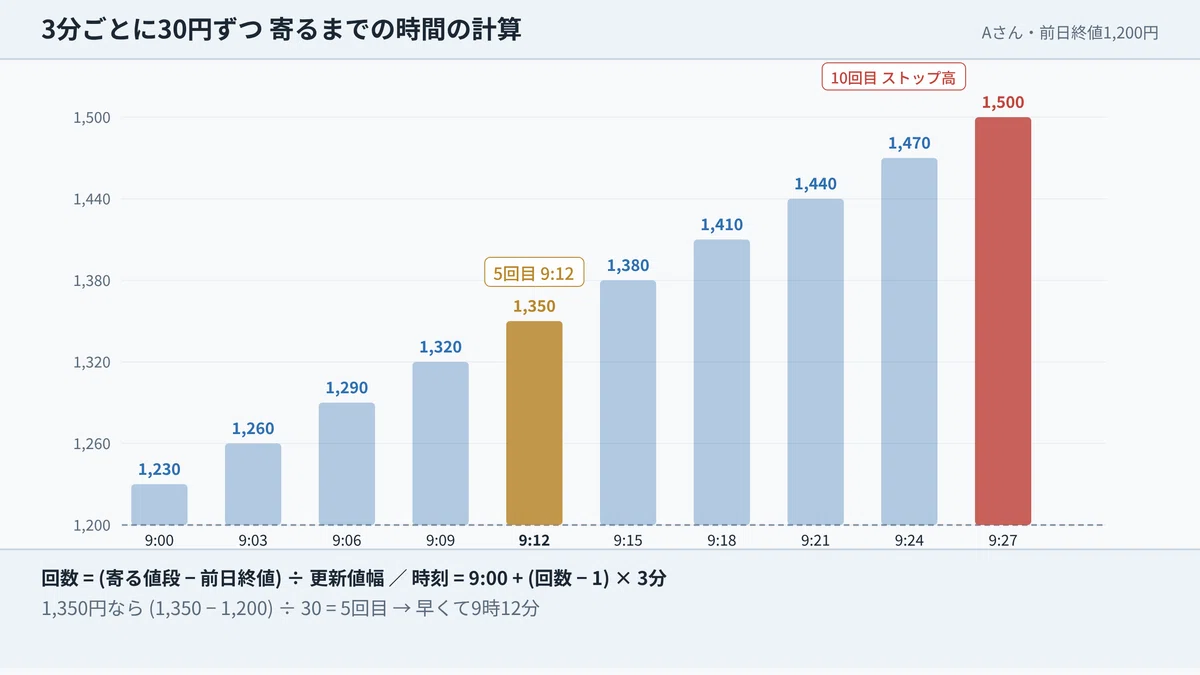
The time until the market opens can be determined by calculating which update it is using “(Opening Price – Previous Day’s Closing Price) ÷ Tick Size,” and then adding 3 minutes for each update starting from 9:00 AM.
Background: If a special quote is issued but no orders appear on the opposite side, the exchange moves the quote by the tick size every 3 minutes. This is to avoid sudden large price jumps and instead gradually raise (or lower) the price to attract orders from people who are willing to sell (or buy) at that price. The 3-minute interval also gives people who see the quote time to think and place their orders.
Here are the quotes for Person A’s stock if it does not open at 9:00 AM: 1,230 yen at 9:00, 1,260 yen at 9:03, 1,290 yen at 9:06, 1,320 yen at 9:09, 1,350 yen at 9:12, 1,380 yen at 9:15, 1,410 yen at 9:18, 1,440 yen at 9:21, 1,470 yen at 9:24, and 1,500 yen at 9:27.
By working backward from this, you can determine the lower limit of the opening time. For example, if you think “it looks like selling will appear around 1,350 yen,” that is the 5th update (1,350 – 1,200) ÷ 30. Since the 1st update is at 9:00, you add 3 minutes × 4 to 9:00 to get 9:12. Even if it opens at 1,350 yen, the earliest it can open is 9:12.
Conversely, if it has not opened by 9:12, you know the opening price will be higher than 1,350 yen. Since the quote price and the time are linked one-to-one, you can tell “which update it is” by looking at the clock, and you can also determine the lower limit of the opening price.
The 10th update is the daily price limit of 1,500 yen, which is at 9:27. If it still hasn’t opened after 9:27, it means there is a surplus of buy orders at the daily price limit price for the rest of the day.
What this calculation provides is merely the lower limit of the opening time. If enough orders appear on the opposite side during the 3-minute update intervals, it will open at that quoted price. Conversely, if buy orders increase as people see the quote rising, it will not open for even longer. The update at which it opens is determined by the volume of orders that appear with each update.
Chapter 4: Rules for Opening at a Special Quote Price
The market opens at a special quote price when the conditions for Itayose (board matching) are met at that price.
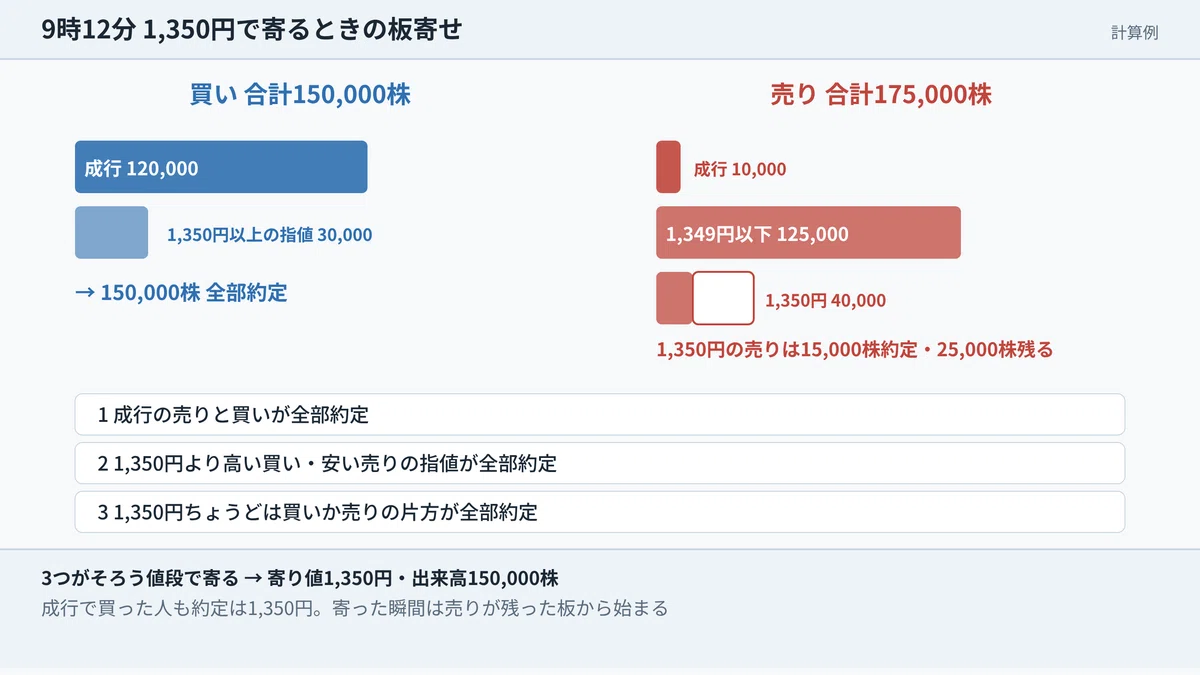
Background: In Itayose, the system searches for a price that simultaneously satisfies the following three conditions and executes trades at that single price: All market buy and sell orders must be executed. All limit buy orders higher than the execution price and all limit sell orders lower than the execution price must be executed. For orders at the exact execution price, either all buy orders or all sell orders must be executed. If there is no price that satisfies these three conditions, the market will not open.
Let’s verify the scenario where Person A’s stock opens at 1,350 yen at 9:12 using the numbers on the board as an example.
On the buy side, there are 120,000 shares at market and 30,000 shares at limit prices of 1,350 yen or higher, for a total of 150,000 shares. On the sell side, assume there are 10,000 shares at market, 125,000 shares at limit prices of 1,349 yen or lower, and 40,000 shares at the exact limit price of 1,350 yen.
When executed at 1,350 yen, all 150,000 buy shares are executed. On the sell side, the 10,000 market shares and the 125,000 shares at 1,349 yen or lower are all executed, and the remaining 15,000 shares are executed from the 40,000 shares at the exact 1,350 yen limit. This leaves 25,000 sell shares at 1,350 yen. Since the three conditions are met, the opening price is 1,350 yen and the trading volume is 150,000 shares.
At 9:09, when the price was 1,320 yen, it means there were not enough shares on the sell side and there was a surplus of market buy orders. The market will not open at a price where all market buy orders cannot be executed.
There are two things we can learn from this rule. First, the execution price for someone who placed a market buy order is unknown until the market opens. Even someone who bought at market after seeing the 1,230 yen quote will have their order executed at 1,350 yen. Second, the moment the market opens, continuous trading begins with a board that still has orders remaining on one side. In the example, there are 25,000 sell shares remaining at 1,350 yen.
Chapter 5: Three Numbers to Watch on the Board Before the Market Opens
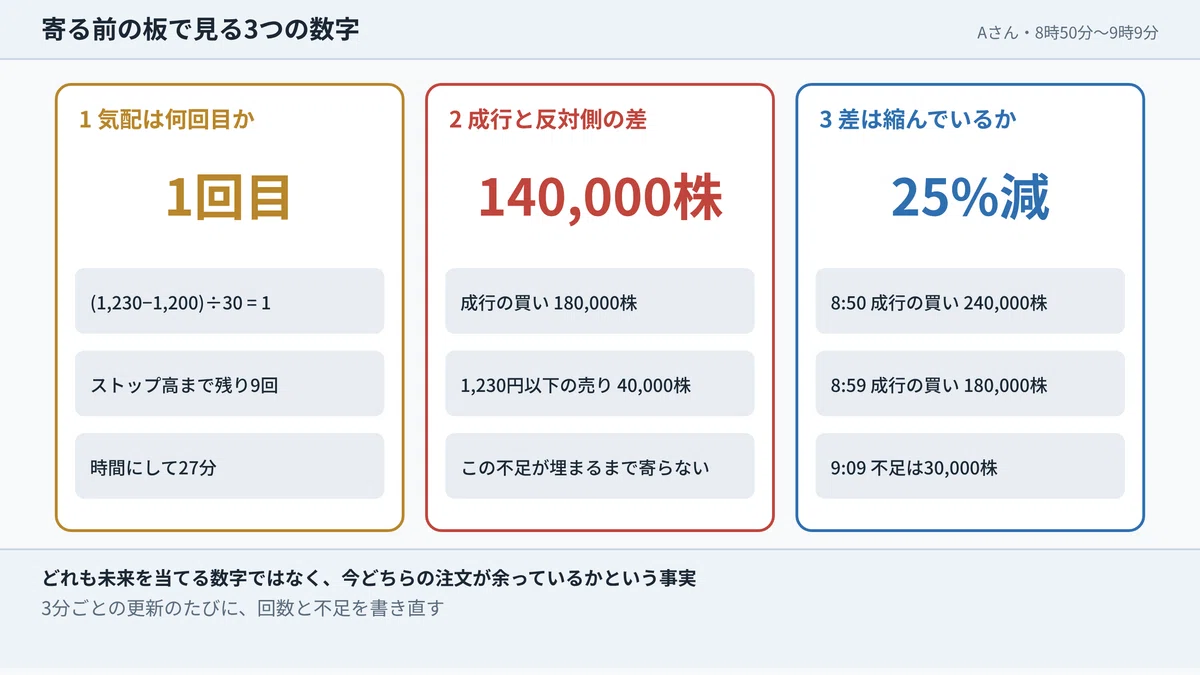
Before the market opens, you should look at three things: how many times the quote has updated, the difference between the number of market orders and the number of orders on the opposite side, and whether that difference is shrinking.
The first is how many increments the quoted price is away from the previous day’s closing price. For Person A’s stock, the 8:59 AM quote of 1,230 yen is the first increment, calculated as (1,230 – 1,200) / 30. You can read this as having 9 increments left until the daily limit high, which translates to 27 minutes.
The second is the difference between the number of market orders and the total number of orders on the opposite side up to the quoted price. For example, if at 8:59 AM there are 180,000 shares in market buy orders and a total of 40,000 shares in sell orders at 1,230 yen or lower, there is a shortage of 140,000 buy shares. As long as this shortage is not filled, the stock will not open at 1,230 yen. Depending on the screen, the number of market orders may be displayed on the top line of the quote.
The third is whether that difference is shrinking or widening over time. For example, if the 240,000 market buy orders at 8:50 AM have decreased to 180,000 by 8:59 AM, it means 60,000 shares, or 25%, were canceled in 9 minutes. Since order cancellations are free before the market opens, this decrease can be read as the fact that some people have stopped their buying intentions before the opening.
You can use the same perspective even after 9:00 AM. If the shortage has shrunk to 30,000 shares by 9:09 AM, it becomes more likely that the stock will open at the next update or the one after that. Conversely, if the shortage increases every time the quote rises, you should assume it will not open for a while longer.
None of these are numbers meant to predict the future. They are facts about which quote increment we are currently at and how many orders are left on either side at this very moment. Rewriting those facts every 3 minutes is how you read the order board before the market opens.
Chapter 6: Special Quotes and Continuous Execution Quotes During Trading Hours
Special quotes appear not only at the opening but also during trading hours. A similar concept is the continuous execution quote.
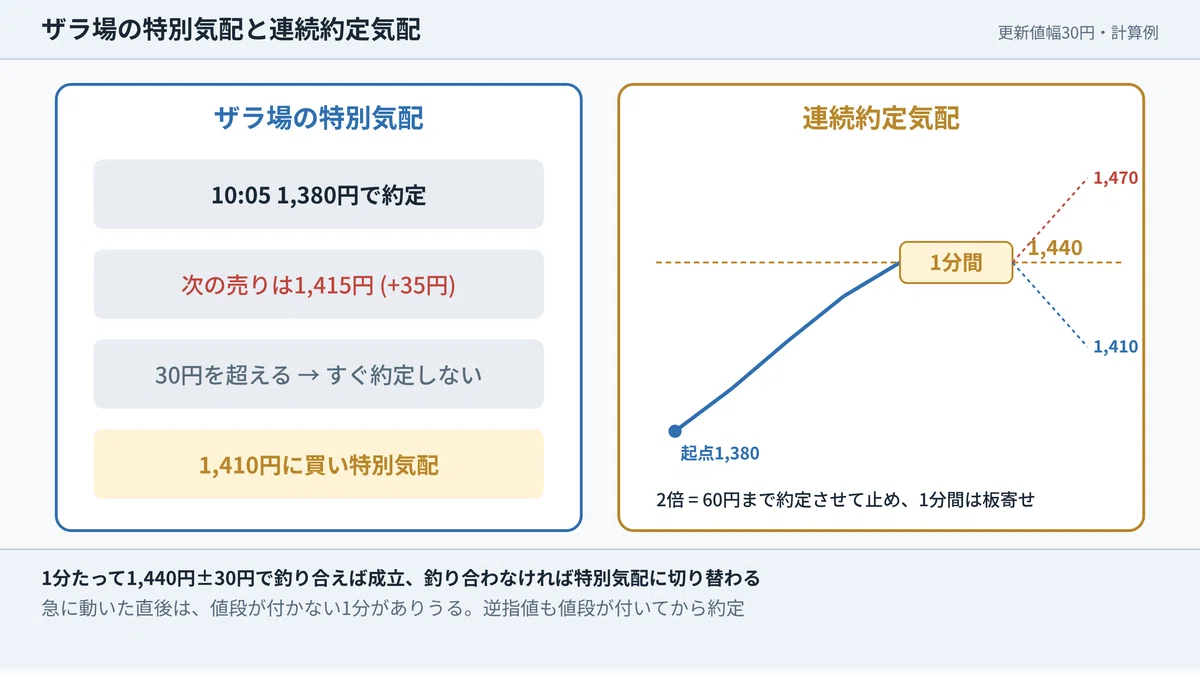
A special quote during trading hours appears when the next execution cannot occur without exceeding the update price range from the immediately preceding execution price. For example, suppose Person A’s stock was executed at 1,380 yen at 10:05 AM, but the sell board is thin, and the next available sell order is at 1,415 yen. Since 1,415 yen is 35 yen away from 1,380 yen, exceeding the 30-yen update price range, a buy special quote appears at 1,410 yen.
Background: Continuous execution quotes act as a brake when large orders move the price by eating through the board without going through a special quote. When it seems that executions will continue beyond twice the update price range from the starting execution price due to a single order or multiple orders within one minute, the system stops the execution at the twice-the-range level and issues a continuous execution quote for one minute. This mechanism took its current form following the revision of trading rules in November 2019.
For Person A’s stock, the update price range is 30 yen, so twice that is 60 yen. If a large buy order eats through the board starting from 1,380 yen at 10:05 AM, it will stop once it reaches 1,440 yen, and a continuous execution quote will appear at 1,440 yen for one minute.
While a continuous execution quote is displayed, trading is conducted via order matching. After one minute, if there are orders on the opposite side within the 30-yen update price range from 1,440 yen, they will be executed immediately. If they do not balance within that range, it will switch to a special quote at 1,470 yen (or 1,410 yen if moving downward).
In day trading, this means that immediately after a sudden price movement, there may be a one-minute period where no price is set. Even if your stop-loss order is triggered during that minute, it will only be executed after a price is set. If the ‘Ren’ (continuous) mark appears on the screen, recalculate when and at what price your order might be executed based on the update price range.
Chapter 7: Sell Special Quotes and Calculations for When the Increment Changes Below 1,000 Yen
Sell special quotes work with the same mechanism as buy quotes but in the opposite direction. However, when the price drops and crosses the boundary of a price range, the increments become finer.
Background: The update price range is determined by which price range the previous price or quote price falls into. When a quote drops below 1,000 yen and enters the price range of less than 1,000 yen, the update price range from there becomes 15 yen instead of 30 yen. Since the daily price limit is determined by the previous day’s closing price, the daily limit low price does not change.
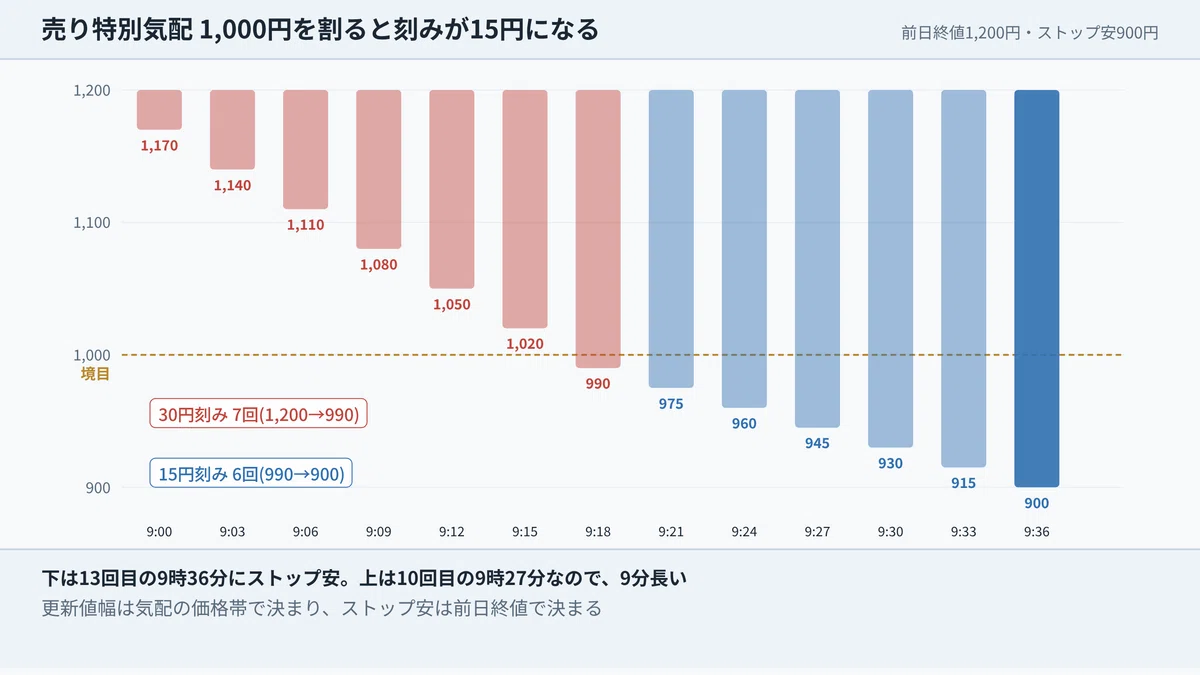
Suppose Person A’s stock has poor earnings and enters a sell special quote. It is 1,170 yen at 9:00 AM, 1,140 yen at 9:03 AM, 1,110 yen at 9:06 AM, 1,080 yen at 9:09 AM, 1,050 yen at 9:12 AM, 1,020 yen at 9:15 AM, and 990 yen at 9:18 AM. Up to this point, it is in 30-yen increments.
Since 990 yen is less than 1,000 yen, from the next point on, it will be in 15-yen increments. It becomes 975 yen at 9:21 AM, 960 yen at 9:24 AM, 945 yen at 9:27 AM, 930 yen at 9:30 AM, 915 yen at 9:33 AM, and 900 yen at 9:36 AM. Since the daily limit low is 900 yen, calculated by subtracting the 300-yen limit from the previous day’s closing price of 1,200 yen, it stops here.
Counting the number of times, there are 7 increments of 30 yen and 6 increments of 15 yen, making the 13th time the daily limit low. While it takes 10 increments to reach the top, it takes 13 increments to reach the bottom at 9:36 AM. Even with the same 300-yen price range, the bottom takes 9 minutes longer.
This difference matters when calculating the time until the market opens. For stocks where the previous day’s closing price is near the boundary of a price range, calculating with only one row of the table will result in a time discrepancy. Check which price range the quote has entered every time it updates.
The same thing happens on the upper side. For example, if the previous day’s closing price is 1,450 yen, the tick size expands from 30 yen to 40 yen once the quote enters the 1,500 yen range or higher. For stocks that straddle the boundary, use two rows in the table to count the number of updates.
Chapter 8: When the Quote Reaches the Daily Price Limit (Stop-High)
Even if the quote rises to the daily price limit, if there are excess buy orders, the stock may remain at that price for the rest of the day without a trade being executed.
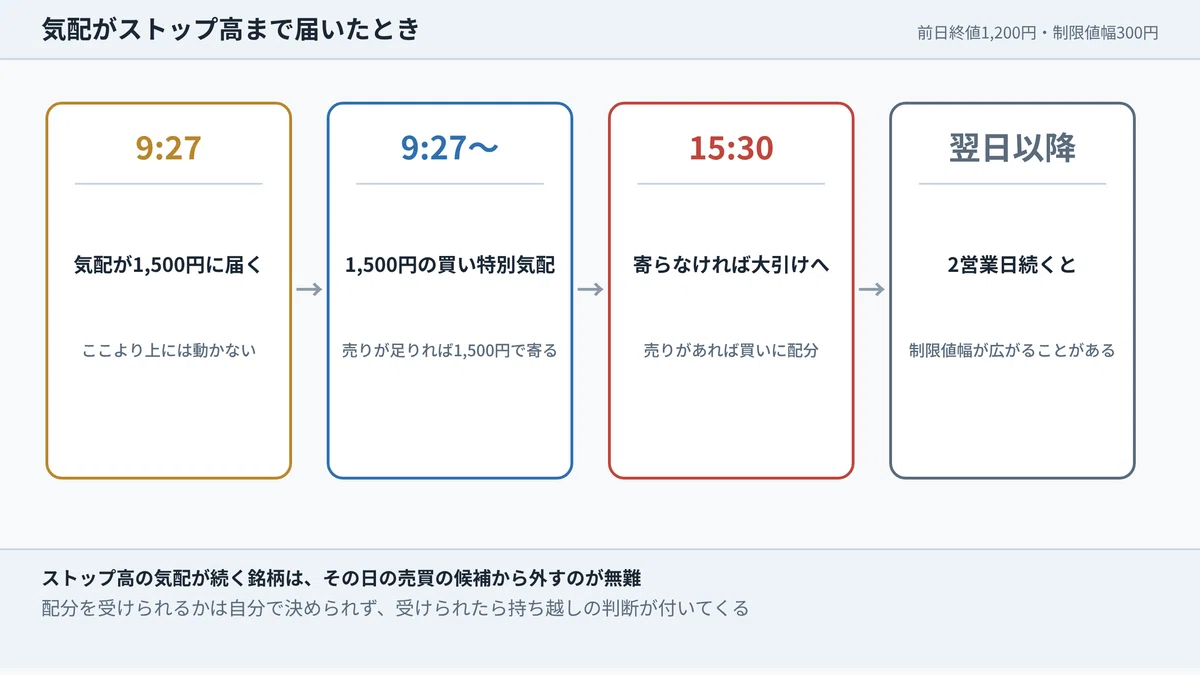
For Person A’s stock, the quote reaches 1,500 yen at 9:27 AM. Since the quote cannot be moved higher than 1,500 yen, a special buy quote at 1,500 yen continues from this point on. If enough sell orders at 1,500 yen appear to cover all market buy orders and limit buy orders at 1,500 yen, the stock will open at 1,500 yen.
If they do not appear, the stock will proceed without a price being set until the market close at 3:30 PM. At the market close, if there are sell orders at the daily price limit, there is a mechanism to allocate those shares to buy orders to execute trades. This is called a ‘stop allocation,’ and even if you have placed a buy order, there is no guarantee that you will receive an allocation.
The Japan Exchange Group stipulates that for stocks that hit the daily price limit, receive no stop allocation, and have a trading volume of zero shares for two consecutive business days, the price limit range will be expanded starting from the next business day. On the day the range is expanded, the daily price limit changes, so the calculation for the number of updates also changes.
The approach for day trading is simple: it is safer to exclude stocks that have a continuous daily price limit quote from your trading list for the day. Even if you manage to buy, you will be faced with the decision of whether to hold the position until the next morning. Holding overnight is a different decision from day trading.
Chapter 9: Following a Certain Wednesday from 8:00 AM to 3:30 PM
Returning to the Wednesday in the prologue, let’s list Person A’s day in chronological order. The numbers are calculation examples.
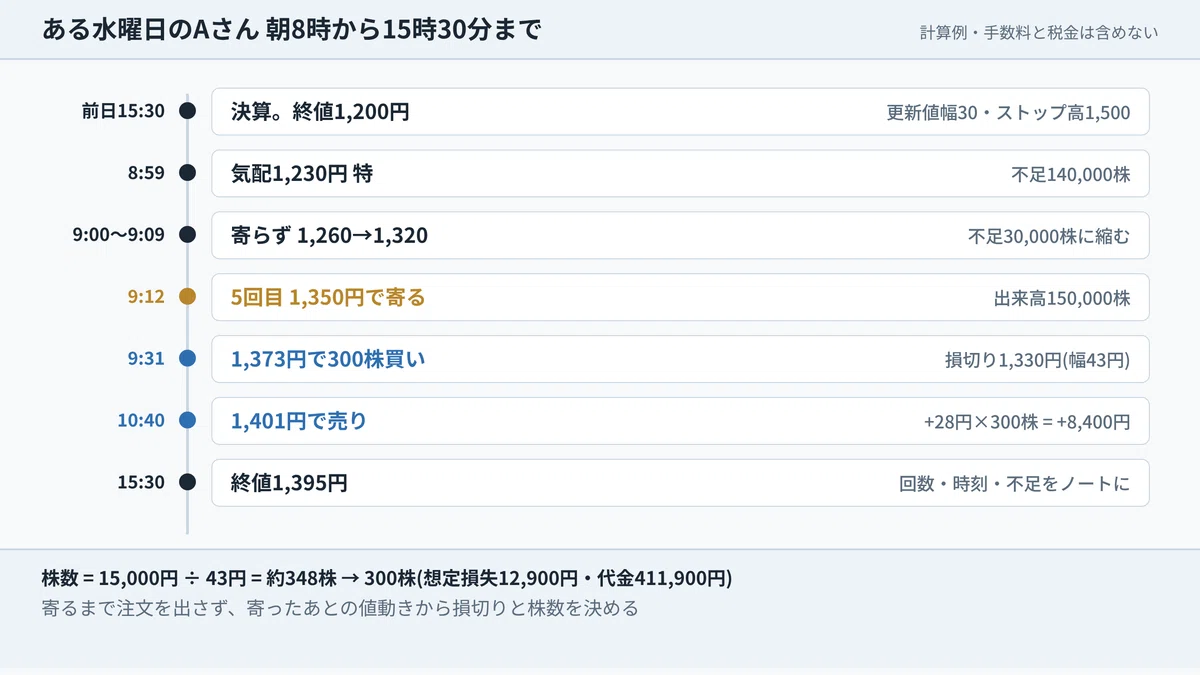
At 3:30 PM the previous day, the company’s financial results were released. The closing price was 1,200 yen. That evening, Person A wrote down the update tick size of 30 yen, the daily price limit of 1,500 yen, and the 10 updates required to reach the daily price limit. They decided that the loss per trade would be 0.5% of their 3 million yen capital, or up to 15,000 yen.
Order acceptance begins at 8:00 AM. At 8:50 AM, the quote is 1,230 yen, with 240,000 shares in market buy orders. By 8:59 AM, this decreases to 180,000 shares, and there are 40,000 shares in sell orders at 1,230 yen or lower. The shortfall is 140,000 shares. Person A decides not to place an order until the stock opens.
At 9:00 AM, it does not open and remains a special quote at 1,230 yen. At 9:03 AM it is 1,260 yen, at 9:06 AM it is 1,290 yen, and at 9:09 AM it is 1,320 yen. At this point, the shortfall has shrunk to 30,000 shares. At 9:12 AM, it opens at the 5th update price of 1,350 yen. The trading volume is 150,000 shares.
The price movement from the opening until 9:20 AM saw a high of 1,372 yen and a low of 1,331 yen. Person A places a stop-buy order 1 yen above the high at 1,373 yen, and sets the stop-loss 1 yen below the low at 1,330 yen. The range is 43 yen.
The number of shares is 15,000 yen divided by 43 yen, which is approximately 348 shares; rounded down to the nearest 100-share unit, this is 300 shares. The loss if the stop-loss is triggered is 43 yen times 300 shares, which is 12,900 yen, and the purchase cost is 411,900 yen. At 9:31 AM, 300 shares were executed at 1,373 yen.
During the 10:00 AM hour, the price moved between 1,380 yen and 1,400 yen, and no continuous execution quotes appeared. At 10:40 AM, when it broke below the 5-minute chart low, they sold at 1,401 yen. The profit was 28 yen times 300 shares, which is 8,400 yen (excluding commissions and taxes).
They did not trade in the afternoon. The afternoon session opened at 1,388 yen at 12:30 PM, and the closing price at 3:30 PM was 1,395 yen. Person A ended the day by writing in their notebook which update the opening price was (the 5th), the time it opened (9:12 AM), and the way the shortfall decreased before opening, line by line.
Chapter 10: What Not to Do During Special Quotes
Do not jump into stocks with special quotes using market orders before they open.
The first reason is market buy orders before the opening. If you see the 1,230 yen quote at 8:59 AM and buy 300 shares at market, you might think in your head that the cost is 369,000 yen, but the actual execution price is the opening price. If it opens at 1,350 yen, the cost is 405,000 yen, meaning you bought it for 36,000 yen more than expected. If it opens at the daily price limit of 1,500 yen, it costs 450,000 yen, a difference of 81,000 yen.
Furthermore, the price immediately after opening tends to be volatile. In Person A’s example, after the opening price of 1,350 yen, it dropped to 1,331 yen by 9:20 AM. The 300 shares bought at the opening price already had an unrealized loss of 5,700 yen. If you enter with a market order without deciding on a stop-loss price, you will be forced to make a decision during this drop.
The second point is to assume that the quoted price is a ‘price you can buy at.’ The special quote price is a tentative price issued by the exchange, and it does not necessarily mean that a trade will be executed at that price. If you place a limit buy order, you must do so with the understanding that if the stock opens at a price higher than your limit, your order will not be executed.
The third point is placing large orders for stocks with continuous daily limit-high quotes in anticipation of an allocation. You cannot decide for yourself whether you will receive an allocation, and if you do, you are then faced with the decision of whether to hold the position overnight.
All of these are things that can be avoided by waiting until the stock opens. If you follow the sequence of not placing orders until the stock opens, and then deciding your stop-loss price and number of shares based on the price movement after it opens—just like Person A—you can trade on a morning with special quotes using the same procedure as any other morning.
Chapter 11: Things That Cannot Be Determined
Even if you understand the mechanism of special quotes, there are still things that cannot be determined.
The first is how many updates it will take for the stock to open. What you can calculate is only the opening time and the lower limit of the price; the actual opening price is determined by the orders that appear and are canceled with each update. Some people stop selling when they see the quote rise, while others add to their buy orders.
The second is which direction the price will move after it opens. At the moment it opens, continuous trading begins from an order book where orders on one side were left over. There are days when it goes up from the opening price and days when it goes down; neither can be determined from the numbers in the order book before the opening.
The third is the screen display. The way special quotes, continuous execution quotes, and market order volumes are displayed differs depending on the securities company and the tool. Please use the method of reading the numbers in this article only after confirming where those numbers appear on your own screen.
The fourth is markets other than the Tokyo Stock Exchange (TSE). On PTS (Proprietary Trading Systems), stocks may be traded at prices different from the TSE, and you may see prices that differ from the TSE’s special quotes.
The fifth is changes to the system. The tables for update price ranges and daily price limits, as well as the mechanism for continuous execution quotes, have been reviewed in the past. The numbers in this article are based on information confirmed on the Japan Exchange Group website on October 21, 2026. Before using them, please check the latest tables published by the exchange.
Conclusion
Let’s return to 8:59 in the prologue. The special quote of 1,230 yen might not open even when it hits 9:00. What you know when it doesn’t open is the time and the lower limit of the price: it will not open at 1,350 yen until 9:12, and it will reach the daily limit-high of 1,500 yen by 9:27.
To the question of whether to buy at market or wait, the answer was to wait until it opens. The only thing to do while waiting is to rewrite the number of updates and the number of insufficient shares every 3 minutes.
In the end, what you learned in this article is just one formula: (Opening Price – Previous Day’s Closing Price) ÷ Update Price Range to get the number of updates, and adding 3 minutes each at 9:00. For Person A’s morning, it was 150 ÷ 30, which is 5 updates, making it 9:12. The point was that this one division is all you need on a morning with special quotes.
Methods for distinguishing how to view the next morning based on the time of announcement for openings after earnings reports, as well as a list of major earnings release dates in the first half of November, are summarized in a paid article.
https://note.com/takway/n/n20e32194747c
When you see a stock with a special quote, do you place an order before it opens, or do you place it after it opens? Please let me know in the comments, and I will use it as a reference for my next article.
If you follow me, you will receive new articles in the morning and evening.
This article explains the mechanism of special quotes and order matching. The numerical values in the article are calculation examples for explanatory purposes, and the stock names are fictitious. These are not actual trading results. The content regarding update price ranges, daily price limits, and continuous execution quotes is based on the trading system pages of the Japan Exchange Group (confirmed on October 21, 2026). This does not recommend trading specific stocks, nor does it guarantee future results. Please make investment decisions at your own responsibility.