Hello, I’m Kabu-inu Money-kun 🐶
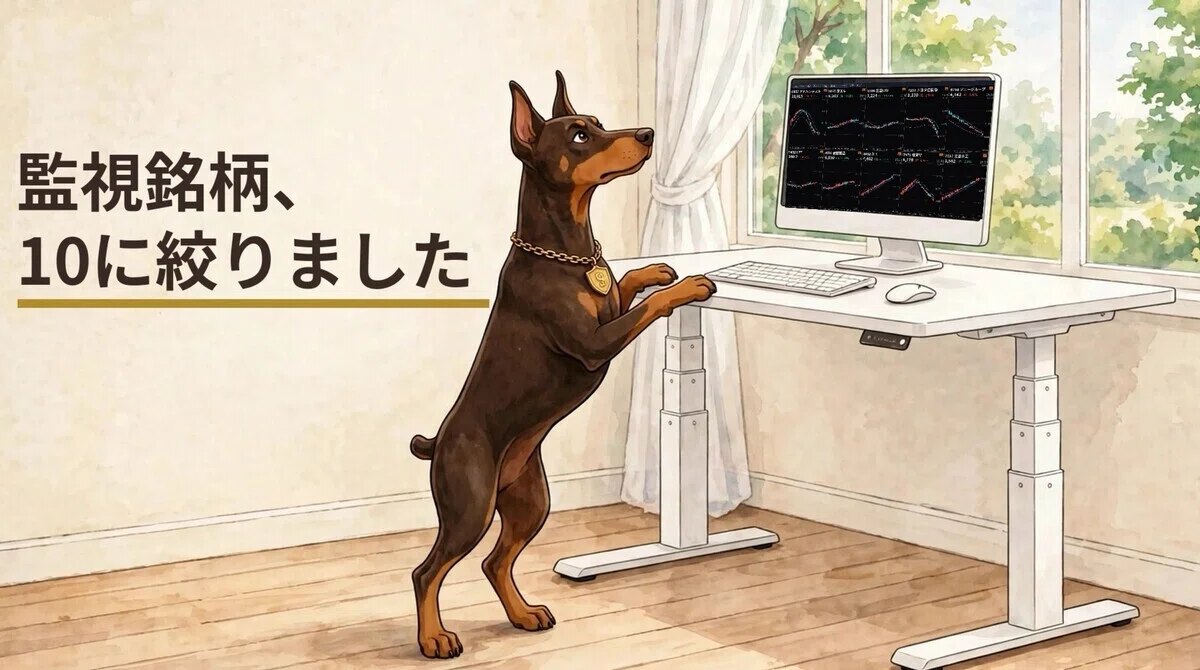
Today, I’m not talking about trading, but about the “stocks I watch.” For the first month or so since I started day trading, I picked candidates every morning based on that day’s news, but I didn’t have a core watchlist. Now that I can embed stock lists into my notes, I’ve decided to narrow it down to 10 stocks.
For those who are struggling:
・You can’t settle on which stocks to watch for day trading and are searching from scratch every morning.
・You only look at popular sectors like semiconductors and get stuck on days when those sectors are weak.
・You don’t really understand the difference between a “watchlist” and a “buy list.”
This article is recommended for people like this.
What you will learn in this article:
・The 3 criteria for deciding on watchlist stocks (sector diversification, policy tailwinds, and affordable prices).
・The reason I excluded “stocks with too high a minimum purchase unit” from the start.
・The 10 stocks I actually chose and the role of each.
To conclude, a watchlist is not a “list of stocks I want to buy,” but rather a “group of faces I check every morning.” Whether or not I actually buy them is decided separately based on that day’s news and my own trading style.
Why I made the list
On note, I can now embed stock charts and stock lists into my articles. To be honest, the initial trigger was that I needed to put into words the “stocks I always watch” so that I could use them in my own articles.
Looking back, my trading in October was heavily skewed toward Advantest. It’s a strength to have one stock you know well, but if that’s all you have, your judgment becomes sloppy on days when that stock is volatile or stagnant. The goal is to decide on a set of faces to watch every day so that I can tell “which sector is receiving capital today.”
Criterion 1: Diversify sectors
I compared my initial list of 10 stocks with Matsui Securities’ “Day Trading Suitability Ranking” (stock price volatility x trading value). Half of the candidates were regulars in the ranking, and the other half were stocks with small price movements that I had chosen as “defensive candidates.”
This is where I thought about sector diversification. The top of the ranking depends on the market theme at the time (currently semiconductors and electric wires). If you narrow your watchlist down to just those, you’ll have zero candidates on days when that sector is weak. Conversely, if the sectors are spread out, the chances of the “star of the day” being in your list increase regardless of the theme.
Note that this ranking displays 100 items, and defensive stocks like Takeda Pharmaceutical (41st), Kao (50th), NTT (51st), and Seven & i (94th) also appeared further down. It is an indicator used under the premise that the ranking is based on “order of volatility,” not “order of good stocks.”
Criterion 2: Are there policy tailwinds?
The government’s “Basic Policies for Economic and Fiscal Management and Reform 2026 (Basic Policies 2026)” includes “17 Strategic Fields” for priority public-private investment. These include AI/semiconductors, the defense industry, drug discovery/advanced medicine, content, and information and communications.
Day trading is a one-day battle, but the news of the day is not unrelated to “where the money is designed to flow.” Stocks that overlap with these 17 fields are more likely to see sustained medium- to long-term news and capital flows. I made this the core of my watchlist.
What I struggled with in choosing candidates was the final slot. At one point, semiconductor and IP (content) stocks seemed to have a seesaw relationship. On days when semiconductors are sold, IP is bought, and vice versa. If both are on the watchlist, I can follow the star regardless of which side of the seesaw goes up. Also, defense is a theme that cannot be ignored macro-economically.
Criterion 3: Is it an “affordable price”?
This is the criterion most directly linked to my own capital. My day trading capital is 1.2 million yen, and my maximum loss per trade is 12,000 yen. I determine the number of shares by calculating backward from my stop-loss range.
With this yardstick, stocks that are too expensive in terms of share price itself cannot be handled from the start. For example, Disco costs about 5 million yen for one unit (100 shares). Even if they are good stocks that are regulars on the rankings, they don’t fit my model. I have removed stocks that I ‘cannot buy even if I watch them’ from the list.
The fixed 10 stocks
・Advantest (6857) Semiconductors
・Tokyo Electron (8035) Semiconductors
・Mitsubishi UFJ Financial Group (8306) Finance
・Toyota Motor (7203) Automotive
・Sony Group (6758) Electronics/Content
・NTT (9432) Telecommunications
・Takeda Pharmaceutical (4502) Pharmaceuticals
・Kao (4452) Daily Necessities/Chemicals
・Nintendo (7974) Content/IP
・Mitsubishi Heavy Industries (7011) Defense/Heavy Industry
The ones I removed along the way were JR East and Seven & i. Seven & i was the only pure domestic retail stock that didn’t fit directly into the 17 fields or market themes. Instead, I added Nintendo and Mitsubishi Heavy Industries, bringing it to exactly 10 stocks.
The two semiconductor stocks are leading-role price movers, Sony and Nintendo are content, Takeda is drug discovery, and Kao is defensive daily necessities. Mitsubishi UFJ and NTT also serve as thermometers to gauge the overall market sentiment on volatile days.
Summary
・The watchlist is not a ‘buy list’ but a ‘roster to check every morning.’ Whether to buy is decided by the day’s news and patterns
・There are three criteria: sector diversification, tailwinds from policy (the 17 strategic fields), and whether the price is ‘buyable’ with my capital
・Use rankings as indicators of price movement and liquidity, and create reasons to buy separately based on macro factors and news
This list is not fixed. If themes change, I will swap them out. When that happens, I will write about it honestly.
Following me would be a great encouragement!
Making difficult investing as easy as talking while taking a walk.
*This article is not an investment solicitation. Please invest at your own risk and within the scope of your surplus funds, woof🐶*