What is day trading?
Day trading, also called intraday trading, is short-term trading in which all positions are closed before the end of the trading day. The day trader aims to earn on price moves within the day, not on the long-term development of a company or a cryptocurrency. They trade equities, indices, currencies on the forex market, commodities or cryptocurrencies, often through leveraged products such as CFDs or futures. Trading runs in both directions: a long position bets on rising prices, a short position on falling ones.
The advantage: nothing happens to your money overnight. Opening gaps, news out of Asia and weekend crashes only hit those holding positions. The price for that is many trades, tight stops and therefore high costs relative to the gain per trade.
For learning, the distinction from the other trading styles helps:
| Trading style | typical holding time | trades per week | costs relative to the target |
|---|---|---|---|
| Scalping | seconds to minutes | very many, often over 50 | very high |
| Day trading | minutes to hours | 5 to 30 | high |
| Swing trading | days to weeks | 1 to 5 | medium |
| Position trading | weeks to months | under 1 | low |
In crypto there is no close, the market runs around the clock. Day trading cryptocurrencies therefore means you decide yourself when your trading day ends, say at 22:00, and close everything by then. Without that cut-off you drift into swing trading without noticing, only with no plan for the night.
Can you make a living from day trading? What studies show
The short answer: almost nobody can, and the evidence here is unusually clear. Three sources measuring different things point the same way.
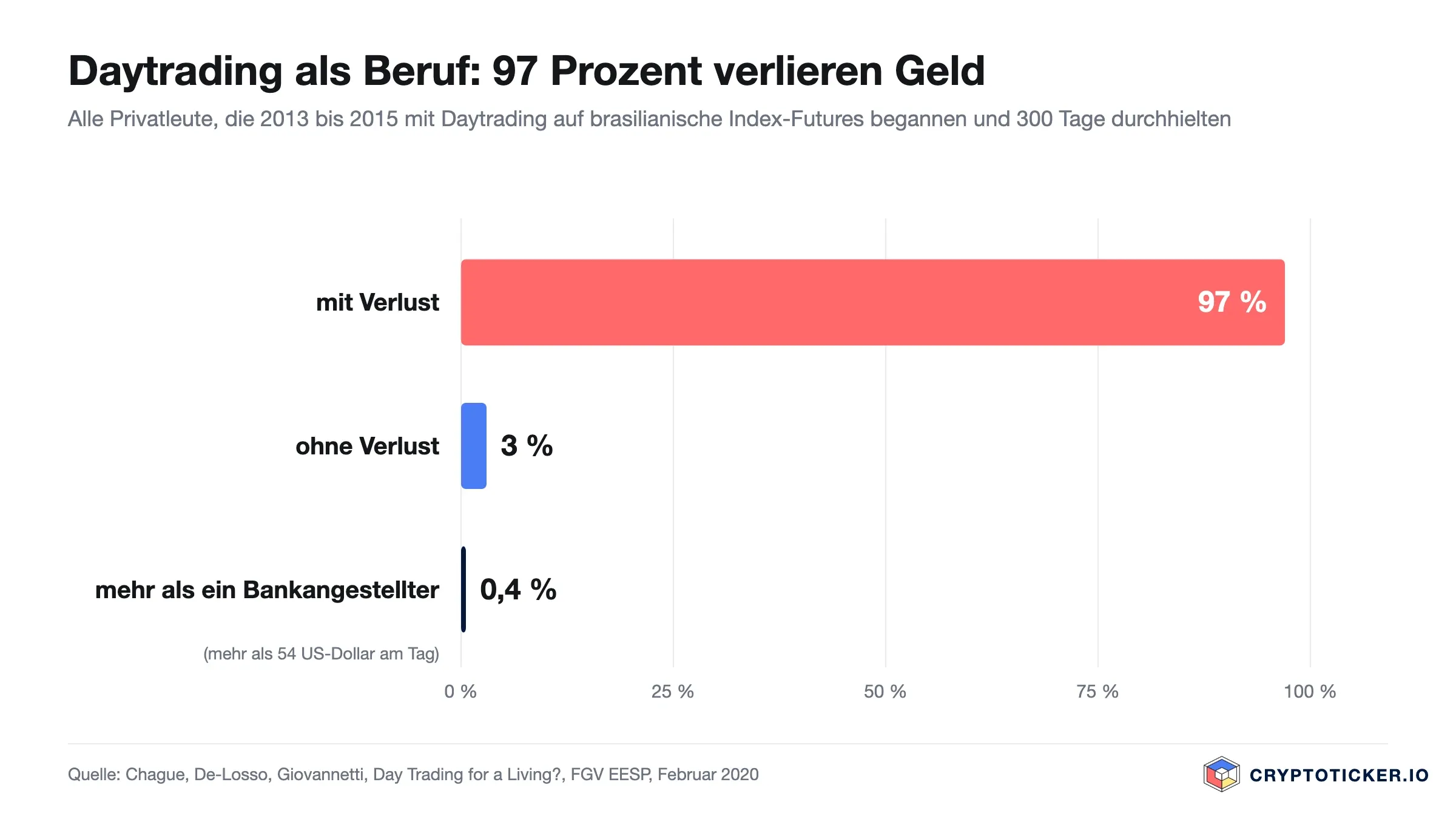
Brazil, every day trader in one market. The economists Fernando Chague, Rodrigo De-Losso and Bruno Giovannetti examined every individual who began day trading Brazilian equity index futures between 2013 and 2015, one of the highest-volume markets in the world. Of those who traded for at least 300 days, 97 percent lost money. Only 0.4 percent earned more than a bank clerk, meaning more than 54 US dollars a day. The single best performer reached 310 US dollars a day, with a standard deviation of 2,560 US dollars. The authors found no learning effect: trading longer did not make anyone better (Day Trading for a Living?, FGV EESP, February 2020).
Taiwan, 15 years of day trading. Brad Barber, Terrance Odean and colleagues studied day traders on the Taiwan Stock Exchange from 1992 to 2006. Fewer than 1 percent of them achieved predictably and reliably positive abnormal returns after fees (Journal of Financial Markets, volume 18, 2014). So skilled traders exist, but they are the exception, and they can only be told apart from the lucky after years.
Europe, retail CFD accounts. The European securities regulator ESMA found in 2018 that typically 74 to 89 percent of retail accounts at CFD providers lose money (ESMA, notice of March 27, 2018). CFDs are the tool of many day traders because they allow large positions on little capital.
Our reading: day trading is a craft with a negative average outcome. Learning it is still worthwhile, for a different reason than the one sellers of trading courses promise. Once you have worked through position size, fees and hit rate, you understand every form of trading better, including the long-term kind. So learn it with play money and with the clear question of whether your numbers add up after costs.
Learning day trading in six steps
The road from the first chart to the first real trade splits into six steps. Each step has a result you can write down.
- Fix the market and the time window. One market, one time of day. To start with, Bitcoin between 15:00 and 18:00 is enough, when most of the volume runs (chart further below).
- Choose a strategy and write it down. Entry, stop loss, target and abort in one sentence each. More on that in the section on day trading strategies.
- Set the risk per trade. One percent of capital is the common ceiling; for beginners half a percent is better.
- Calculate the position size. From risk and stop distance, never from instinct and never from the leverage available.
- Set a daily loss limit. After three losing trades or a two percent daily loss, the day is over.
- Keep a journal and review it. Every trade with time, reason, result and fees. Review after 50 trades, not after the first good day.
Calculating position size in day trading
Position size is the most important number in day trading, more important than any entry rule. It follows from two values: the amount you are willing to lose at most on this trade, and the distance between entry and stop loss.
Position size = risk in euros ÷ stop distance in percent
An example with 5,000 euros of capital and one percent risk, so 50 euros per trade. The fee is 0.05 percent per execution, as in the CryptoTicker trading simulator; a trade has two executions, entry and exit.
| Stop distance | Position size | Leverage needed | Fees round trip | Fees as a share of risk | Hit rate to break even at 2 to 1 |
|---|---|---|---|---|---|
| 0.25 % | €20,000 | 4× | €20.00 | 40 % | 46.7 % |
| 0.5 % | €10,000 | 2× | €10.00 | 20 % | 40.0 % |
| 1 % | €5,000 | no leverage | €5.00 | 10 % | 36.7 % |
| 2 % | €2,500 | no leverage | €2.50 | 5 % | 35.0 % |
Read the table from left to right: the tighter the stop, the larger the position, the higher the leverage and the bigger the share of your risk that fees eat up. At a 0.25 percent stop distance, 40 percent of what you risk already goes to the provider before the price has moved at all. With CFDs on cryptocurrencies that first row would not even be possible for retail clients, where leverage is capped at 2 to 1 (more on that under risks).
The order is therefore always the same: first the risk in euros, then the stop at a point the chart dictates, then the position size, and the leverage last. Choosing the leverage first and then hunting for a stop that somehow fits means working backwards and losing control of the amount.
Fees in day trading: why tight stops are expensive
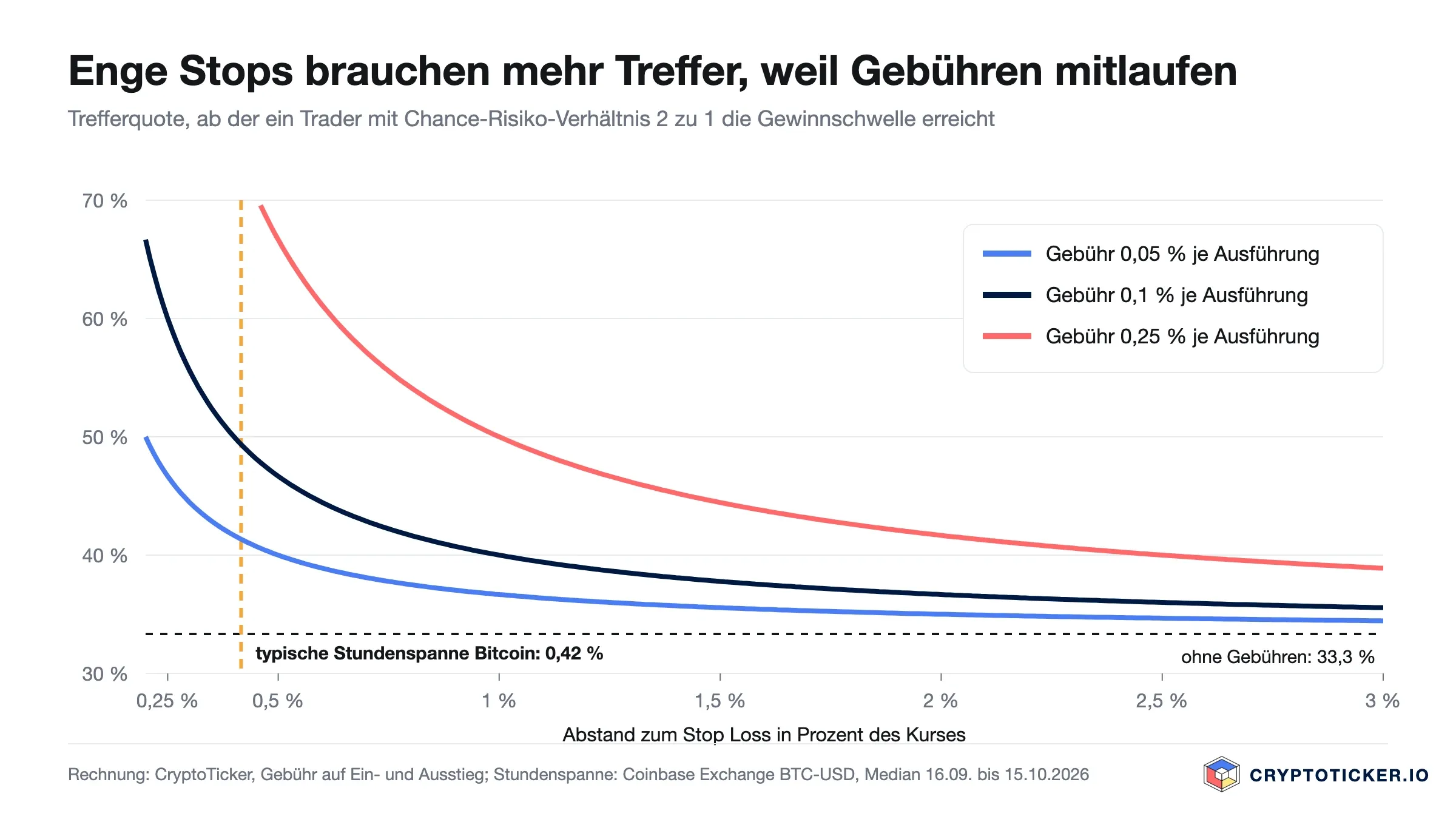
A day trader’s break-even point hangs on three numbers: hit rate, reward-to-risk ratio and fees. Without fees, a reward-to-risk ratio of 2 to 1 needs a hit rate of 33.3 percent: one winner offsets two losers. With fees the threshold rises, and the more so the tighter the stop sits.
The formula behind it is short. If g is the fees of a trade in multiples of your risk (fee per execution times two, divided by the stop distance), then: hit rate needed = (1 + g) ÷ (1 + reward-to-risk ratio). At a 0.1 percent fee and a 0.5 percent stop distance, g = 0.4 and the hit rate rises to 1.4 ÷ 3 = 46.7 percent.
Two costs come on top that appear in no fee table. The spread, the gap between buy and sell price, acts like a further fee. And slippage arises when a stop order is filled worse than planned in a fast move. Both hit day traders harder than long-term investors because they enter and exit far more often.
In practice: before your first real trade, check what your provider charges per execution and work out the break-even point for your typical stop distance. If it comes out above 45 percent, the stop is too tight or the provider too expensive. Fees and licences of the platforms are in the exchange comparison.
Stop loss in day trading: distance set by volatility
A stop loss is an order that closes your position automatically as soon as the price reaches a set level. It caps the loss at the amount you calculated beforehand. The only question is where it sits.
A stop sitting inside normal volatility is triggered by noise, not by a genuine countermove. How large that noise is can be measured. In Bitcoin, the range between the high and the low of an hour from September 16 to October 15, 2026 had a median of 0.42 percent, and in a quarter of the hours it exceeded 0.63 percent (hourly trading data from Coinbase Exchange for BTC-USD, 720 hours).
A stop 0.25 percent below the entry therefore sits in the middle of an ordinary hour. It gets hit often and is expensive because of the fees, as the chart above shows. For beginners a simple rule applies: the stop sits at least one typical hourly range away from the entry, in Bitcoin therefore more like 0.5 to 1 percent, and at a point the chart justifies, such as below the last low. The position size then becomes smaller, and that is exactly the intention.
Day trading strategies for beginners
There are dozens of day trading strategies; two are enough to start with. What matters is not which you choose but that you write it down precisely enough for another person to trade it.
Momentum trading: going with the move
In momentum trading you enter a market already moving clearly in one direction and ride part of that move. An example in Bitcoin: after the US stock market opens, the price rises more than one percent within 30 minutes on clearly higher volume than in the hour before. You buy the first pullback, the stop sits below its low, the target at twice the distance. The weakness of the strategy: it loses in sideways phases.
Breakout: leaving the range
In a breakout you mark the range of a quiet phase, say between 09:00 and 15:00. If the price breaks above the high or below the low on rising volume, you enter in the direction of the break. The stop sits in the middle of the range. Many breakouts fail; the strategy lives off a few large winners, which is why a reward-to-risk ratio of at least 2 to 1 is mandatory.
Scalping, news and swing trading: what does not belong here
Scalping with holding times of seconds generates so many executions that fees and spread make up most of the result. News trading on economic data brings the strongest slippage of the day. And swing trading is not a day trading strategy but a style of its own with positions held overnight; holding your losers overnight in the hope of a recovery does not make you a swing trader, it means you broke your rule.
Best time for day trading crypto
Cryptocurrencies trade around the clock, but not evenly. For day traders, volume is what counts: more turnover means tighter spreads and less slippage. The trading hours of the large stock exchanges therefore shape the crypto market too.
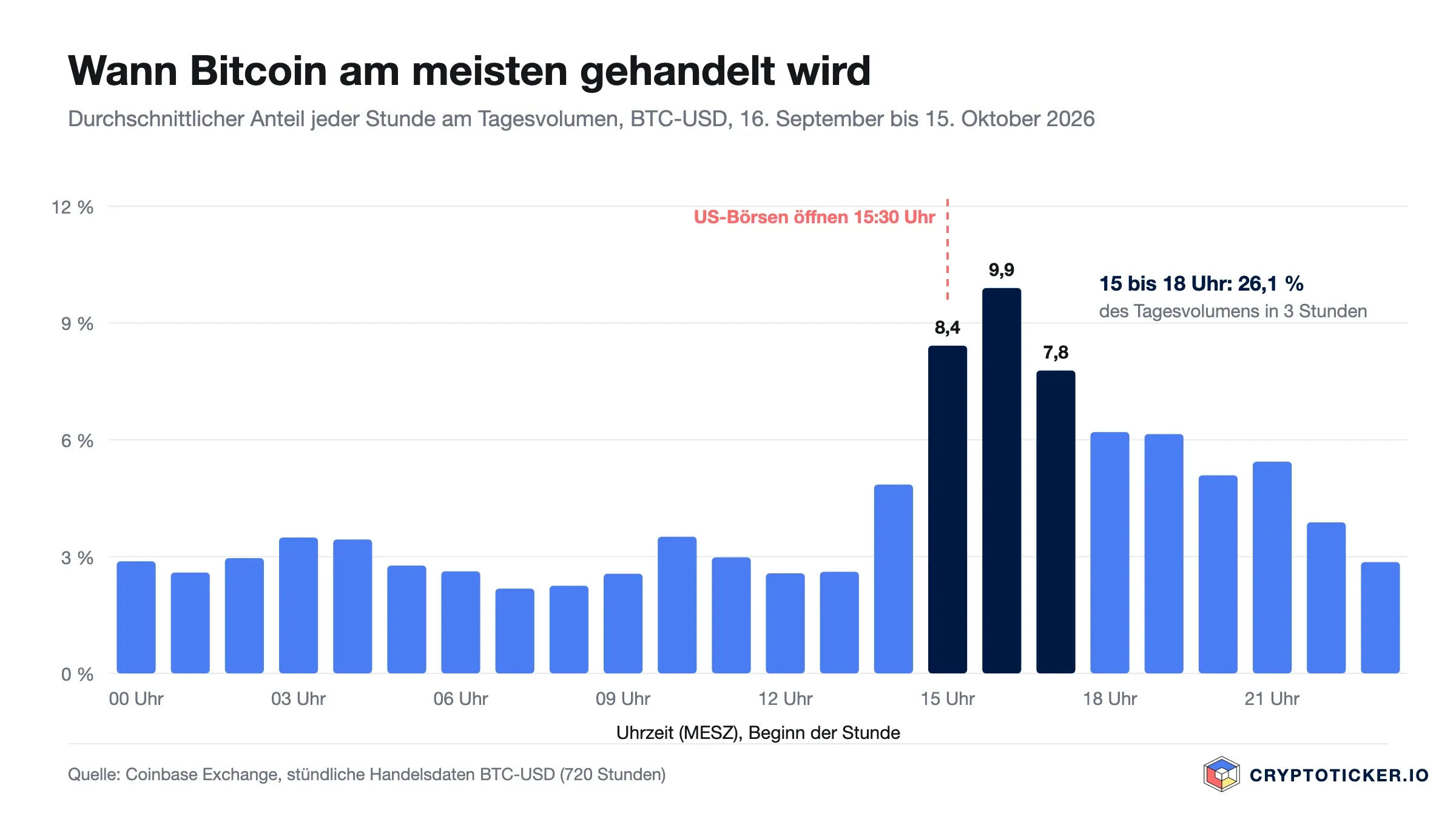
The review of hourly Coinbase trading data for BTC-USD from September 16 to October 15, 2026 shows a clear pattern:
- 15:00 to 18:00: 26.1 percent of daily volume in three hours. The US exchanges usually open at 15:30 German time, and turnover rises with them.
- 16:00: the strongest hour at 9.9 percent, around 4.5 times the weakest at 07:00 with 2.2 percent.
- 07:00 to 10:00: only 7.0 percent in total. Trading before work means trading in the thinnest market of the day.
In the euro pair BTC-EUR the pattern is flatter but the same: 23.1 percent of volume falls between 15:00 and 18:00 there. For anyone in a job that is good news. Trading after work or in a late lunch break catches the busiest phase of the day.
Risks in day trading: leverage, CFDs and psychology
Day trading carries three risks that reinforce one another: leverage, costs and yourself.
Leverage. At leverage of 10, a countermove of around 10 percent is enough to wipe out the stake. For retail clients in Germany, BaFin has capped CFD leverage since its general decree of July 23, 2019: the margin on cryptocurrencies is 50 percent of the position value, which corresponds to leverage of at most 2 to 1; on major currency pairs it is 3.33 percent, so up to 30 to 1. If the balance falls to half the required margin, the provider closes the position. You cannot lose more than your account balance with CFDs; an obligation to pay in more is excluded for retail clients.
CFD trading. Every CFD provider has to state in its risk warning what percentage of its retail accounts lose money. Read that figure before opening an account; it is the most informative number on a broker’s page.
Psychology. The most common mistakes are not arithmetic errors. They are the revenge trade after a loss, moving the stop when the price nearly reaches it, and carrying on trading on a bad day. The only thing that helps against all three is a rule fixed before the trading day: the daily loss limit from step 5.
Learning day trading with a demo account: a four-week practice plan
The practice plan builds on the CryptoTicker trading simulator: 10,000 euros of play money, real prices for the 50 largest cryptocurrencies, free and without signup. Every execution costs a 0.05 percent fee, so you do not learn a strategy that only works without costs. The pro mode adds leverage up to 100, limit and stop orders, trailing stops and RSI, MACD and Fibonacci.
One trick for realistic numbers: risk 0.5 percent per trade in the simulator, so 50 euros. That is exactly the amount you would later risk with 5,000 euros of real money at one percent.
| Week | Exercise | Rule | What you know at the end |
|---|---|---|---|
| 1 | Bitcoin only, long only, between 15:00 and 18:00 | €50 risk per trade, stop at least 0.5 % away, at most 3 trades a day | whether you set position size and stop without error |
| 2 | One strategy from this article, in writing | Target at twice the stop distance, no moving the stop | your hit rate after about 15 trades |
| 3 | Long and short, daily loss limit | Stop after 3 losing trades or a 2 % daily loss | whether you keep the limit when it counts |
| 4 | Review of all trades | Hit rate against the break-even from the table, fees in euros | whether your numbers add up after costs |
After four weeks you have around 40 trades. That is too few for a final verdict but enough to see whether you keep to the rules. If your hit rate is above the break-even from the table and you have not moved a stop, practise for another four weeks. If it is below, you know it now, and it has cost you nothing.
What the simulator cannot deliver is the pressure of real money. So when you switch: the first real stake is smaller than the play money, and the rules stay the same. How a simulator differs from a broker’s demo account is set out in the guide to paper trading.
Online brokers and trading apps for day trading: what matters
For day trading you need an online broker or a trading app that executes fast and costs little. Five points decide:
- Regulation: for securities and CFDs a supervisor in the EU, such as BaFin; for cryptocurrencies a licence under the European MiCA regulation.
- Cost per execution: fee plus spread, calculated against your typical stop distance as in the table above.
- Order types: stop loss, limit and ideally a combined order of stop and target that secures both sides automatically.
- Execution in fast markets: how far does the filled price deviate on stop orders? That only shows up in a hectic hour.
- Demo account: practise on the platform you will later trade on, with the same fees.
Which providers are licensed for crypto in Germany and what they cost is shown in the crypto broker comparison.
Tax on day trading in Germany
Gains from day trading are taxable in Germany, but the rules depend on the product.
Cryptocurrencies held privately count as private disposals. The gain is taxable if no more than a year lies between purchase and sale (section 23 of the Income Tax Act). In day trading that is practically always the case, and the gain is taxed at your personal rate. It stays tax-free only if your total gain from private disposals in the calendar year is below 1,000 euros.
Equities, ETFs, CFDs and futures fall under investment income. The withholding tax of 25 percent applies (section 32d of the Income Tax Act) plus the solidarity surcharge and, where applicable, church tax, less the saver’s allowance of 1,000 euros a year. With many trades, tax advice is worth the money.
If you then want to trade with real money, the exchange comparison weighs the fees, licences and deposit methods of the providers.