


Synopsis
After losing about 1 million yen in day trading between July and August, this guy once cut his losses on day trading itself.
However, since his gambling-style scalping kept recurring, he decided to restart in October with a different approach, aiming for a mild trading style that would hopefully keep him around the break-even line.
This time, I looked back at the 18 trading days from September 29 to October 23, when I started aiming for this mild trading atmosphere, to see what went well, what went wrong, and to explore future winning strategies.
Summary
Target Period
18 trading days from 9/29 to 10/23
Realized Profit/Loss during the target period
+16,709 yen
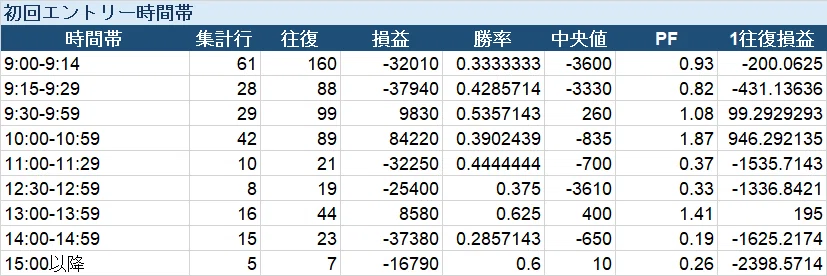
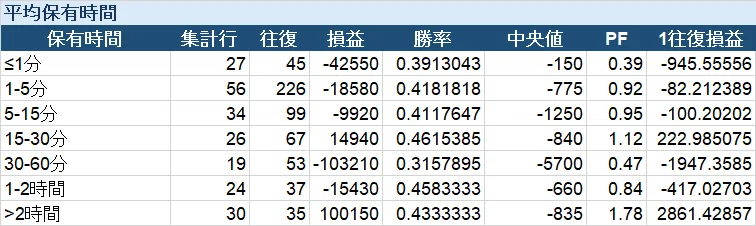
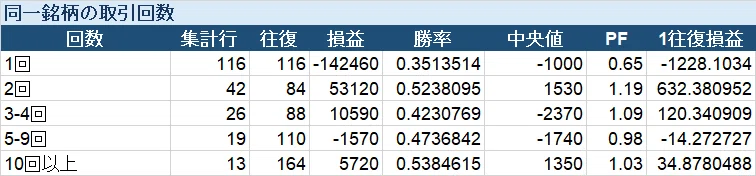
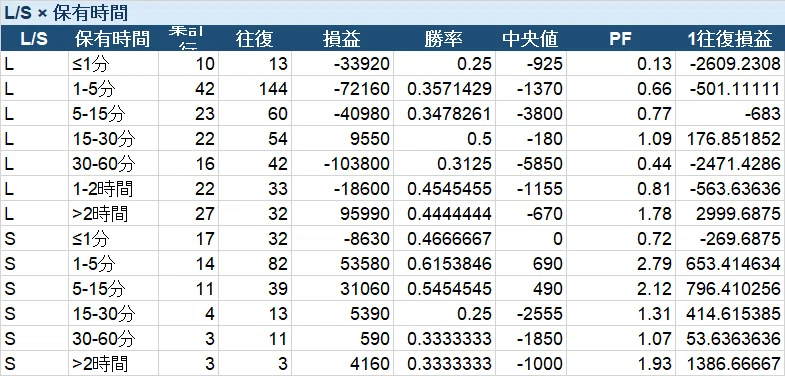
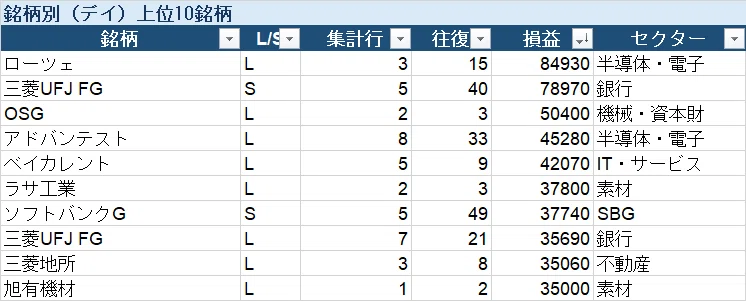
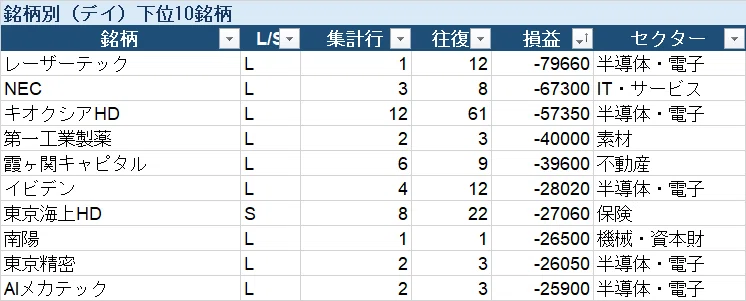
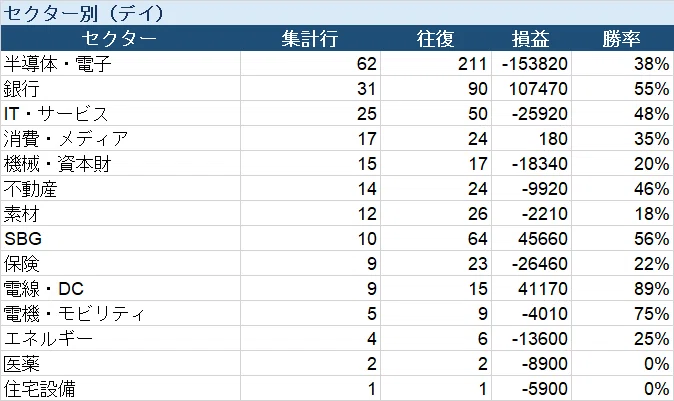
Profit/Loss by trading method, etc.


Impressions
-
The above is a summary and analysis I had Chappy perform at my discretion by feeding it my daily execution history. The breakdown below L/S is basically day trading data, but honestly, my frank impression is that you cannot tell the cause of wins and losses from the numbers alone.
-
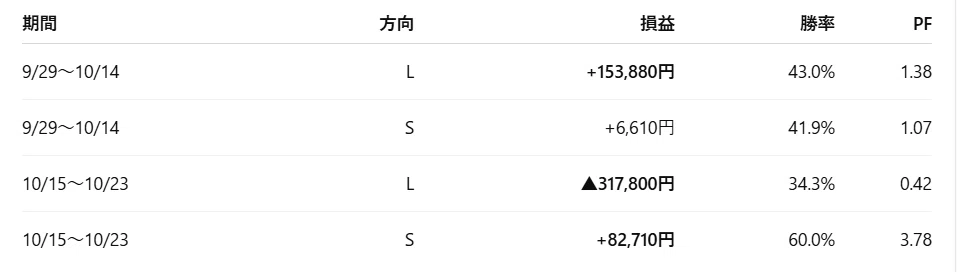
If I were to dare to bring it up, it would be that, as I mentioned in my diary on 10/2, despite the fact that ‘the results of the September trial trading showed that long positions were overwhelmingly better,’ at this point, short positions have reversed that, and the balance is also positive (discussed later).
-
Regarding the time of day, there might be some trends… but I think the holding time and number of trades are largely due to differences in methods, such as ‘whether I traded frequently in short bursts’ or ‘whether I entered once and held for a longer time.’ Of course, if you get down to it, whether you scalp or hold will affect your balance, but as for day trading/scalping based on technicals and fine price movements, it became clear in my practice from July to August that I have no talent for it, so I don’t intend to dig deeper into that now.
-
What I am aiming for now is ‘establishing a strategy to consider directionality based on materials, market conditions, and supply and demand on a time axis of one to several days’, so I want to forget about the skill of ultra-short-term trading for now.
-
Also, the breakdown by stock is quite difficult to interpret, and saying it would have been better not to touch semiconductors is just hindsight, and there is also the possibility that I would have made a huge profit if I had entered with a short position… If I were losing continuously with both long and short positions, it would be a matter of ‘I shouldn’t touch them in the first place because I can’t read the direction,’ but from this result, it seems that the factor of ‘being too fixated on long positions even though it was a falling market’ was greater, so this is a reflection I want to apply to my trading from tomorrow onwards.
-
Finally, regarding the overall balance, I think it couldn’t be helped this time because I touched Kioxia in a swing trade. In the first place, considering the balance with other trades, I should have either not touched it or cut my losses immediately when it turned negative.
Market Turning Point
Market turning point around mid-October
-
As mentioned above, from the end of September to the first half of October, long positions were dominant, and after that, short positions became almost completely dominant. Bank stocks, which had been leading the market this year, and semiconductors, which had shown a temporary recovery, turned sluggish from around mid-October, and both the Nikkei Stock Average and TOPIX have continued to decline.
-
If I had focused on just two sectors, banks and semiconductors, I might have noticed the change a little sooner, but since I basically didn’t fix the target stocks and traded a wide range of stocks that had news that day, I think I underestimated the fact that the overall market trend had changed.
Future trading applying these reflections
-
Looking back at my trading over the past month, what seems like a potential winning strategy going forward is to determine the direction of the market sentiment and target stocks and sectors that align with that sentiment I think.
-
No matter how much I research individual stock news, it’s hard to win if I enter in the opposite direction of the market sentiment. I want to thoroughly follow the order of first confirming the direction of the overall market and major sectors, and then selecting stocks based on individual news.
-
Conversely, what I’m bad at is market turning points or markets where there is no clear direction in either way, or markets where rapid reversals or whipsaws occur in the very short term. When such situations are suspected, I want to be mindful of not forcing a directional bet and instead calmly wait and see.
-
Also, in order not to miss market turning points, I will not just judge whether it is ‘risk-on or risk-off’ now, but I will also remember to confirm why that trend is occurring and continuously track the underlying factors and environmental changes.
-
Writing this, I feel like I wasn’t doing the obvious things lol, but it’s good that I could realize it again. I hope I can get even a little bit of results from tomorrow onwards.


