
Lithium batteries were first invented in the 1970s. But it didn’t take them too long before they took over the world. They now power the iPhone in your pocket, the laptop on your desk, the smartwatch on your wrist, and the 74 million electric cars driving on roads worldwide.
The lithium demand, meanwhile, is skyrocketing. Data suggests it has climbed by roughly 30 percent each year this decade. This has pushed mining firms to hunt for new lithium discoveries. The Appalachian region of the eastern US is believed to hide an estimated 2.3 million tons of undiscovered lithium. At the same time, Germany’s Altmark region reportedly contains an astonishing 43 million tons of lithium carbonate equivalent (LCE).
But lithium comes with major challenges. Mining is difficult. Refining is expensive. Supply chains remain extremely fragile. Then there is the greatest concern of all: fire risks. The reason for the latter is what engineers call thermal runaway, a chain reaction that can trigger toxic smoke and explosions that are particularly difficult to stop.
While some researchers are trying to make lithium safer, others are betting on an entirely different alternative: vanadium redox flow batteries (VRFB). The reason? In contrast to lithium, VRFBs do not catch fire and can store renewable energy for extended periods.
Behind the technology
Vanadium redox flow batteries are a promising energy storage technology, and they have actually been around since the 1980s. They were developed by Maria Skyllas-Kazacos, PhD, a professor at the University of New South Wales (UNSW), and her research team, after they found that using vanadium in both the positive and negative electrolytes eliminated cross-contamination issues affecting earlier flow battery versions.
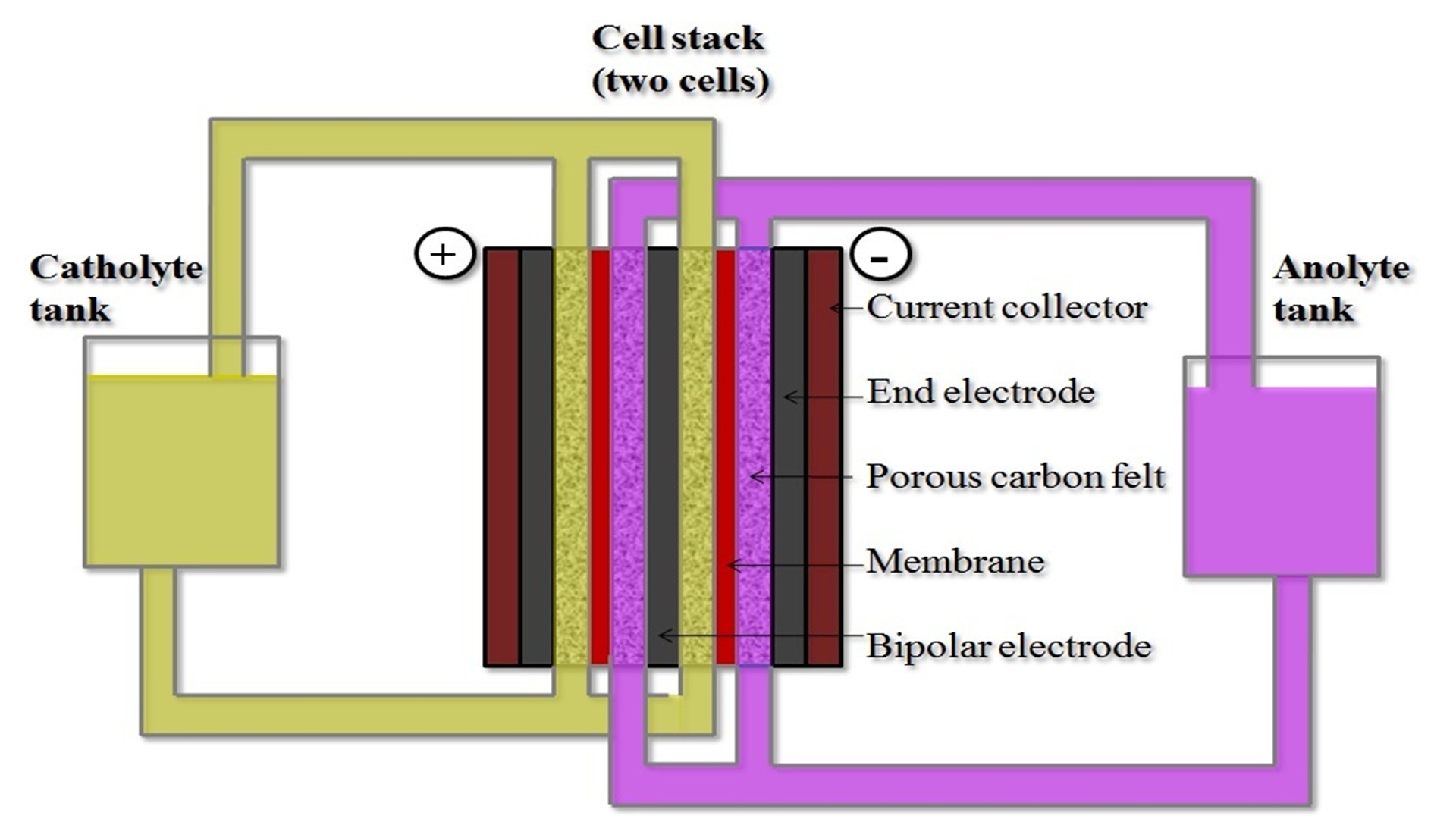
These batteries store energy in liquid electrolytes kept inside two separate tanks. The liquids contain vanadium ions in four different oxidation states, such as: V2+, V3+, VO2+ (vanadium IV), and VO2+ (vanadium V). Their liquid electrolytes are primarily made up of water and dissolved metallic salts, which is why they carry no fire or explosion risk.
During charging and discharging, vanadium ions continuously switch states to store and release energy. This reversible reaction process greatly improves the battery’s reliability and long-term performance. The battery features a simple structure.
Credit: University of New South Wales (UNSW)
Apart from the two electrolyte tanks (or reservoirs), it has cell stacks (units where the energy conversion happens), pumps (which circulate the electrolyte from the tanks through the cell stacks), and power electronics (which manage the flow of electricity to and from the grid).
A thin membrane, inside the cell stacks, separates the positive and the negative electrolytes, while allowing specific ions to pass through. This ensures efficiency and prevents the liquids from mixing.
VRFBs are non-flammable and have a very low risk of thermal runaway. They can also operate safely at temperatures of up to 122 degrees Fahrenheit (50 degrees Celsius). They are also very durable. Most systems can go through 10,000 cycles, while some can exceed 20,000 with proper maintenance.
How do VRFBs work?
When a vanadium redox flow battery charges, electricity from an external source triggers electrochemical reactions inside the cell stack. On the negative side, vanadium ions change from V3+ to V2+ as they gain electrons.
Simultaneously, ions on the positive side shift from VO2+ (vanadium IV) to VO2+ (vanadium V) by releasing electrons. Simply put, during this process, the battery converts electrical energy into chemical energy stored in the liquid electrolytes.
Once the battery discharges, the process reverses. The vanadium ions return to their original states and release the stored energy as electricity. Considering these reactions are highly reversible, the battery can charge and discharge thousands of times with very little degradation.
Additionally, the technology relies on sensors and controllers to regulate pumps and monitor electrolyte flow. They also track its State of Charge (SoC) to prevent chemical imbalances, improve efficiency, and extend the system’s lifespan.
Pros and cons
The global population growth of 0.9 percent annually is expected to raise future energy and storage demands. Hence, VRFBs’ greatest advantage is the potential for large-scale renewable energy storage.
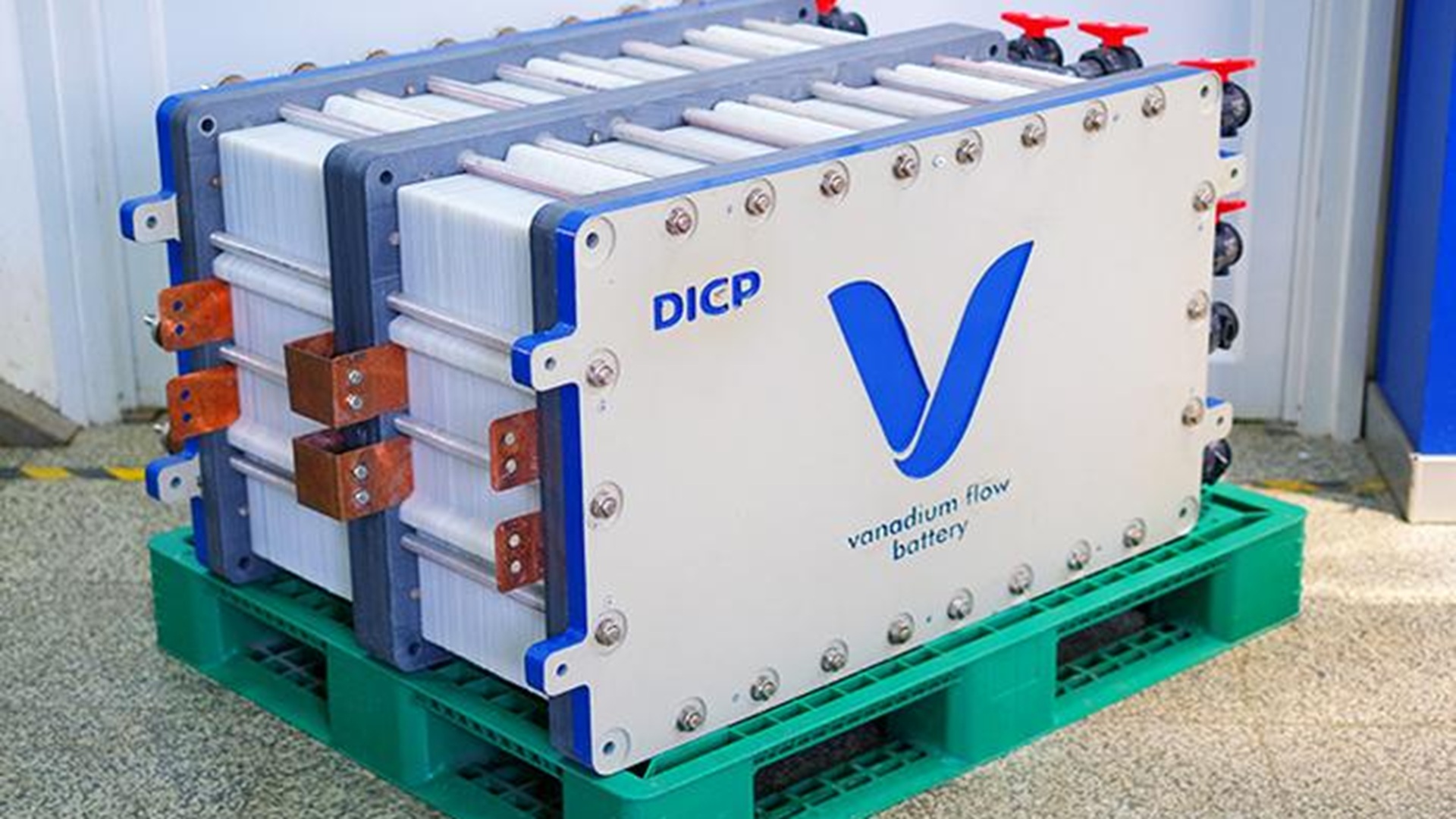
They can also deliver power for hours or even days, and are well-suited for grid support and long-term energy storage. Fast response time is another advantage they offer. They respond extremely quickly to fluctuations in electricity demand, and could stabilize the grid during voltage drops or sudden supply changes. They have high storage capacity with very low self-discharge.
Credit: DICP
VRFBs have a long operational life and can therefore run for decades with little to no degradation and relatively low maintenance requirements. They’re also highly efficient, and their water-based electrolytes are reusable and recyclable.
Nonetheless, the technology doesn’t come without disadvantages. VRFBs feature a lower energy density than lithium-ion (Li-ion) batteries, which limits their range of applications. Because of this, they need more physical space to store the same amount of energy.
As of 2026, upfront costs for the technology can reach USD 500 per kilowatt-hour (kWh). Even though the prices are slowly declining, they can still present barriers for smaller installations. Furthermore, they’re sensitive to extreme temperatures, meaning they potentially need climate control systems to keep them operating. Finally, vanadium supply can also be limited.
Future potential
Despite the challenges, the technology remains a promising solution for storing renewable energy. Power grids are increasingly relying on solar and wind energy, and hence the demand for safe, long-duration storage systems is expected to grow.
At the same time, in December 2025, China unveiled the world’s largest vanadium flow battery energy facility. The Jimusaer Vanadium Flow Battery Energy Storage Project pairs a 200-megawatt/1-gigawatt-hour (MW/1 GWh) battery system with a massive one-gigawatt photovoltaic power plant.
In the meantime, as of late 2025, Australia launched plans for a 50 MW/500 MWh vanadium redox flow battery project. It is expected to become the largest VRFB installation outside China.
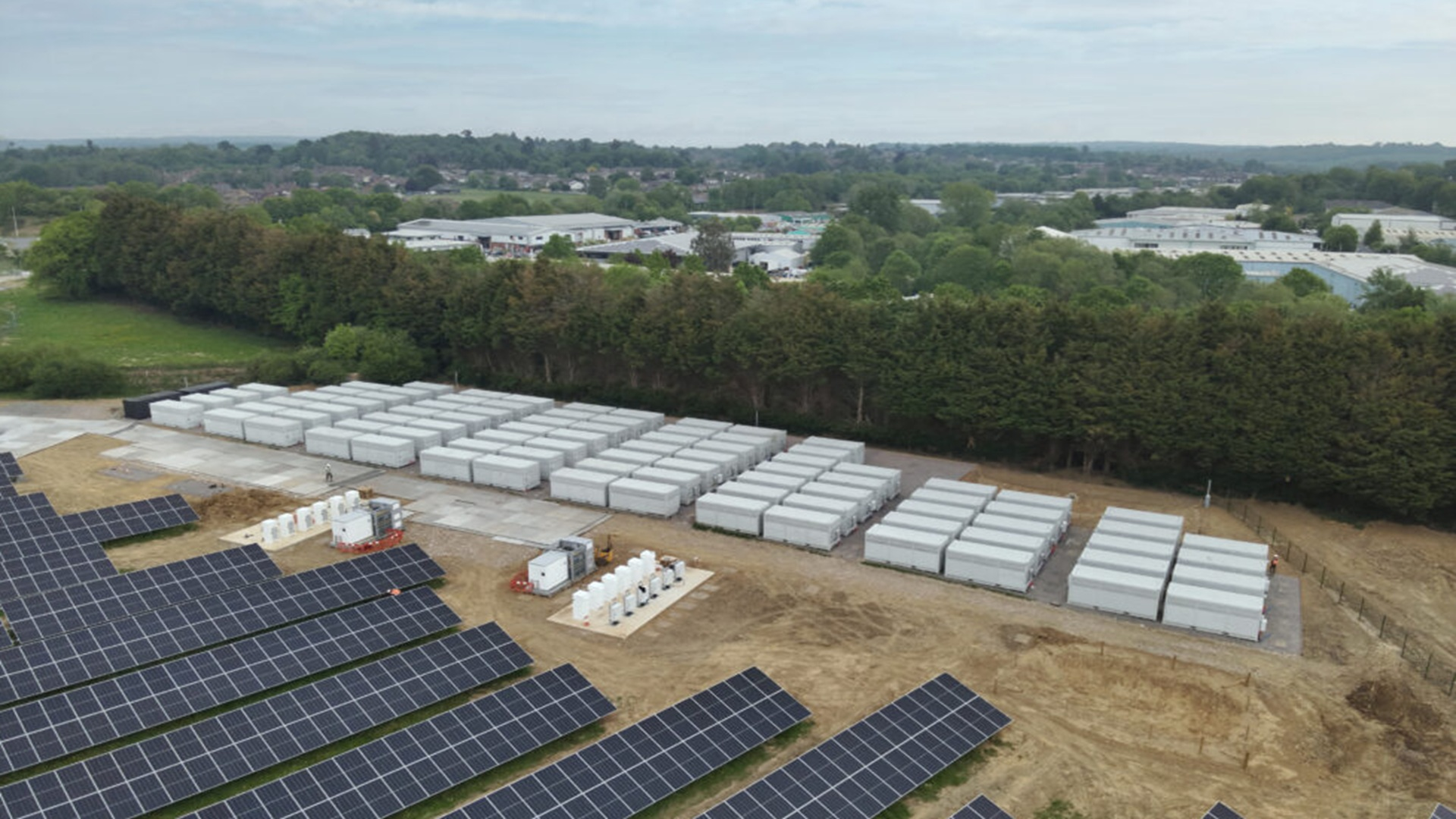
Credit: Invinity Energy Systems
Meanwhile, at present, Europe’s biggest VRFB remains the 1 MW/8 MWh system located in Cubillos del Sil, Spain. However, in May 2026, the UK unveiled plans to launch an even larger vanadium flow battery system.
Located in East Sussex in England, the 20.7-megawatt-hour (MWh) Copwood VFB Energy Hub has 90 flow batteries with a three-megawatt (MW) solar array. Once operational in late 2026, it will store enough energy to power 3,000 homes during nighttime.