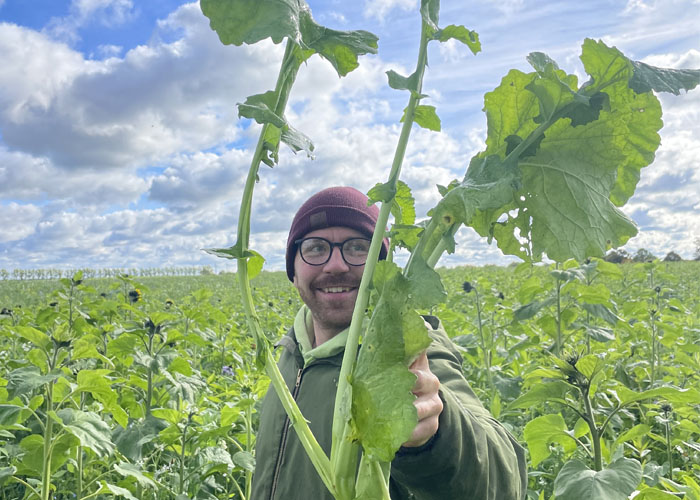

In Germany, farmer Wilhelm Zahn is enrolled in ADM’s regenerative agriculture program, ADM re:generations and is putting these principles into practice. At LBG GbR Bagemuehl in Woddow, Zahn and his team are building a farming system centred on soil conservation, diversified crop rotations and long-term resilience.
Zahn first learned about ADM re:generations during a meeting in Mecklenburg-Western Pomerania, following the program’s expansion to Germany in 2025. The program helps farmers strengthen their businesses by providing financial incentives and technical support to farmers implementing regenerative practices such as cover cropping and reduced tillage – methods that protect and enhance soil health, biodiversity, climate resilience, and water resources while supporting farm business development. The program’s comprehensive design collects data from participating farms and equips farmers with tools to position their operations for the future and to help reduce and sequester emissions.
A farm focused on soil health
LBG GbR Bagemuehl operates around 700 hectares of arable land in Brandenburg’s Uckermark region, an area known for relatively large-scale farming operations. Zahn describes the farm as a mid-sized operation that has taken a particularly committed approach to regenerative agriculture.
The farm started adopting regenerative agricultural practices six years ago. According to Zahn, the decision reflected a broader realisation that conventional cultivation practices were placing increasing pressure on soils and farm resources.
“We committed ourselves to soil conservation practices,” he explains. “That meant trying to avoid full-area soil disturbance wherever possible.”
The farm introduced a Strip-Till One Pass system, a specialised piece of equipment that allows crops to be sown directly into stubble or crop residues while disturbing only narrow strips of soil where seeds are placed. This technique significantly reduces the intensity of cultivation while still preparing a suitable seedbed for crops.
Today, roughly half the farm’s land is left completely untouched at the surface, while the remainder receives only minimal and shallow cultivation. By limiting disturbance to narrow planting strips, the farm is able to preserve soil structure and biological activity across much of the field while still maintaining productive cropping systems.
For Zahn, however, regenerative agriculture is not simply about adopting new machinery or isolated techniques. Instead, he views it as a comprehensive management system that requires consistency across all aspects of the farm.
“Regenerative practices have to be implemented across the entire crop rotation and across all crops,” Zahn said. “If you only use the technology occasionally, you don’t get the same positive effect.”
This approach led the farm to evaluate a wide range of practices beyond cultivation methods. The team conducted more detailed soil analyses, including tests that examine micronutrients and broader soil health indicators, and explored approaches such as compost tea and alternative fertilisation strategies aimed at strengthening biodiversity.
Diversifying crop rotations
A more diverse crop rotation is another essential component of the farm’s approach. Historically, many farms in the region have relied on a relatively simple rotation of oilseed rape, wheat and barley, which remains a common and economically important cropping system. While those crops still play a central role at LBG GbR Bagemuehl, Zahn has gradually expanded the rotation to include a broader mix of crops in order to support soil health and reduce long-term weed pressure.
Catch crops, or cover crops planted between main harvests, now play an important role in the system by protecting the soil surface and increasing organic matter. At the same time, the farm has begun experimenting with additional cash crops such as oats, grain maize, silage maize, and grain hemp grown for human consumption. Most recently, the farm trialed soybeans, further diversifying the cropping system.
Not every crop delivers the same financial return, but Zahn believes the broader benefits of diversification justify the approach.
“We sometimes accept that certain crops are not the most lucrative,” he explains. “But the important question is whether the overall system works. If a crop helps the rotation function better and improves the soil, then it can still be worthwhile.”
When testing new crops, the farm prefers to scale large enough to reflect real farming conditions. Small trial plots can provide useful information, but they often fail to reveal the logistical or agronomic challenges that appear when crops are grown more widely. Practical considerations also influence crop decisions, like limited storage capacity, which means crops must be relatively easy to harvest, transport and market soon after threshing.
“If we try something new like soybeans, we want to test it on several hectares rather than just a very small area,” Zahn says. “When you grow something on a larger scale, you encounter completely different practical issues.”
Although financial incentives offered in ADM re:generations were not the main motivation for adopting regenerative practices, Zahn says they can help reduce risk – particularly when investing in cover crops that may not always succeed in dry conditions. “In a dry summer you are never completely sure whether the cover crop will grow,” he says. “So even a small payment per hectare can make it easier to plant more hectares with confidence.” Such programs can also provide an additional source of income that is less directly tied to yields, offering farmers greater financial stability during periods of market volatility.
Responding to climate pressures
The farm’s shift toward regenerative practices was partly influenced by a series of challenging weather conditions – specifically the dry seasons of 2018 and 2019. During those years, extremely dry autumn conditions made soil cultivation particularly difficult and reinforced the need for systems that could better manage moisture and maintain soil structure.
Reducing soil disturbance through regenerative practices can help soils retain moisture more effectively and improve their ability to absorb rainfall when it occurs. These improvements are increasingly valuable as farmers across Europe experience more frequent weather extremes. Six years into the transition, the soil continues to show gradual improvement.
“Soil simply needs time to recover,” he explains. “But every year we see progress. In some areas water infiltration is now much better than it used to be.”
Early improvements to soil recovery
Although regenerative agriculture practices often require several years before their full benefits become apparent, the farm showed positive changes relatively quickly. Improved biological activity also accelerated the decomposition of straw mulch left after harvest, helping nutrients cycle more effectively through the soil.
Soil structure improved as well, increasing both water infiltration and the ability for machinery to travel across fields without damaging the soil surface. Nutrient management also evolved as the system matured. While the farm experienced a brief period of reduced nitrogen availability early in the transition, nutrient cycles eventually stabilised.
Recent soil sampling shows particularly low levels of nitrogen leaching, with most available nitrogen remaining in the upper soil layers where crops can use it. The farm also experimented with undersown crops in oilseed rape, planting legumes and companion crops alongside the crop to help suppress weeds and improve nitrogen dynamics.
Looking forward
Regenerative agriculture represents a long-term investment in both the land and future of the farm. Zahn expects adoption across Germany to take time, as many farmers remain cautious about changing established systems. But he believes wider adoption will grow as more farmers experiment with these practices.
“In practice it’s often a gradual process,” he says. “But the more farmers gain experience with it, the more widely it will spread.”
For farmers considering programs like ADM’s re:generations, his advice is straightforward: “I would definitely recommend ADM and re:generations. It’s a good incentive to integrate practices like cover crops or reduced tillage, as well as implement them on as much land as possible.”
Ultimately, Zahn’s goal is to build a system that can withstand both environmental and economic pressures, and he believes that healthy soil is the foundation and the work to continue building resilience continues with every season.