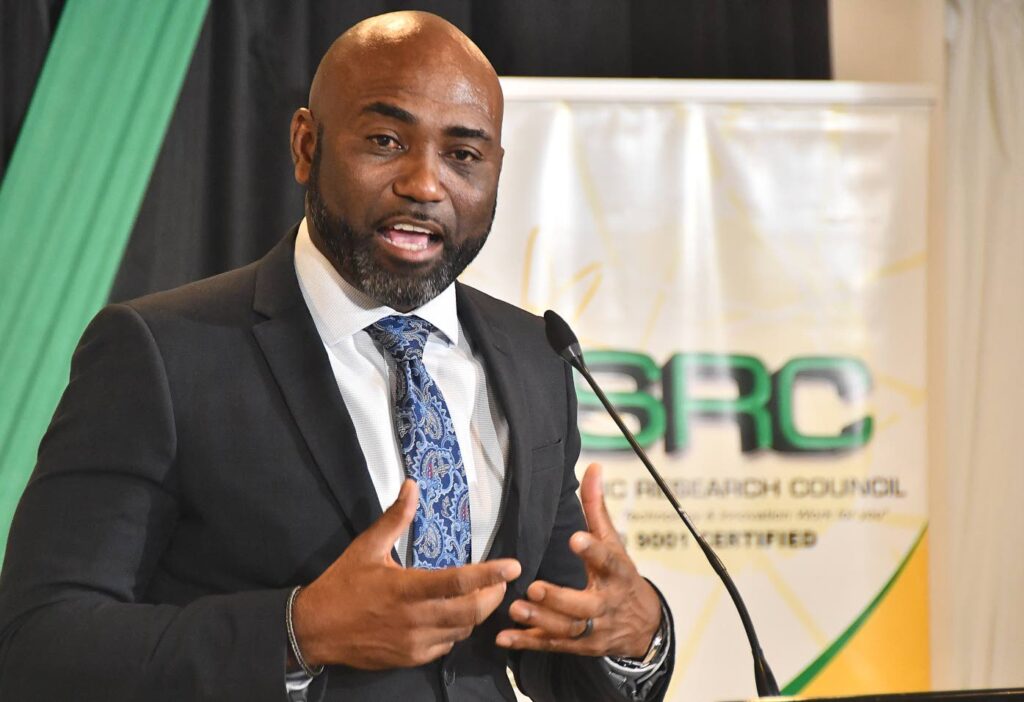
Andrew Wheatley, minister with responsibility for science, technology and special projects in the Office of the Prime Minister (Photo: Naphtali Junior)
Jamaica is advancing plans to be among the small developing countries that use nuclear energy for domestic purposes.
Minister of Science, Technology and Special Projects, Dr Andrew Wheatley, provided an update on the issue during his recent contribution to the Sectoral Debate in the House of Representatives. He pointed to the damage to the electricity grid caused by Hurricane Melissa last October and the ongoing Middle East War that has caused oil prices to spike, as reasons why Jamaica must move to diversify its energy mix.
“Jamaica’s energy future demands that we think beyond the conventional. Hurricane Melissa did not simply damage our electricity infrastructure — it exposed the structural vulnerability of an energy system overwhelmingly dependent on imported fossil fuels. Every disruption costs us. Every price spike costs us. Every hurricane season costs us,” said Wheatley.
“The path to genuine energy sovereignty runs through diversification — and Jamaica is now taking seriously an option that small island developing states have historically deferred: nuclear energy,” he added.
He was clear in pointing out that Jamaica was not about to build a nuclear power plant at this time. “What Jamaica is doing is something equally important: we are building the knowledge base, the institutional readiness, and the international partnerships that any responsible nation must have before that decision can ever be properly made. We are doing the work deliberately, transparently with full scientific rigour”.
Wheatley reminded that in October 2024, the Government executed a Memorandum of Understanding (MOU) with two of Canada’s premier federal nuclear institutions — Canadian Nuclear Laboratories and Atomic Energy of Canada Limited which includes Small Modular Reactors (SMR), nuclear medicine and industrial and agricultural applications. Pointing out that Canadian Nuclear Laboratories operates the Chalk River facility, one of the world’s most advanced nuclear research centres, and that both institutions are actively engaged in Canada’s own domestic SMR programme, Wheatley stated that Jamaica now has a formal nuclear partner at the highest level of international nuclear capability.
Wheatley reminded the Parliament that the International Centre for Environmental and Nuclear Sciences — ICENS — is Jamaica’s existing platform for this work. He noted that through the SLOWPOKE research reactor at the University of the West Indies, ICENS maintains active International Atomic Energy Agency (IAEA) reporting functions, provides environmental monitoring and radiation protection services, and has for decades been Jamaica’s bridge to the international nuclear community.
The science and technology minister said the Nuclear Energy Working Committee has been reconstituted under this portfolio with a clear mandate: to progress the structured assessment of nuclear energy’s viability for Jamaica and to advance the foundational actions that the programme requires. These actions, which he stressed are not capital-intensive are institutional, legislative, and diplomatic. They include: the development of a public consultation and sensitisation programme because, as Wheatley puts it, “no responsible government announces a nuclear energy intention without first engaging its people honestly; the initiation of negotiations for a Nuclear Cooperation Agreement with Canada, which is required to unlock the full technology-transfer scope of the MOU; formal notification to the IAEA of Jamaica’s intent to examine small reactor installation, which unlocks IAEA assistance at no direct cost to Jamaica; and the drafting of a Jamaican nuclear regulatory framework — because before any commercial decision is made, Jamaica must have the independent regulatory architecture to oversee it.
Wheatley explained that all five programme documents underpin that Jamaica’s nuclear assessment converge on SMRs as the appropriate technology for a grid of Jamaica’s scale, and on a Build-Own-Operate-Transfer model with a Power Purchase Agreement as the commercial structure. This, he said keeps costs off the Government’s balance sheet while securing clean, reliable baseload power.
“This is not fantasy. This is the energy pathway that serious small nations are pursuing. And Jamaica, with its existing research infrastructure at ICENS, its partnership with Canada, and its reconstituted working committee, will seek to position itself to be among them,” Wheatley said.