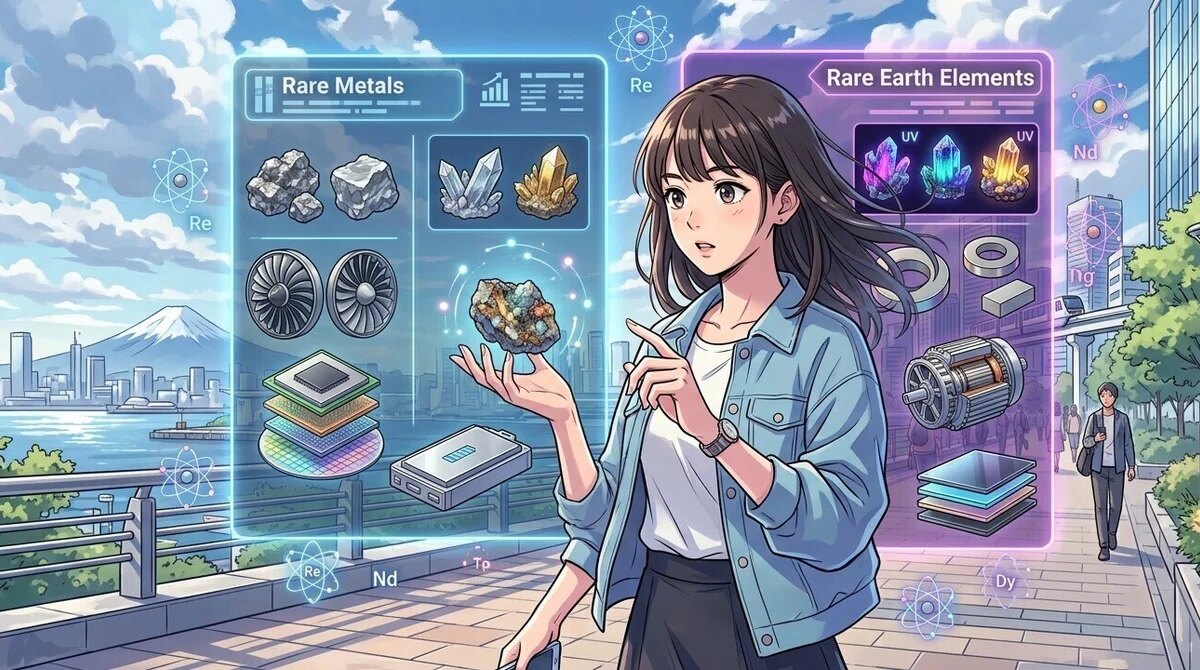
Although the terms “rare metal” and “rare earth” are frequently seen in news and newspapers, surprisingly few people can accurately explain the difference between the two. While the image of both being “rare metals” tends to take precedence, in reality, rare earths are merely a subset included within the broader framework of rare metals. In this article, I would like to explain as clearly as possible the differences in their definitions, the types of representative elements included in each, their specific uses in our daily lives, and the international situation surrounding their supply.
What are rare metals?
As the name suggests, rare metals refer to “rare metals,” but this is less of a strictly defined academic term and more of a classification established by Japan’s Ministry of Economy, Trade and Industry from a policy perspective. Rare metals are collectively defined as non-ferrous metals that are either scarce on Earth, difficult to extract in pure form due to technical or economic reasons, or difficult to procure stably because production is concentrated in specific countries or regions.
In Japan, the Ministry of Economy, Trade and Industry designates over 30 elements as rare metals, including lithium, beryllium, boron, fluorine, magnesium, titanium, vanadium, chromium, manganese, cobalt, nickel, gallium, germanium, selenium, rubidium, strontium, yttrium, zirconium, niobium, molybdenum, ruthenium, rhodium, palladium, indium, antimony, tellurium, cesium, barium, hafnium, tantalum, tungsten, rhenium, osmium, iridium, platinum, thallium, bismuth, and rare earths. In other words, rare earths are positioned as one group included in this long list of rare metals.
The background behind the creation of the rare metal classification involves not just scarcity as a resource, but also a sense of crisis in industrial policy. Even if the reserves of these metals are not necessarily small, they are treated as “metals that exist in quantity but are difficult to obtain stably” because production is concentrated in specific countries or the content in ore is extremely low, making refining unprofitable. The fact that they are essential materials for high-tech, automotive, and energy industries, yet their supply is prone to instability, has pushed rare metals to the forefront as an important theme in economic security.
What are rare earths?
On the other hand, rare earths are a collective term for 17 elements known as “rare earth elements.” Specifically, they include the 15 elements occupying atomic numbers 57 to 71 on the periodic table—lanthanum, cerium, praseodymium, neodymium, promethium, samarium, europium, gadolinium, terbium, dysprosium, holmium, erbium, thulium, ytterbium, and lutetium—known as the lanthanoids, plus scandium and yttrium, which have similar chemical properties, for a total of 17 elements classified as rare earths.
Despite the name “rare earth,” many of the elements included are actually not that scarce in the Earth’s crust. For example, cerium is said to exist on Earth in amounts equal to or even greater than copper or lead. The reason they are called “rare” is that these elements are widely distributed in a thin state mixed with other minerals, and it is extremely rare for them to exist as high-concentration deposits on their own. The process of separating and refining specific rare earth elements from ore is chemically very complex, and because of the high costs and environmental impact, there are limited places in the world where they can be produced in an economically viable way.
Furthermore, rare earths are characterized by their very similar chemical properties. This is because their outer electron configurations are almost identical, which makes it technically difficult to separate each element from the ore, requiring advanced solvent extraction and ion exchange technologies for refining. The fact that only a limited number of countries in the world have established this separation and refining technology and commercialized it on a large scale is one of the causes of international tension surrounding rare earths.
Organizing the differences between rare metals and rare earths
Based on the explanation so far, I would like to reorganize the differences between the two. The biggest difference is the “breadth of scope.” Rare metals are a large category that includes over 30 diverse metal elements, encompassing all non-ferrous metals that are industrially important but carry supply risks, excluding so-called “base metals” like iron and aluminum. In contrast, rare earths are a subset within the rare metal category, limited to only 17 elements that are adjacent on the periodic table. It is easy to understand if you imagine that within the large family of rare metals, there is a group of brothers and sisters with similar properties called rare earths.
Another difference is the nature of why they are considered rare. For many metals classified as rare metals, the reasons for their scarcity vary by element, such as low reserves, production being concentrated in specific countries, or the lack of established refining technology. In contrast, rare earths are characterized by the fact that they are considered “rare” for a relatively common reason: despite not being particularly scarce in the Earth’s crust, they are difficult to separate and refine because their chemical properties are so similar to each other.
There is also a difference in how their uses have expanded. Rare metals appear individually in all aspects of industry, from automotive exhaust purification catalysts to stainless steel, cemented carbide tools, and substrate materials for electronic components. In contrast, as will be described later, rare earths are characterized by the fact that while they are used in relatively limited fields such as permanent magnets, phosphors, abrasives, and catalysts, they often play a decisive role in each field that is difficult to replace.
Representative types and uses of rare metals
Since there is a wide variety of metals classified as rare metals, I would like to pick up a few representative ones and look at their uses.
Lithium is an essential element for the positive electrode materials and electrolytes of lithium-ion batteries installed in smartphones, laptops, and electric vehicles, and demand is expanding rapidly amid the trend toward electrification to realize a decarbonized society. Cobalt is also an important metal used in the positive electrode materials of lithium-ion batteries, and because its main producing country is concentrated in the Democratic Republic of the Congo, the stability of its supply chain has often been viewed as a problem.
Titanium is used in aircraft airframes and parts, as well as medical implants such as artificial joints, due to its characteristics of low specific gravity and high strength. In the form of titanium oxide, it is one of the rare metals that is familiar but often overlooked, as it is widely used as a white pigment in paints and cosmetics.
Tungsten has an extremely high melting point among metals and is very hard, so it has been used for cutting tools, cemented carbides, and light bulb filaments. Molybdenum is used as an additive for special steel by taking advantage of its resistance to high temperatures, contributing to the improved durability of automotive parts and industrial machinery.
So-called “platinum group metals” such as platinum, palladium, and rhodium are also important rare metals. These are used as the core material for catalytic converters that neutralize harmful substances in automobile exhaust gases, and because their production is concentrated in specific countries like South Africa and Russia, they are known as metals where geopolitical risks can directly affect supply.
In addition to these, many rare metals that we are not consciously aware of are incorporated into the digital devices we use daily, such as gallium and germanium used as semiconductor materials, and indium used for transparent electrodes in liquid crystal panels.
Typical types and uses of rare earths
I would also like to look at typical elements of rare earths and their uses.
Neodymium is an element that, when combined with iron and boron, can create what is known as a “neodymium magnet,” which is one of the most powerful permanent magnets currently known. These magnets are widely used as essential components for making motors and generators compact and high-performance, such as in hard disk drives, speakers, motors for electric and hybrid vehicles, and even turbines for wind power generators. Dysprosium plays a role in maintaining magnetic force even in high-temperature environments when added in small amounts to these neodymium magnets, and its importance is particularly high in applications involving heat generation, such as automotive motors.
Cerium and lanthanum are used as abrasives for glass and lenses, and are also used as co-catalysts for automobile exhaust gas purification catalysts. Terbium and europium are used as phosphors to enhance the color reproducibility of light-emitting diodes and displays, supporting vivid image expression. Yttrium is utilized as a laser material used in fiber optic communication and as an additive for highly heat-resistant ceramics.
What these uses have in common is that they all play a role in creating a decisive difference in performance that is difficult to replace with other materials. In particular, neodymium magnets are essential materials for promoting renewable energy and electrification because they are directly linked to the miniaturization and weight reduction of electric vehicle motors and wind power generators, and their importance is increasing in the global trend toward decarbonization.
Why are rare metals and rare earths attracting attention?
The background to why rare metals and rare earths have attracted so much attention lies in the rapid development of high-tech industries and environment-related industries. Many products that support modern life and a decarbonized society, such as smartphones, electric vehicles, solar panels, and wind power generators, require these rare metals to improve their performance, and their demand continues to expand year by year.
On the other hand, there is a significant imbalance in supply. Regarding rare earths in particular, the majority of global production is said to be concentrated in China, and China has also established an overwhelming position in refining technology. In the past, when diplomatic relations with a specific country became tense, concerns about the potential restriction of rare earth exports rose, and it was widely reported as international news. Because of this history, rare earths have come to be treated not only as industrial raw materials but also as bargaining chips in diplomacy and economic security between nations.
In response to this situation, various countries are taking measures to reduce their dependence on specific countries. Specifically, efforts such as the development of new mines, recycling initiatives called “urban mining” to recover rare metals and rare earths from used products, and research and development of alternative materials to reduce the amount used itself are underway. In Japan as well, research into technologies to recover rare metals from household appliance and automobile waste, as well as the development of stockpiling systems, are being carried out, and how to secure stable procurement as a resource-poor country has been a long-standing policy issue.
Summary
If I were to summarize the difference between rare metals and rare earths in one word, rare metals are a large framework encompassing over 30 types of non-ferrous metals that are important for the economy and industry but prone to unstable supply, while rare earths are a specific group consisting of 17 elements adjacent to each other on the periodic table included within that framework. While the reasons for being considered rare and the uses for each rare metal element differ, rare earths share the common characteristic of being difficult to separate and refine due to their similar chemical properties, and they play irreplaceable roles in fields such as permanent magnets, phosphors, and catalysts.
Both are quietly incorporated into the smartphones, automobiles, and home appliances around us, and we are almost never conscious of their existence in our daily lives. However, in a future society where decarbonization and digitalization will advance further, the trends in supply and demand for these metals and the international situation will continue to have a significant impact on our lives and economy. Correctly understanding the difference between the terms rare metal and rare earth should also be useful for deciphering the background of news regarding resources.
Speaking of side income methods that even employees at companies that prohibit side jobs or civil servants can do openly (click image)