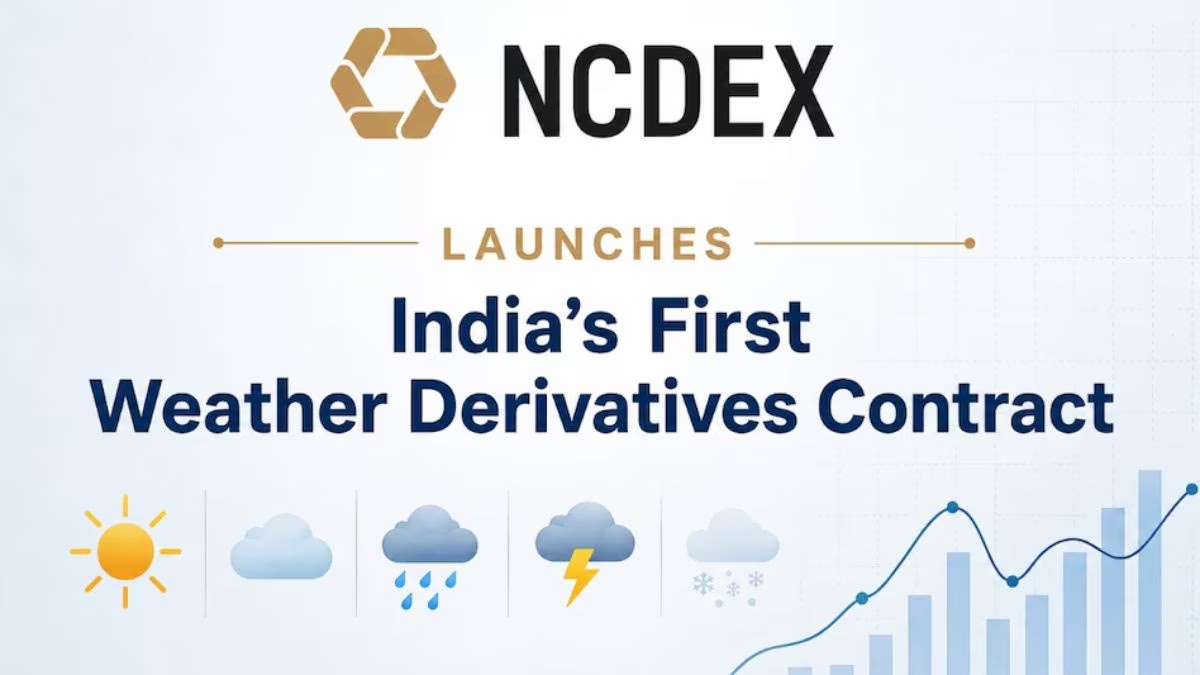
NCDEX has introduced India’s first rainfall futures contract, assigning a monetary value to the monsoon. The key, however, is no longer whether the monsoon can be traded but how quickly the ecosystem develops the infrastructure to make such trading genuinely effective, writes V Shunmugam
How the Mumbai rainfall futures came into being
Globally, weather derivatives originated in the 1990s and gained popularity among energy companies seeking protection against seasonal weather fluctuations. India’s regulatory environment changed when the government amended Schedule I of the Securities Contracts (Regulation) Act, 1956, to expand the list of eligible underlying assets for derivatives, now including weather indices.
The National Commodity and Derivatives Exchange (NCDEX) took advantage of this change to introduce RAINMUMBAI, India’s inaugural exchange-traded rainfall futures contract tied to Mumbai’s monsoon rainfall compared to its long-term average. Although the monsoon is yet to arrive in Mumbai, trading on this contract will be open from May 29.
Who will trade it?
Speculators will trade information — India Meteorological Department (IMD) outlooks, El Niño signals, private forecasts — and take directional positions. Hedgers will trade exposure. A cold-beverages firm loses revenue when heavy rain reduces outdoor mobility; an umbrella manufacturer sees higher sales as the monsoon intensifies.
Their weather exposures are mirror images — one a natural seller, the other a natural buyer. Construction firms, logistics companies, event managers, power utilities, and lenders to weather-sensitive businesses can all find hedging utility in a transparent rainfall benchmark.
What moves the price of this product?
Rain itself isn’t bought or sold. Instead, the trading commodity is a number— the total deviation of Mumbai’s monsoon rainfall from its long-term average, record-ed at the IMD’s Santacruz and Colaba stations. These contracts are quoted in millimetres, with a minimum increment of 1 mm and a value of Rs 50 per mm per lot.
They are available from June to September. Price movements depend on monsoon forecasts, satellite imagery, global climate indicators, and private weather models. If the market expects above-average rainfall, the contract price increases; if below, it decreases. Settlement is cash-based only, as no one can deliver monsoon.
How is the trade done, and where does it settle?
Imagine the June contract is quoted with a cumulative deviation of 100 mm. A trader anticipating a heavy monsoon purchases one lot. If the final settlement is 130 mm, the trader gains 1,500 (30 mm ×50). Conversely, if it settles at 80 mm, the trader incurs a Rs 1,000 loss. Settlement is based on the final IMD rainfall index value, which is objective and non-disputable.
This is significant given media reports that Skymet, a private weather forecaster, has challenged NCDEX’s exclusive dependence on IMD data, referencing an earlier MoU between them. NCDEX asserts its contract has full regulatory approval.
When viewed dispassionately, the dispute between NCDEX and Skymet indicates the need for a healthy development. Questions about benchmark design, data governance, and provider rights are critical components of the market infrastructure — and this conversation will ultimately strengthen the trading ecosystem.
Can farmers hedge using Mumbai rainfall futures?
Probably not directly — at least, not yet. Mumbai’s monsoon isn’t a precise indicator of conditions faced by soyabean farmers in Vidarbha or guar farmers in Rajasthan. Local factors such as rainfall timing, soil moisture, and crop stage sensitivity influence farm results; a Mumbai index introduces considerable basis risk.
Operational challenges also exist: futures involve daily margin requirements, which demand cash-flow discipline that most small farmers can’t maintain. Even if a farmer correctly predicts local weather, he could still suffer losses if margin calls occur before settlement.
Globally, weather futures on platforms like the Chicago Mercantile Exchange often are modestly liquid as hedgers with specific local risks prefer customised over-the-counter (OTC) solutions or parametric insurance (a risk-transfer product that pays a pre-agreed lump sum when a measurable event occurs, rather than compensating for actual physical damages).
Where should this market go next?
RainMumbai is just a start, not the endpoint. The more pressing innovation lies in localisation — creating a rainfall index for soyabean-growing regions in Indore and a Jodhpur index for guar farmers. Geography-specific contracts will encourage real hedger involvement.
Outside of exchanges, banks can develop OTC rainfall-linked products for agribusinesses, while insurers can turn rainfall indices into parametric covers that pay out automatically when hitting certain thresholds. Regulators can gradually enable options on rainfall indices, enabling more precise hedging.
The successful resolution of the Skymet dispute could boost private weather-data infrastructure — a critical missing piece. Since the monsoon has always been India’s major economic factor, the key is no longer whether it can be traded but how quickly the ecosystem develops the infrastructure to make such trading genuinely effective.
The writer is partner, MCQube
Disclaimer: The views expressed are the author’s own and do not reflect the official policy or position of Financial Express.