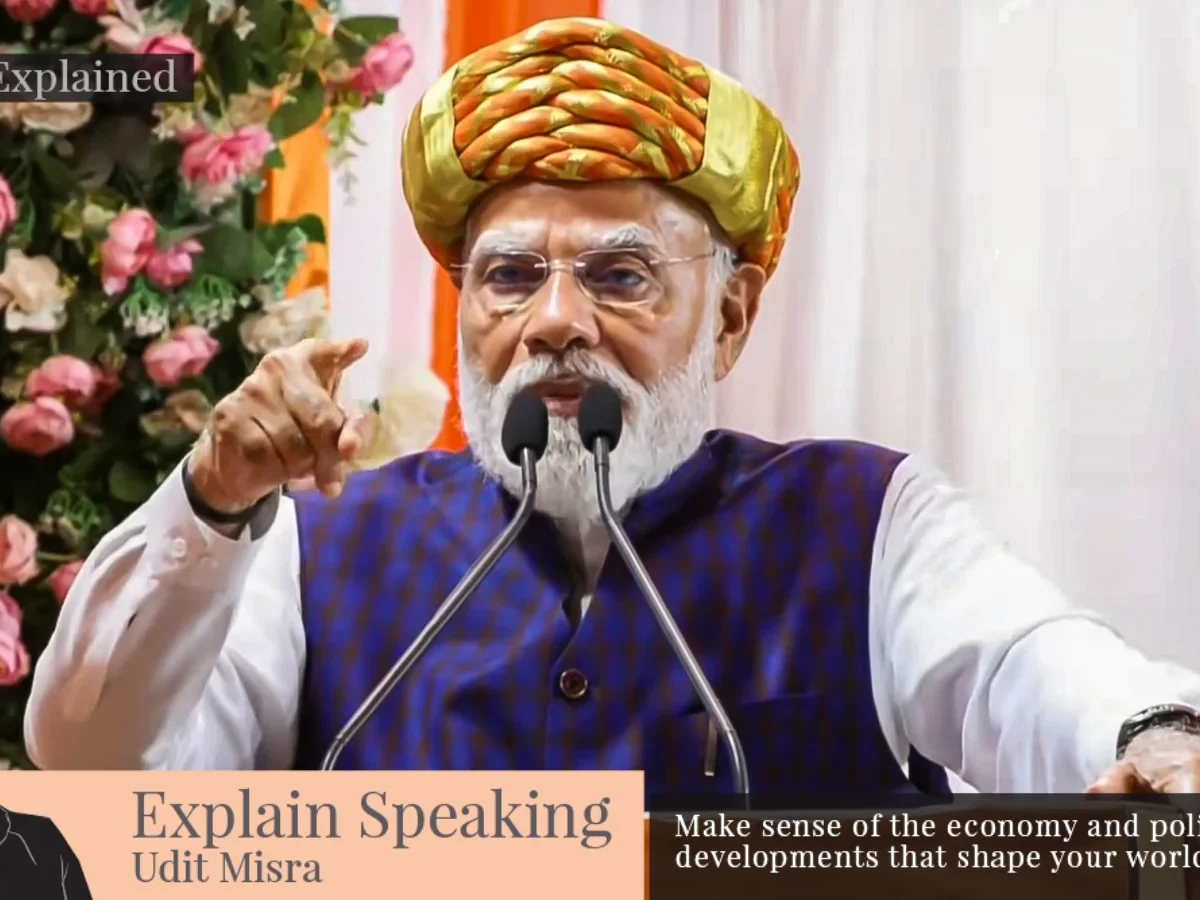
Prime Minister Narendra Modi has urged Indians to save foreign exchange (forex) by any means necessary. In a recent speech, he called on Indians to stop buying gold for a year. Imports of gold are a huge reason why Indians demand forex. In the same vein, he has also urged Indians to work from home in a bid to reduce the consumption of imported crude oil — another big drain on forex.
He also urged Indians to cut back the use of edible oil in their food by 10%; he said this will not only cut back on the import of edible oils and save forex but also improve the health of Indians.
He also urged the farmers to cut back on the use of chemical fertilisers by half if possible; he said that too much use of chemical fertilisers was ruining soil health, and instead advocated the farmers should shift to natural farming.
He also took this opportunity to underscore the need for buying “made in India” products and focusing on “swadeshi” products and being “vocal for local” instead of buying imported goods of everyday use. He asked Indians to make a list of things they buy and wean out the imported products (say, “scissors or toothbrush”) and substitute them with Indian ones.
He also called on other institutions and organisations — from the judicial courts to labour unions to media — to help work towards this goal.
What is the link between forex and the PM’s demand?
Story continues below this ad
This call comes in the wake of the war in Iran and the associated supply and price shocks of goods like fuel and fertiliser.
Indians typically import large quantities of the commodities Modi mentioned in his speech.
When Indians buy goods from outside the country — be it gold or a toothbrush or fertiliser or edible oil — India ends up running down its pile of forex held with the RBI, India’s central bank. That’s because the transaction of importing goods from outside the country involves Indians using their rupees to buy dollars and then using those dollars to import (buy) goods from outside the country.
Under normal circumstances, foreigners across the world also buy Indian goods, and thus they use dollars to buy Indian rupees, and this leads to dollars adding to Indian forex reserves with the RBI.
Story continues below this ad
But the situation can go off-balance if Indians imports far outstrip Indian exports; in such a scenario India will keep spending dollars without getting as many in return.
If such a situation sustains for long, it has two effects: one, Indian runs down its pile of forex, and two, while this is happening, Indian rupee’s exchange rate weakens against the dollar (or whatever other currency that India is using to trade).
There is another way in which forex come in and out of India: through foreign investments. Foreigners invest in India (either by creating new factories and offices — called foreign direct investment — or by buying shares in Indian companies listed in the stock market — called foreign portfolio investment) while Indians invest in other countries, again via the same two routes.
For most part of India’s history since the economic reforms in 1991, there has been a broad trend: Indians import more goods and services than they export — this is called running a “current account deficit” — while foreigners invest in India more than Indians invest outside India — and this called a “capital account surplus”. Typically the capital account surplus is bigger than the current account deficit — implying more dollars are coming in than going out — and thus India adds to its forex reserves. This situation is technically called a “Balance of Payment (BoP) surplus”.
Story continues below this ad
What is the link between BoP and rupee’s exchange rate?
As long as the BoP is in surplus — that means, more dollars are coming into the country than going out — the RBI can either let the rupee’s exchange rate strengthen or it can simply accumulate forex reserves.
Often the RBI accumulates forex reserves for a variety of reasons, one of them being because letting the rupee strengthen may not help Indian exports. Moreover, having a healthy level of reserves helps in times of crisis.
When the BoP goes into a deficit, either the rupee weakens or, if the RBI defends rupee’s exchange rate by selling dollars in the market, the forex reserves fall.
Story continues below this ad
So, has the situation changed? And how bad is it?
For a while now — roughly since mid-2024 — India’s BoP surplus has taken a hit. While the current account deficit hasn’t worsened as much, the trouble has been the capital account surplus has shrunk — and in fact, often become a deficit itself.
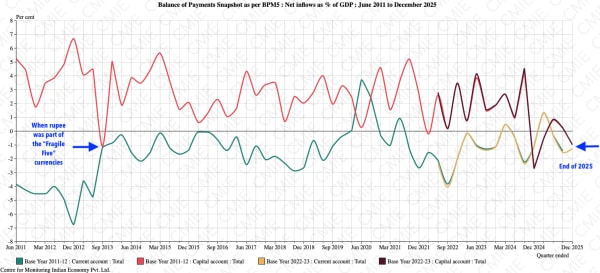 Chart 1.
Chart 1 shows that India’s current BoP situation appears as weak as it was in 2013, when India was designated as one of the “fragile five” economies by Morgan Stanley, a reputed international investment bank.
As a result, both the ill-effects that a BoP deficit brings are happening.
Story continues below this ad
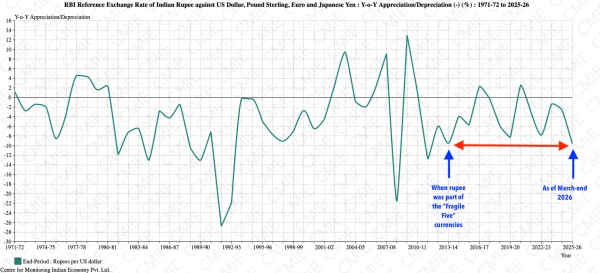 Chart 2.
One, the rupee is weakening against the dollar (Chart 2) and second, the RBI has been drawing down its forex reserves to defend the rupee’s exchange rate (Chart 3).
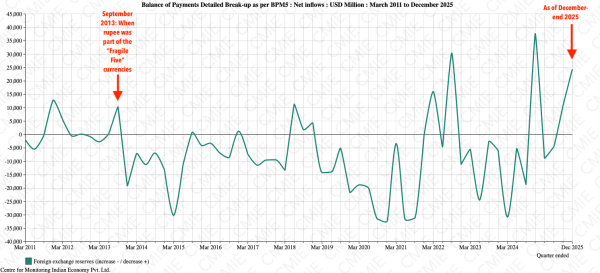 Chart 3.
The most troublesome bit is that the more the rupee weakens — thanks to India’s heavy dependence on import of crude oil (which itself has become very costly since the start of the war in Iran) — the more the imports become costlier and the vicious cycle strengthens.
Will the PM’s mantra help?
There are many ways to analyse Modi’s call.
There are two ways for India to deal with the forex situation:
Story continues below this ad
- Either reduce the demand for dollars by cutting domestic consumption, or
- Boosting India’s ability to earn more forex by improving domestic production.
All of Modi’s suggestions are focused on cutting consumption to spend less forex while none focus on boosting production to earn more forex. This choice has several implications.
On the face of it, if all Indians were to suddenly stop using gold in all ceremonies and substitute it with fresh flowers plucked from the nearby garden, and if all Indians stopped stepping out from home for any reason (or just cycled) then it is true that India’s imports will fall since imports of gold and crude oil are the big reasons for our imports being higher than our exports. This, in turn, will reduce our demand for dollars by reducing or even eliminating the current account deficit.
But such a move will likely come at the cost of overall economic growth because all businesses that use crude oil or gold or edible oil will likely suffer lower sales, not to mention the inefficiency due to cutbacks.
Weaker consumption, especially in a country that is already struggling with weak consumption, will drag down growth in the immediate time period of the current year.
Story continues below this ad
Further, weak consumption levels have been a key reason why businesses have not increased their investments into the Indian economy despite the government’s best efforts. As such, a strict adherence of the PM’s call could further disincentivise businesses.
Moreover, while the cut in consumption helps the current account, it may further worsen the capital account: After all, why would the foreign investors return to an economy that they are already shunning if that economy chooses to further roll back consumption.
Arguably, there can be another scenario in the medium term: That consumption doesn’t get reduced but gets diverted to Indian firms, and Indian businesses invest because Indians only prefer “swadeshi” goods. As such, this call turns around the Indian economy by redirecting all demand towards Indian businesses.
By itself, the idea of becoming self-reliant — or atmanirbhar as the PM calls it — sounds intuitively appealing. To be sure, it goes back to the days of independent India’s start when PM Jawaharlal Nehru adopted a strategy of substituting imports and cutting imports to save forex exchange. But many economists (including former PM Manmohan Singh) thought that was a sub-optimal idea, and that India should have opened up its economy and traded more aggressively with the rest of the world.
Here’s why. While becoming self-reliant is an understandable goal, not every country can become self-reliant in everything.
For instance, while it is true that India is now self-reliant in terms of food production, food production, in turn, depends on imported fertilisers. Further, even if India intends to make all its fertilisers at home — and it does make many at home — there is still the reliance on imported feedstock (fuels such natural gas or naphtha, etc.) that actually account for more than 80% of the total domestic production cost of fertilisers.
So, arguably, if India cannot be self-reliant in fertilisers, it can’t really consider itself to be self-reliant in terms of food production.
Similarly, India cannot replace imported crude oil with any domestic alternatives in a hurry; moreover any shift will cause the economy to slow down.
In other words, crashing India’s overall imports doesn’t necessarily make the economy stronger; if anything, a forced reduction in imports will slow down the economy.
Further, it is also incorrect to say that too much use of chemical fertilisers is hurting India’s soil. What is hurting India’s soil is not too much use of chemical fertilisers but imbalanced use of chemical fertilisers. There is an excessive use of nitrogenous fertilisers (urea) and too little use of phosphorus and potassium, apart from other micro-nutrients. The sole reason for this imbalance is the domestic subsidy regime which over-subsidises urea and thus nudging farmers to overuse it. Reducing use of chemical fertilisers and shifting to natural farming can help to the extent that the use is so excessively imbalanced.
What is required to deal with the forex issue?
Cutting consumption in such a stark manner — not buying gold or not going to office — cannot be a sustainable solution. The only way out of this situation is for India to boost both its domestic production and productivity. It is only when India becomes more efficient as a producer — regardless of what machines we import — that it will be able to grow its share in the global exports market.
Similarly, only when India reforms its ease of doing business will it attract fresh investments either from within the country or from outside. Higher levels of exports and/or improved attractiveness in terms of starting and running a business is the actual recipe for dealing with the forex issue in a sustainable manner.
Already, India’s growth has been modest relative to what it needs to become a developed country. Further, the growth model is such that it fails to create enough good quality jobs. Domestic consumption has been so weak that over the past 2-3 years, all governments — both Union and state-level — have been giving tax relief as well as direct cash transfers running into trillions of rupees in a bid to prevent consumption from cratering further.
Should India be focusing on cutting consumption or boosting production?
Share your views and queries at udit.misra@expressindia.com
Take care,
Udit