
The banks’ capital is divided into two types: Tier 1 and Tier 2. Within Tier 1, there are again two categories:
a) Common Equity Tier 1 (CET 1): This is the core and highest quality of capital, comprising equity shares and reserves, and providing the strongest buffer against losses.
b) Additional Tier 1 (AT 1): This is the supplementary capital, which includes instruments like AT 1 bonds.
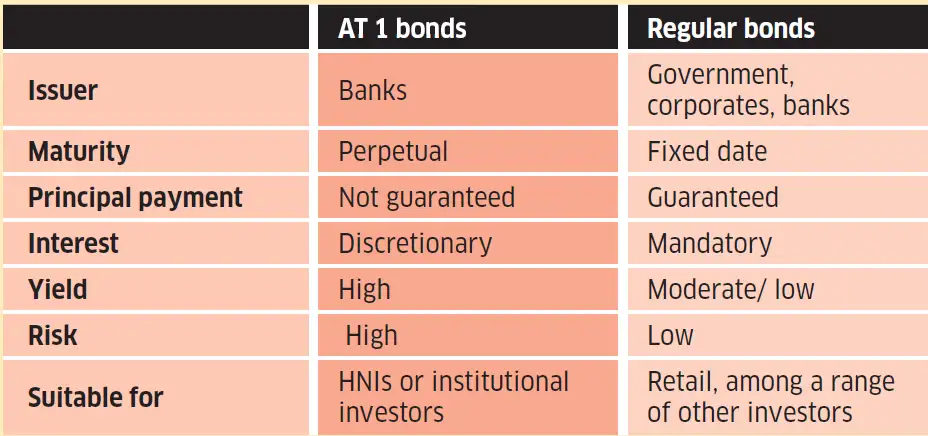
AT 1 vs regular bonds
AT 1 bonds
These are complex debt instruments issued by banks, but are often regarded as hybrid products since they have features of both debt and equity instruments.
These are perpetual bonds, which means they have no maturity or expiry date. They are not like traditional bonds that offer a high degree of safety. They provide higher returns compared to regular bonds, such as government or corporate bonds, but also come with a higher risk.
The bank can convert these into equity or write them off completely during a financial crisis. The banks can also recall the bonds, usually after a specific period. Unlike regular bonds, the payment of principal and interest are not guaranteed.
The minimum ticket size for these bonds is also very high, which makes them unsuitable for retail investors and are fit only for high net worth (HNI) or institutional investors.
No maturity date: Since these are perpetual bonds, there is no maturity date and the principal payment is not guaranteed.
Interest not guaranteed: In case of any financial stress, the bank can decide to discontinue the interest payment.
Write-off risk: In case of a financial crisis, the bank can call back the bonds without any compensation to the investors.
Liquidity risk: The bonds are listed on the stock exchanges, but since these are thinly traded in secondary markets, it’s not easy to sell them in case of an emergency.