‘The wealth of societies in which the capitalist mode of production prevails appears as an immense collection of commodities’
By Judy Cox
Downloading PDF. Please wait…
Friday 03 April 2026

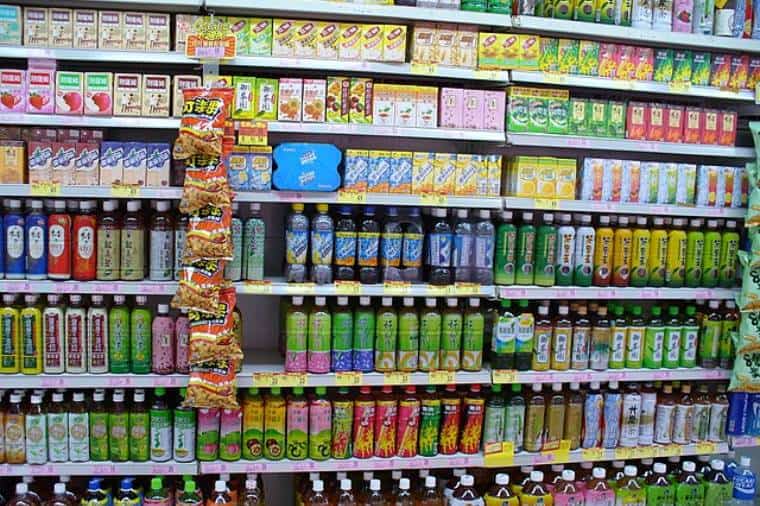
Capitalism presents us with a huge variety of commodities (Pic: Wikimedia commons)
A lot of the time we feel powerless to change the system or even our own lives.
One explanation of that sense of powerlessness is what Karl Marx called “commodity fetishism”.
Commodity fetishism doesn’t mean being obsessed with buying more and more things. It is the attribution of human powers to inanimate objects and institutions. It is the way in which the things we create come to dominate us.
Commodity fetishism has developed because capitalism is the first system of generalised commodity production in history. As Marx observed, “The wealth of societies in which the capitalist mode of production prevails appears as an immense collection of commodities.”
All our achievements, everything we produce, appear as items to be bought and sold.
Human beings have always laboured to create objects to help them meet their needs.
In the past, the producers had a direct relationship with what they produced. They harvested, stitched, wove, carved, baked and brewed things.
We no longer produce in response to the needs of our communities. We produce commodities to be sold on the anonymous marketplace.
Consumers no longer have a relationship with the individual producers. These are transformed into relationships between the commodities they produce.
This intensifies within the capitalist system in which the commodity is “a universal category of society as a whole”, as Marx wrote.
Marx explained how, “It seems as if the thing itself possesses the ability, the virtue, to establish production relations”, rather than the people who produce them.
Money eventually developed to facilitate the circulation of commodities. Money takes on the value of the objects it represents and it appears to create value.
Marxist theorist Istvan Meszaros explained, “People’s attitude towards money is, undoubtedly, the outstanding instance of capitalist fetishism, reaching its height in interest bearing capital.
“People think they see money creating more money, self-expanding value—workers, machines, raw materials—all the factors of production—are downgraded to mere aids, and money itself is made the producer of wealth.”
The domination of commodities is now so pervasive that it seems inevitable.
Production is increasingly governed by the specialisation of skills and the rationalisation of processes. This increases overall productivity, but it means we lose sight of, and can take no satisfaction in, the finished product.
Hungarian Marxist Georg Lukacs described how this “specialisation leads to the destruction of every image of the whole”. Everything appears fractured and fragmentary.
What happens in relation to commodities generalises across society. It appears that some mysterious force called “the market” causes prices to rise and fall, creates and destroys jobs and disciplines elected governments.
Crucially, commodity fetishism is experienced differently by different classes. Lukacs argued that the ruling class can never rise above commodity fetishism. It is locked into capitalism which it understands as natural and inevitable.
Workers are also shaped by commodity fetishism. But the working class is in a unique position. It can tear the veil of commodity fetishism from capitalism because its struggles reveal its own hidden role in producing the wealth of society.
Lukacs suggests that only the working class is able to develop “revolutionary consciousness” due to the distinct way in which their achievements are divorced from their creative ability and become a commodity.
Class struggle means workers no longer see themselves as isolated individuals, buffeted by forces beyond their control. They have the power to influence events.
Commodity fetishism explains both why capitalism makes us feel powerless—and how the working class can realise their collective power.