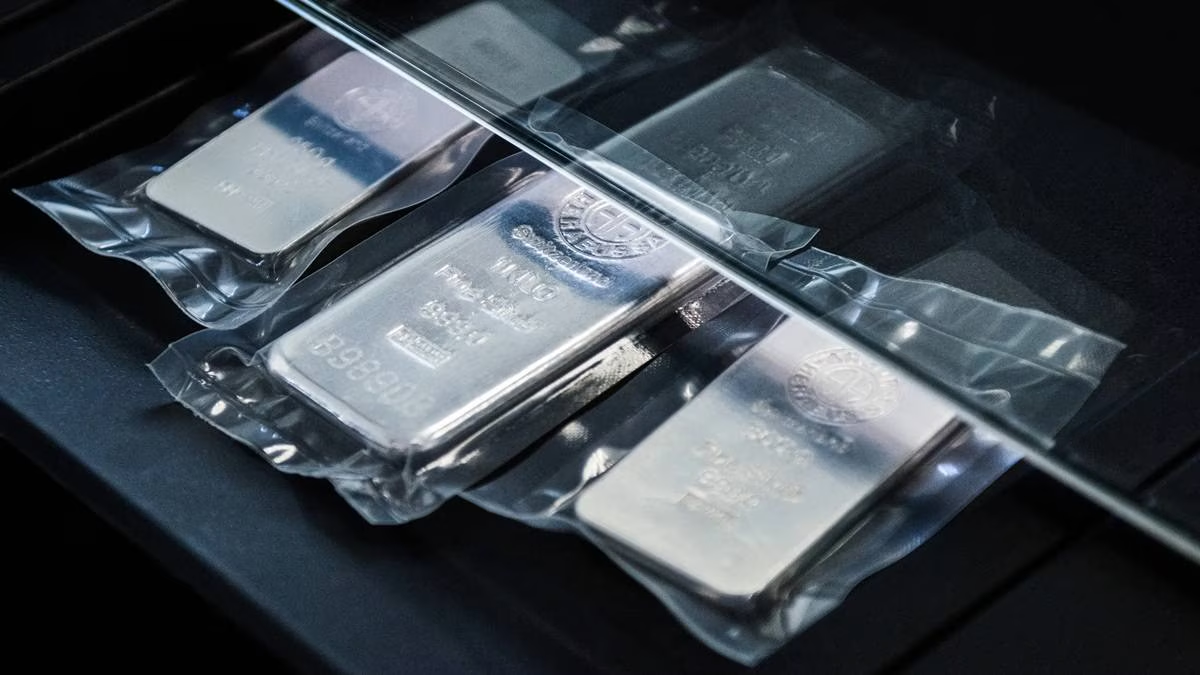
Retail investors in India now have an opportunity to invest in silver through the futures market. MCX India has launched Silver 100 (100 gram) Futures contracts with effect from Monday, June 01, 2026.
The new contract reduces the smallest tradable lot size from 1 kg to 100 grams — making silver futures accessible to smaller investors for the first time.
“MCX’s Silver 100 Futures is a meaningful step toward widening retail participation in silver, because it reduces the smallest tradable contract size from 1 kg to 100 grams, effectively lowering the entry barrier by about 10 times,” says Kaynat Chainwala, AVP – Commodity Research, Kotak Securities.
What this means in rupee terms
The 1 kg silver contract for 03 July 2026 trades at Rs 2.7 lakh, while the spot price on June 2 closed at about Rs 2.65 lakh. “At current prices, a 1 kg silver futures contract worth about Rs 2.7 lakh requires an upfront margin of roughly Rs 54,000, assuming exchange margins of around 20%.
In comparison, the new Silver 100 contract can be traded with a margin outlay of approximately Rs 5,500. This significantly improves accessibility for retail investors seeking exposure to silver futures,” says Chainwala.
The amount one pays as margins is not fixed but is dependent on the prevailing silver prices and exchange margin norms. “Futures require only an upfront margin (typically 5–10% SPAN-plus-exposure for silver), so opening a single SILVER100 position practically needs around Rs 3,000 – Rs 5,000 — far below the lakhs required for larger lots, though delivery demands full value,” says Dr. Renisha Chainani, Head of Research at Augmont.
Contract details
For the Silver 100 (100 gram) Futures contracts, the trading unit will be 100 grams, but the quotation or the base value will be 10 grams. On June 2, 10-gram silver closed at Rs 2,656.9. On May 3, Silver 100 (100 gram) Futures contracts for 30 June 2026 were trading at Rs 2,718.00, down by 0.8%.
The contract expiry months for Silver 100 (100 gram) are June 2026, July 2026, August 2026, September 2026, October 2026, and November 2026.
How to start trading
“A commodity-trading-enabled demat account with a SEBI-registered broker is needed; investors place a buy order under the symbol ‘SILVER100’ at MCX. Costs include the upfront margin, brokerage, exchange transaction charges, GST on brokerage, SEBI turnover, and stamp duty,” informs Dr. Chainani.
“Retail investors who do not intend to take physical delivery should square off or roll over their positions before expiry. This allows them to exit the contract through market settlement without moving into the physical delivery process,” adds Chainwala.
Daily price limits
Silver tends to be more volatile than gold. A study by DSP Mutual Fund showed silver outperformed gold in 10 of 26 years, but during rallies of both precious metals, silver significantly outperforms gold. In 2025, gold generated over 65% returns while silver outperformed by delivering over 140%. The recent fall in silver price has been equally sharp — since January 2026, gold has decreased by 20% and silver by 38% from their January highs.
To manage this volatility, MCX has put daily price movement limits in place. For Silver 100 (100 gram), the exchange has implemented a narrower slab of 4%. Whenever the narrower slab is breached, the relaxation will be allowed up to 6% without any cooling-off period in the trade.
In case the daily price limit of 6% is also breached, then after a cooling-off period of 15 minutes, the daily price limit will be relaxed up to 9%. In case price movement in international markets is more than the maximum daily price limit (currently 9%), the same may be further relaxed in steps of 3%.
Watchouts
If Silver 100 futures seem complex, investors who wish to invest in silver for the long term may consider buying Silver ETFs.
“For most retail participants, Silver 100 Futures is likely to be used primarily for tactical exposure. While the smaller contract size lowers entry barriers, investors should remain aware that futures are leveraged instruments and can experience significant price volatility, which may amplify both gains and losses,” cautions Chainwala.
Dr. Chainani explains the risks: Leverage is the biggest risk — adverse moves trigger margin calls, and losses can exceed the deposited amount. Silver is highly volatile — prices rose nearly 175% during 2025, with sharp daily swings. A newly launched contract may carry liquidity and wider-spread risk until volumes build. Daily mark-to-market settlement demands active monitoring. Holding beyond expiry triggers rollover costs or an unwanted physical-delivery obligation if positions aren’t squared off. Policy shifts matter too — import duty on precious metals rose from 6% to 15% on May 13, 2026.
Disclaimer: This article is for informational purposes only and does not constitute investment advice or a recommendation to buy, sell, or hold any commodity or financial instrument. Silver futures are leveraged products and carry significant risk of loss, including the possibility of losing more than the initial margin. Tax implications for derivatives gains classify them as business or speculative income, necessitating professional tax advice. Prices are subject to high volatility and may be influenced by domestic and global factors beyond an investor’s control. Readers are advised to consult a SEBI-registered investment advisor or commodity broker before making any trading decisions. Past performance of silver or any other commodity is not indicative of future returns.