The government’s move to restrict silver imports is expected to trigger short-term supply concerns, as industry participants anticipate domestic prices could trade at a premium when markets reopen on Monday.
Chirag Thakkar, director at Amrapali Gujarat, said if international silver prices remain at Friday’s closing levels, “the Indian spot price may trade at a premium of $1.5 to $2 per ounce” on Monday.
Silver was trading at a discount of nearly $6 per ounce immediately after the import duty hike announced earlier, but the gap gradually narrowed to around $3 by Friday. Industry participants said discounts narrowed further on Saturday following a decline in international prices.
Till recently, steep discounts reflected weak domestic demand for silver while global fundamentals for the metal remain bullish.
Sequence of Policy Measures
In the past week, the government has taken several measures to curb gold and silver exports amid rising concerns due to West Asia crisis that has caused the rupee to decline above 96 to a dollar.
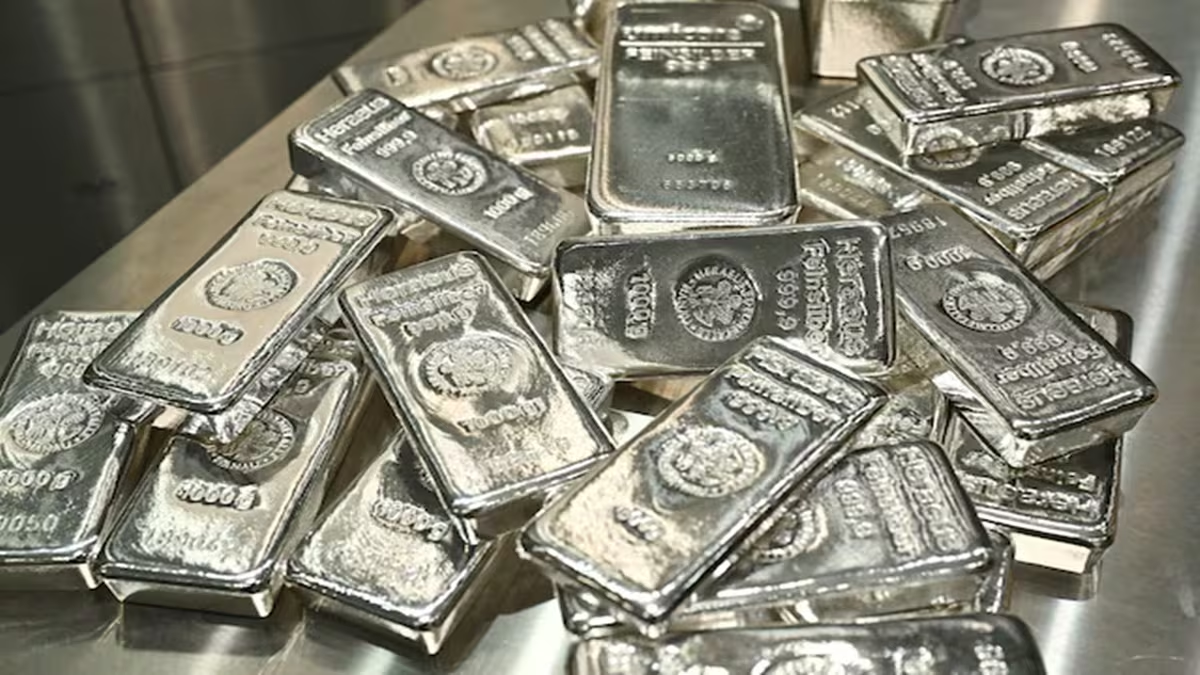
Last Wednesday, it raised the customs duty on imports of gold and silver to 15% from 6%, and on platinum to 15.4% from 6.4% to moderate these non-essential. On Saturday, it notified that imports of bars containing silver up to 99% would now be in the restricted category if it is meant for domestic consumption. However, silver imported for processing and value-added exports such as jewellery would continue to be unrestricted.
Traders now expect the import restrictions to tighten local availability and support higher prices. Market participants holding inventories are likely to seek higher premiums, as sourcing fresh silver for investment purposes could become difficult. Many stockists are also reluctant to sell immediately, anticipating higher prices ahead.
Viraj Didwania, director at Foresight Bullion, said the sequence of policy measures indicated the government’s intent to curb non-essential precious metal imports. “These measures are good for the country and help conserve foreign exchange,” he said.
“There is enough silver refining capacity in the country. Four refineries have been approved by the London Bullion Market Association (LBMA). Going forward, these refineries can import raw material containing silver and refine it into LBMA-standard bars acceptable for Silver ETFs,” he added.
Impact on ETFs and Industry
However, until such supply chains stabilise, silver exchange-traded funds (ETFs) may face sourcing challenges if investor demand rises sharply. Fund managers could struggle to procure sufficient metal if domestic premiums widen further. Silver fund-of-funds may also face similar pressures.
India produces silver primarily as a by-product of zinc production. Four domestic refineries currently hold LBMA accreditation and are capable of manufacturing bars eligible for ETF holdings, though market participants said scaling up such supply could take time.
While the government notification exempts silver imports meant for exports, export-oriented units will not be permitted to divert excess supplies into the domestic market.
Industry executives said industrial users would continue to receive import licences under “actual user” conditions. There are also no restrictions on imports of silver dore, silver granules or silver paste.
The solar sector, which is a major consumer of silver paste, is expected to continue imports without disruption. India currently imports around 90 per cent of its silver paste requirement, with domestic production accounting for less than 10 per cent.
Jateen Trivedi, vice-president for research (commodity and currency) at LKP Securities, said the measures amounted to tighter regulation rather than a complete halt to imports.
“The silver import restriction doesn’t mean India has shut the door; it means the entry is now guarded. Supply isn’t stopping — it is being regulated and channelised,” he said.
According to Trivedi, the MCX-LBMA spread will be a key indicator to track the extent of domestic tightness and the premium Indian buyers are paying over global prices.
“Listed refiners and ETF pricing in India will also reflect the tightness, because they become the easiest access point when physical supply is gated,” he added.