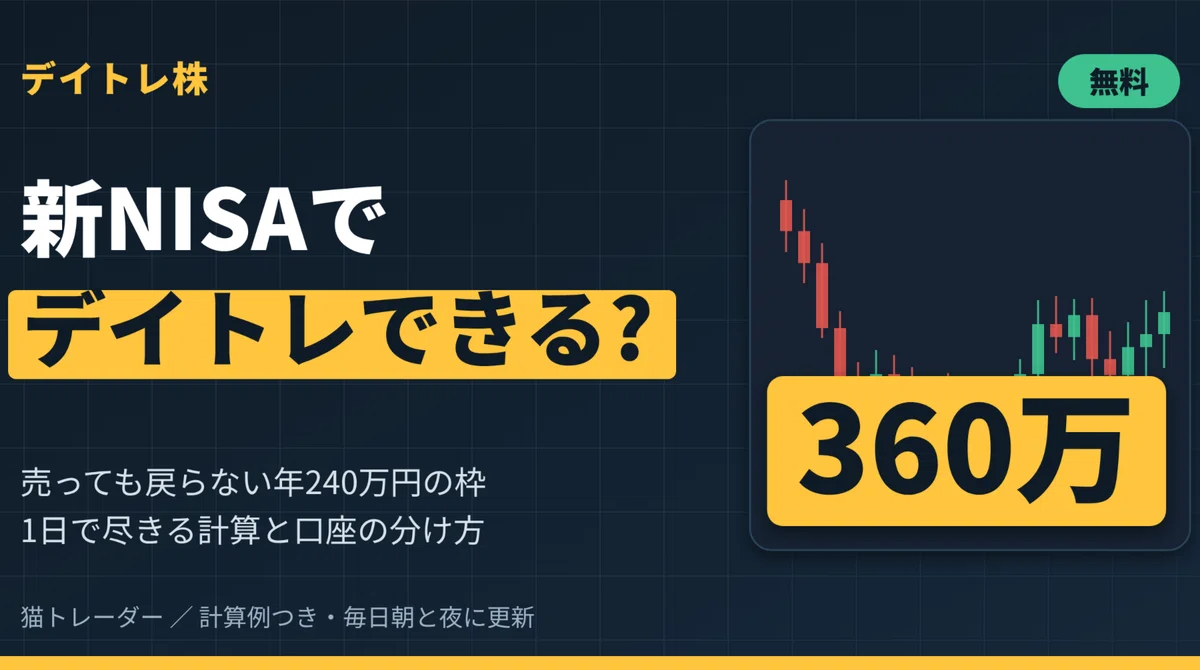
9:12 AM, stock price 1,500 yen. Person A is looking at the account field on the order screen. Is it a taxable account or a NISA account? If it’s NISA, there is no tax on profits. In that case, wouldn’t it be more profitable to do day trading in a NISA account? With a buy order for 1,000 shares at 1.5 million yen in front of them, their finger stops.
Since the new NISA started, this question has become very common. To conclude, it is possible to buy stocks in a NISA account and sell them on the same day. It is not prohibited. However, day trading in a NISA account tends to use up the annual growth investment quota in a single day.
Do you know when the quota for stocks sold in a NISA account returns? After reading this article, you will be able to calculate the following three things yourself.
First, how much the annual quota decreases with a single trade. Second, the amount you gain in a NISA account when you make a profit, and the amount you lose in a NISA account when you incur a loss. Third, how to divide the use of taxable accounts and NISA accounts so as not to waste the quota.
For the calculations, we will follow Person A, who has the funds, as an example. We will track from 9:00 AM to 3:00 PM using the same stock with a price of 1,500 yen and the same Friday figures.
I will write the honest truth first. The NISA system changes little by little with each year’s tax reform. As of August 2026, there is also a request from the Financial Services Agency to allow the quota for sold stocks to be returned within the same year. This article is calculated based on the system decided as of October 16, 2026. I cannot guarantee that it will be the same from next year onwards.

Chapter 1: The two quotas and figures of the new NISA
The new NISA quota is divided into two levels: an annual quota and a lifetime quota. Before entering the topic of day trading, I will list these figures first.
Background: According to Financial Services Agency documents, the new NISA is a system that started in January 2024, the period for opening an account is permanent, and the period for holding tax-free is indefinite. You must be 18 or older to open an account. It is managed as a separate quota from the old NISA that existed since 2014.
The annual quota is called the annual investment limit. The installment investment quota is 1.2 million yen per year, and the growth investment quota is 2.4 million yen per year, for a total of 3.6 million yen per year. This 3.6 million yen is the upper limit of the ‘amount purchased’ between January 1st and December 31st.
The lifetime quota is called the tax-free holding limit. The total is 18 million yen, of which up to 12 million yen can be used for the growth investment quota. This is the upper limit of ‘how much you hold now,’ and it is counted by the purchase price (book value).
These two quotas are counted differently. The annual investment limit is the total amount purchased in that year and does not decrease even if you sell. The tax-free holding limit is the total book value of the stocks you hold, and it decreases when you sell. This difference determines the compatibility with day trading.
The products you can buy are also divided by quota. The installment investment quota is only for certain investment trusts suitable for long-term accumulation and diversified investment. The growth investment quota covers listed stocks and investment trusts. It is the growth investment quota that allows you to buy individual stocks.

Chapter 2: Only the 2.4 million yen growth investment quota can be used for day trading
Although the NISA annual figure of 3.6 million yen looks large, the portion that can be used for day trading is only the 2.4 million yen growth investment quota.
Background: Margin trading is not a transaction subject to NISA tax exemption. You cannot hold margin trading positions in a NISA account, nor can you put stocks obtained by settling margin buys into a NISA account. The basis for this is Article 37-14 of the Act on Special Measures Concerning Taxation. Only physical stocks can be traded in a NISA account.
Since the 1.2 million yen installment investment quota can only be used to buy investment trusts, it cannot be used for day trading of individual stocks. The remaining 2.4 million yen growth investment quota is the upper limit for buying stocks in a NISA account.
Most day trading is done through margin trading. With margin trading, you can trade as many times as you want on the same day with the same funds, and you can also start by selling. Since NISA accounts are only for physical stocks, you cannot do short selling, and you can only buy first and then sell.
Another restriction is the number of accounts. You can only buy in a NISA account at one financial institution per year. Even if you use two securities companies, you can only buy with NISA at one of them that year. There is a procedure to change financial institutions, but if you have already bought with NISA that year, you cannot change until the following year.
As an example, let’s assume Person A has not bought anything with NISA this year. Person A’s growth investment quota of 2.4 million yen remains intact. For a stock priced at 1,500 yen, 2.4 million yen ÷ 1,500 yen = 1,600 shares is the number of shares that can be bought in a NISA account this year.

Chapter 3: The limit decreases every time you buy, and it does not return within the same year even if you sell
The annual investment limit decreases by the amount purchased, and it does not return within the same year even if you sell. This single line explains why day trading and NISA are a poor match.
Background: In the Financial Services Agency’s Q&A, it is stated that the tax-exempt holding limit is managed by book value balance, and if you sell, the limit corresponding to that book value can be reused from the following year onwards. Since the annual investment limit is the ‘upper limit of the amount purchased in that year,’ the fact that you bought something does not disappear even if you sell it.
Let’s follow Mr. A’s numbers. If he buys 1,000 shares at 1,500 yen at 9:12 AM, the purchase amount is 1,500 x 1,000 = 1.5 million yen. The remaining growth investment limit becomes 2.4 million yen – 1.5 million yen = 900,000 yen.
Suppose he sells all 1,000 shares at 1,520 yen at 10:05 AM. Although the money on hand returns to 1.52 million yen, the remaining growth investment limit stays at 900,000 yen. The 1.5 million yen portion of the limit does not return this year even if sold.
In a specific account, you can buy again immediately with the money from the sale. In a NISA account, even if the money returns, the limit does not, so the next purchase can only be for the remaining 900,000 yen.
This is where it is easy to make a mistake if you think of NISA as a ‘tax-free wallet.’ You can take money in and out of a wallet, but the NISA annual investment limit is like a ticket gate you can only pass through once a year. The 1.5 million yen that passed through once cannot pass through again in the same year, even if you sell and take it out.
The limit after selling returns to the tax-exempt holding limit from the following year onwards. However, this refers to the 18 million yen lifetime limit, and it does not mean the annual investment limit for the following year increases. This point will be calculated in Chapter 7.

Chapter 4: Calculation showing the annual growth investment limit is exhausted on Mr. A’s first day
If you day trade in a NISA account, almost none of that year’s growth investment limit will remain by the end of the first day. Let’s continue the calculation with Mr. A.
For the first trade, he bought 1,000 shares at 1,500 yen at 9:12 AM and sold them at 1,520 yen at 10:05 AM. The profit is (1,520 – 1,500) x 1,000 = 20,000 yen. The remaining growth investment limit is 900,000 yen.
For the second trade, he tries to buy at 10:40 AM at a stock price of 1,515 yen. The number of shares he can buy with the remaining 900,000 yen is 900,000 yen / 1,515 yen = 594.0… shares. Since stocks are in 100-share units, he can buy 500 shares, and the purchase amount is 1,515 x 500 = 757,500 yen.
With this, the remaining growth investment limit is 900,000 yen – 757,500 yen = 142,500 yen. Since it takes 151,500 yen to buy 100 shares at 1,515 yen, he can no longer buy this stock in NISA this year.
When he sells 500 shares at 1,505 yen at 11:00 AM, the profit/loss is (1,505 – 1,515) x 500 = -5,000 yen. Adding the two trades in the NISA account, the profit is 20,000 yen – 5,000 yen = 15,000 yen.
The NISA account trading for the day ends here. In two hours in the morning, he used 2,257,500 yen out of the 2.4 million yen annual growth investment limit. The remainder is 142,500 yen, and he cannot buy any more high-priced stocks until December 31st.
Even if you change the number of shares bought, the structure is the same. If you buy 1,600 shares at 1,500 yen in one go, it is exactly 2.4 million yen, and the limit is exhausted in one trade. Since 2.4 million yen / 1.5 million yen = 1.6, the limit is one trade of 1.5 million yen per year, plus one small trade with the remainder.
Day trading is a selling method that captures small price movements repeatedly. Considering doing this several times a day, every day, a limit that can only be used once or twice a year is not suitable as a tool for day trading.

Chapter 5: The amount gained in NISA when a profit is made
The benefit of NISA is that the tax on profits is eliminated. Let’s calculate how much this amounts to for one day trade.
When a profit is made on stocks in a specific account (with withholding tax), 20.315% tax is deducted. The breakdown is 15.315% for income tax and reconstruction special income tax, and 5% for resident tax. Profits in a NISA account are not subject to this tax.
Calculating based on a profit of 20,000 yen from the first trade, in a taxable account, income tax and special reconstruction income tax of 20,000 × 15.315% = 3,063 yen, and resident tax of 20,000 × 5% = 1,000 yen, totaling 4,063 yen, would be deducted. In a NISA account, it is 0 yen. Looking only at the first trade, NISA is 4,063 yen more profitable.
We will compare the result of the day by adding the second trade’s -5,000 yen. In a NISA account, the 15,000 yen profit is not taxed, and 15,000 yen remains in hand. If the same trade were made in a taxable account, the 15,000 yen profit would be taxed 3,047 yen, leaving 11,953 yen. The difference is 3,047 yen.
3,047 yen is not a small amount. However, in exchange for this 3,047 yen, Person A has used up their growth investment quota for that year. Let’s compare this to using the same 2.4 million yen quota by, for example, buying and holding.
As an example, suppose 2.4 million yen worth of stock is bought and sold one year later after a 10% price increase. This is not a price increase forecast, but a hypothetical figure for comparison. The profit is 240,000 yen, and while 48,756 yen in taxes would be charged in a taxable account, it is 0 yen in a NISA account.
Even with the same 2.4 million yen quota, if used for a single day of day trading, 3,047 yen is saved from taxes, and if a profit of 240,000 yen is made, 48,756 yen is saved. Although the size of the quota is the same, the size of the benefit is determined by the ‘profit made on that quota.’ Day trading with small price ranges has smaller profits per trade, so the benefit per quota is also smaller.

Chapter 6: When You Lose Money, NISA Becomes Disadvantageous
Losses in a NISA account are treated as if they did not exist for tax calculation purposes. Since losses also occur almost every day in day trading, this is more important than the profit side.
Background: Losses incurred in a NISA account are considered non-existent for tax purposes. You cannot offset these losses against profits or dividends in taxable or general accounts, nor can you carry them over to subsequent years. The structure is such that while profits are tax-free, there is no way to use losses for tax calculations.
As an example, suppose Person A buys 1,000 shares at 1,500 yen in a NISA account and cuts their losses at 1,480 yen. The loss is (1,480-1,500) × 1,000 = -20,000 yen.
Suppose Person A makes a profit of 50,000 yen in a taxable account in the same year. The 50,000 yen in the taxable account is taxed 7,657 yen in income tax and special reconstruction income tax, and 2,500 yen in resident tax, totaling 10,157 yen.
If the -20,000 yen loss had occurred in a taxable account, it would be offset against the 50,000 yen within the same account, resulting in a profit of 30,000 yen. The tax would drop to 6,094 yen, meaning 10,157 yen – 6,094 yen = 4,063 yen would be returned.
The -20,000 yen loss incurred in a NISA account cannot be used for this offset. The tax on the taxable account remains 10,157 yen. Even with the same -20,000 yen loss, if it occurs in a taxable account, 4,063 yen in tax is returned, but if it occurs in a NISA account, it is not returned.
It is a 4,063 yen gain when profitable, and a 4,063 yen loss when losing. Since day trading involves repeating loss cuts at a fixed range many times, day trading in a NISA account makes it easy for this ‘non-returned 4,063 yen’ to accumulate.
Furthermore, even for trades that end in a loss, the annual investment quota is reduced by the amount purchased. It is a double reduction: you lose money and your quota also decreases.

Chapter 7: The 18 Million Yen Quota and the True Meaning of ‘Returning the Following Year’
The phrase often seen in NISA explanations, ‘if you sell, your quota is restored,’ refers to the 18 million yen lifetime side. It does not mean the amount you can buy the following year increases.
Continuing with Person A’s figures. This year, the amount purchased with the growth investment quota is a total of 2,257,500 yen, consisting of 1.5 million yen and 757,500 yen. Since both trades were sold on the same day, there are no stocks held at the end of the year.
The tax-exempt holding limit is counted by the book value of the stocks held. Since Person A holds 0 yen worth, the 2,257,500 yen worth that was sold returns to a state where it can be used as a lifetime quota from the following year onwards.
However, the amount that can be bought the following year remains at the 2.4 million yen annual investment quota (growth investment quota). Even if the lifetime quota returns, the upper limit that can be bought in one year does not change. If Person A day trades with NISA again the following year, they will use up that year’s quota on the first day in the same way.
I will also calculate the number of years until the lifetime quota limit is reached. If you use up the annual investment quota for both accumulation and growth, it is 3.6 million yen per year, and 18 million yen ÷ 3.6 million yen = 5 years. Even if you use it up every year starting from 2024, you will not reach 18 million yen until the end of 2028.
Therefore, until 2028, the annual investment limit will take effect before the question of whether the lifetime limit is restored upon sale. Some securities companies explain that the amount sold between 2024 and 2028 can effectively be reused from 2029 onwards.
From the perspective of day trading, the restoration of the lifetime limit is of almost no help. The issue with daily trading is how many times you can buy within that year, and that is determined by the annual investment limit.

Chapter 8: Using Specific Accounts and NISA Accounts Separately
It is not that you cannot day trade in a NISA account. However, considering the structure of the limits, it is harder to waste your allowance if you separate them: day trading in a specific account, and stocks or investment trusts you intend to hold for a long time in a NISA account.
I will write about an example of how to separate them using Person A. They keep 3 million yen in a specific account (with tax withholding) and perform day trading there. For the NISA account, they invest in investment trusts monthly through the tsumitate investment quota, and in the growth investment quota, they only buy stocks they intend to hold for a long time, a few times a year.
With day trading in a specific account, you can use the money from a sale to buy the next stock immediately. Even if a loss occurs, it is offset against profits from the same year, and the withheld tax is returned even in the middle of the year. Losses carried over across years can be carried forward for three years if you file a tax return.
When deciding which stocks to buy in a NISA account, using the criterion of “Can I hold this stock for more than a year?” makes it harder to waste your limit. The question is different from choosing stocks for day trading. You choose based on whether there is a reason to keep holding it, not on the magnitude of price movement.
You can also hold the same stock in both accounts. This takes the form of day trading the same stock in a specific account, separate from the 100 shares held long-term in the NISA account. Just make sure to check the account column every time you place an order so you don’t make a mistake.
The default account setting on the order screen varies by securities company. If you place a day trading order without checking on a screen where the NISA account is the default, you will use up that year’s limit in one go. It is safer to add the habit of looking at the account column when placing day trading orders.

Chapter 9: Following a Certain Friday from 9:00 to 15:00
I will list Person A’s Friday from the prologue in chronological order, comparing the cases where the accounts were separated and where they were not. It is the same stock with a share price of 1,500 yen.
8:50 AM. The previous night, they decided not to buy in the NISA account today. The remaining growth investment quota remains at 2.4 million yen. The funds for day trading are the 3 million yen in the specific account.
9:12 AM. They buy 1,000 shares at 1,500 yen. They place the order after confirming that the account column is set to “Specific.” If they had chosen NISA here, the remaining growth investment quota would have been 900,000 yen at this point.
10:05 AM. They sell 1,000 shares at 1,520 yen for a profit of 20,000 yen. Since it is a specific account, 4,063 yen in tax is withheld. The money from the sale can be used for the next order immediately.
10:40 AM. They buy 500 shares at 1,515 yen and sell them at 11:00 AM at 1,505 yen for a loss of 5,000 yen. It is offset within the same specific account, making the profit so far 15,000 yen and the tax 3,047 yen. If the same two trades had been done in a NISA account, the remaining limit would have been 142,500 yen at this point, and NISA stock buying for the year would have been almost finished.
11:30 AM. They buy 1,000 shares at 1,510 yen and sell them at 1,525 yen for a profit of 15,000 yen. If they had been using a NISA account, this trade could only have been done in a specific account.
2:10 PM. They buy 1,000 shares at 1,520 yen and cut losses at 1,512 yen for a loss of 8,000 yen. The total for the two trades since 11:30 AM is 15,000 yen – 8,000 yen = 7,000 yen.
3:00 PM. The profit or loss for the specific account on this day is 15,000 yen + 7,000 yen = 22,000 yen. The tax is 4,469 yen, and 17,531 yen remains on hand. The 2.4 million yen growth investment quota in the NISA account remains entirely intact.
If they had not separated them, the two NISA trades in the morning would have resulted in 15,000 yen tax-free, and the two specific account trades from 11:30 AM would have resulted in 1,422 yen of tax on the 7,000 yen profit. The amount remaining on hand would be 15,000 yen + 5,578 yen = 20,578 yen. This is 3,047 yen more than the 17,531 yen when separated, which is the same amount calculated in Chapter 5.
You keep 3,047 yen more by using NISA. In exchange, you have used up 2,257,500 yen of that year’s growth investment quota in this one day. From next Monday until December 31st, Person A cannot buy stocks with NISA. Deciding which to choose means comparing this 3,047 yen with the quota that could have been used for the remaining days of the year.

Chapter 10: If the System Changes from Here On
Regarding the NISA system, it is necessary to distinguish between what has been decided and what is still at the request stage. This information was researched as of October 16, 2026.
Background: Changes to the tax system follow a sequence: they begin with the “Tax Reform Requests” issued by each ministry in the summer, are included in the “Outline of Tax Reform” at the end of the year, are decided by the Cabinet, and then become law in the Diet the following year. At the request stage, nothing has been decided yet.
I will start with what has been decided. The Outline of Tax Reform for Fiscal Year 2026, decided by the Cabinet on December 26, 2025, included the removal of age requirements for the installment investment quota, allowing it to be used by those aged 0 to 17. According to reports, it is scheduled to start in 2027 with an annual limit of 600,000 yen and a lifetime limit of 6 million yen. This applies to investment trusts and is unrelated to day trading.
Now for the request stage. In its tax reform request for Fiscal Year 2027, the Financial Services Agency is seeking to have the tax-exempt holding limit restored “within the current year.” This is a proposal to have the lifetime limit, which currently only returns in the following year or later, restored within the same year the assets are sold.
A September 3, 2026, article by Business Insider Japan explains that the goal of this request is to make it easier to switch products, not to expand day trading.
From a day trading perspective, what is concerning is the treatment of the annual investment limit. The request documents do not state what will happen to the annual investment limit. Even if the lifetime limit is restored within the year, if the annual purchase limit remains the same, the calculation from Chapter 4 where “the limit runs out on the first day” remains unchanged. It is safest to wait until the year-end outline is decided before recalculating.
Conclusion
Returning to 9:12 AM in the prologue. The answer this article provided for the account column where Mr. A’s finger stopped was the specific account. You may day trade in a NISA account, but your annual stock quota will be exhausted on the first day, and losses cannot be used for tax calculations.
I have presented various figures in this article, but only one remains at the end. For a profit of 20,000 yen, the tax you would save in a NISA is 4,063 yen. The question was whether to use up your 2.4 million yen limit in two hours of the morning for that 4,063 yen.
Save tax-free accounts for stocks you intend to hold for a long time. When placing a day trading order, check the account column once. That is the only thing you need to change starting tomorrow.
There is also a paid article that summarizes, with calculation examples, where to cut losses and how many shares to trade when a loss occurs in day trading. If you are going to day trade in a specific account where losses can be used for tax calculations, the next thing to decide is your stop-loss position.
https://note.com/takway/n/n4b8029324776
Are you currently day trading in a NISA account or a specific account? Please let me know in the comments, and I will use it as a reference for my next article.
Follow me to receive new articles in the morning and evening.
This article explains the relationship between the new NISA system and day trading. The figures in the article are calculation examples for explanatory purposes and are not actual trading results. The details of the system were confirmed as of October 16, 2026, through Financial Services Agency documents, tax reform requests published by the Ministry of Finance, securities company explanations, and news reports, and may change due to future tax reforms. Tax calculations are simplified examples and vary depending on individual circumstances. This does not recommend trading specific stocks, nor does it guarantee future results. Please make investment decisions at your own responsibility.