When day trading,
“taking 1 tick”
“2 ticks lower”
“the tick is large”
you may hear terms like these.
What exactly is this “tick”?
Since day trading sometimes involves targeting small price movements of a few yen or several tens of yen, it is important to know the units in which stock prices move.
Furthermore, even for stocks with similar prices, the trading experience changes depending on the granularity of price movements and the state of the order book.
In this article, I will explain:
-
What a tick is
-
What a tick size (call price) is
-
How much profit or loss changes when moving 1 tick
-
Why price movement units differ depending on the stock price
-
The relationship between ticks and spreads
-
What to look for when choosing stocks for day trading
.
What is a tick?
The term “tick” used in stock investment has slightly different meanings depending on the context.
In day trading, it is often used to refer to
The smallest unit of stock price movement
is what it means.
For example,
3,000 yen
↓
3,001 yen
↓
3,002 yen
If the stock price moves in 1-yen increments,
the change from 3,000 yen to 3,001 yen is sometimes referred to as “1 tick.”
However, strictly speaking, the increments at which orders can be placed are called “tick sizes.”
In conversations between day traders, this single increment of the tick size is often called “1 tick.”
What is a tick size?
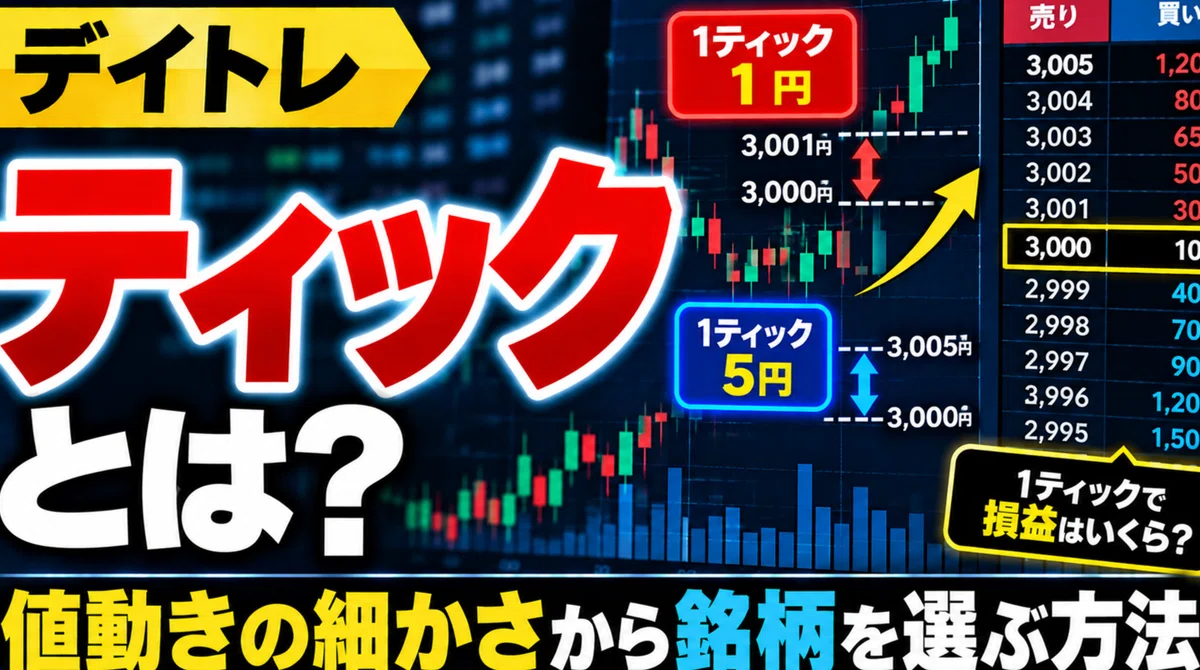
A tick size is the increment of prices at which orders can be placed.
Stock prices cannot always be specified freely in 1-yen increments.
The increments at which orders can be placed are determined by the stock, price range, etc.
For example, if the increment is 1 yen for a certain price range,
3,000 yen
3,001 yen
3,002 yen
are the prices you can order.
On the other hand, if the tick size is 5 yen,
3,000 yen
3,005 yen
3,010 yen
is how the price moves.
In other words,
the monetary value of 1 tick is not always the same.
This is a point you want to remember.
How much does your profit or loss change when it moves by 1 tick?
For example, suppose you hold 100 shares of a stock where 1 tick = 1 yen.
If the stock price goes from
3,000 yen
to
3,001 yen
and rises by 1 tick,
1 yen × 100 shares
so,
+100 yen
is the result.
If it is 500 shares,
1 yen × 500 shares
so,
+500 yen
is the result.
If it is 1,000 shares,
+1,000 yen
is the result.
In other words, even with the same 1 tick, the profit or loss changes significantly depending on the lot size.
What happens if 1 tick is 5 yen?
Next, let’s assume that
1 tick = 5 yen
.
For 100 shares,
5 yen × 100 shares
means
1 tick = 500 yen
.
For 500 shares,
1 tick = 2,500 yen
it becomes.
In other words,
even if you think it’s “just 1 tick”
, the monetary value changes significantly depending on the stock and lot size.
In day trading, before entering a position,
it is also important to understand how much your profit or loss will change if the price moves 1 tick against you
.
Stocks with fine ticks vs. stocks with coarse ticks
One of the reasons why the sense of price movement differs depending on the stock is the price increment.
For example,
Stock A
1 tick = 1 yen
Stock B
1 tick = 5 yen
Let’s assume this is the case.
For 100 shares,
Stock A is 100 yen per tick.
Stock B is 500 yen per tick.
Stock B will have a larger change in profit or loss when the price moves once.
Therefore,
the same 100 shares does not necessarily mean the same risk
.
Ticks and how the order book looks
Ticks are also relevant when looking at the order book.
For example,
3,000 yen buy order book
3,001 yen sell order book
If this is the state, the difference between the best buy and sell prices is 1 yen.
On the other hand,
3,000 yen buy order book
3,005 yen sell order book
If so, there is a price difference of 5 yen.
This price difference between buy and sell orders is called
spread
is what it is called.
In day trading, this spread is also extremely important.
Be careful with stocks that have a wide spread
For example,
a bid price of 3,000 yen,
an ask price of 3,001 yen
means the difference is 1 yen.
However,
a bid price of 3,000 yen,
an ask price of 3,020 yen
means they are 20 yen apart.
If you buy the latter at market price, there is a possibility that it will be executed near 3,020 yen.
And if you try to sell it immediately, the bid board is at 3,000 yen.
That alone creates a large difference.
Therefore, in day trading,
whether the price range is large
is not the only thing;
checking how tight the order book is
is also important.
Do not confuse tick count with price range
This is also a point to be careful about.
For example,
Stock A
1 tick = 1 yen
moves 100 ticks
Stock B
1 tick = 5 yen
moves 30 ticks
Let’s assume this is the case.
In terms of tick count alone, Stock A is higher.
However, the actual price range is,
Stock A
1 yen × 100 = 100 yen
Stock B
5 yen × 30 = 150 yen
respectively.
In other words,
a higher tick count does not necessarily mean a larger price range.
It is not always the case.
You also need to check the price range on a monetary basis.
Liquidity is also important in day trading
You cannot choose stocks based on ticks alone.
Especially important are,
trading volume
and
order book depth
respectively.
For example, even for a stock that moves in 1-yen increments,
If there are almost no orders,
the stock price may move in jumps.
Conversely, if a stock is actively traded,
orders are lined up across many price levels, which can make it easier to trade.
Therefore,
ticks
+ volume
+ order book
+ price range
it is important to look at these in combination.
Are stocks with large ticks dangerous?
Not necessarily.
Even if one tick is large, there are stocks with calm price movements.
On the other hand, even if one tick is small,
for stocks that move dozens of ticks in a short time,
there is significant risk.
What is important is not just
the monetary value of one tick
but also
how many ticks it is moving and at what speed
it is moving.
This also connects to the “price range” and “ATR” explained in the previous article.
If price movements are fast, limit orders may not keep up
In day trading, you may use limit orders.
However, for stocks with extremely fast price movements,
3,000 yen
↓
3,010 yen
↓
3,020 yen
↓
3,030 yen
the price can change in a very short time.
“I’ll buy at 3,010 yen”
By the time you place the order thinking this, it may have already risen to 3,030 yen.
Conversely, in a sharp decline, you may pass the price at which you want to cut losses in a short time.
Therefore,
I check not only the granularity of the ticks but also the speed of price movement
as well.
The combination with lot size is important
I place great importance on lot adjustment in day trading.
The same applies to ticks.
For example,
1 tick = 5 yen
500 shares
means,
1 tick = 2,500 yen
is the result.
If it moves 5 ticks against you,
12,500 yen
will be the amount.
It is important to consider before entering whether your lot size is too large for the loss you can tolerate.
What should you look at when choosing a stock?
When looking at ticks for day trading stock selection, I don’t look at them in isolation, but rather combine them with:
1. Stock price
2. Value per tick
3. Trading volume
4. Order book depth
5. Spread
6. Typical price range
7. ATR
and so on.
Just because there is price movement does not necessarily mean it is easy to trade.
It is important to see if the price movement is one you can handle easily.
Three points to consider when looking at ticks
1. How much is one tick?
The price increment varies depending on the stock and price range.
First, check the prices at which you can place orders.
② How much profit or loss moves with 1 tick
Consider this in combination with your lot size.
With 100 shares versus 1,000 shares, the profit or loss will differ by 10 times even for the same 1 tick.
③ Look at the spread and liquidity
In addition to ticks, check the price difference between the buy and sell boards, as well as the trading volume.
Summary
The “tick” used in day trading generally refers to the smallest increment of a stock price movement.
Strictly speaking, the increment at which orders can be placed is called the “tick size”.
In day trading,
the value of 1 tick
×
number of shares held
determines the profit or loss when the price moves by one increment.
That is precisely why
“100 shares is safe”
is not the right way to think; instead,
it is important to check the following for that stock:
What is the price increment?
How fast does it move?
Is the order book deep?
Is the spread wide?
What is the typical price range?
until you have confirmed these details.
Although a tick is a small unit, it is one of the basic pieces of knowledge you should remember when choosing stocks for day trading and considering risk management.
For those who want to learn more about day trading
On YouTube, I conduct a day trading LIVE stream every morning starting at 8:30.
While watching the actual market, I provide real-time commentary on indices like the Nikkei 225, as well as decisions on entries, profit-taking, and exits.
▶ Click here for YouTube
[YouTube link]
For those who want to learn in more detail
In my YouTube membership, I release content that cannot be fully covered in regular videos or LIVE streams through exclusive videos and more.
Past videos and LIVE streams are also changed to members-only content once a certain period has passed since their release.
▶ Click here for membership details
[Membership link]
For those who want to practice day trading with a game
I believe that day trading is not just about memorizing knowledge, but also about repeating decisions such as “buy, sell, wait, or exit” while watching the market.
Therefore, I have released a day trading game where you can practice the concepts I prioritize in my actual trading, such as indices, market conditions, and supply and demand, in a game format.
▶ Click here for the day trading game
[Game sales note link]
I also update day trading articles on note
I write articles about day trading methods, concepts, trading psychology, and points I am conscious of in the actual market.
If you find the articles helpful, please follow me on note as well.
※ This article is provided for the purpose of learning knowledge and concepts related to investment and does not recommend the buying or selling of specific stocks or financial products. Investment carries the risk of loss, including the loss of principal. Please make actual investment decisions based on your own judgment and responsibility.