
Hark! Late-stage capitalism is here. Subscribe to a portfolio of streaming apps to watch the same team play the same sport in the same week. Watch the constant stream of ads with ever-increasing specificity honed by the flagrant distribution of our personal data. Endure wealth inequality and low gig-economy wages. Drink the Grimace Shake and… do whatever you do with the Labubu.
Much of this economic era is frustrating but if there’s one thing I loathe the most about this hellscape, it’s having to pay money to reserve the right to pay more money.
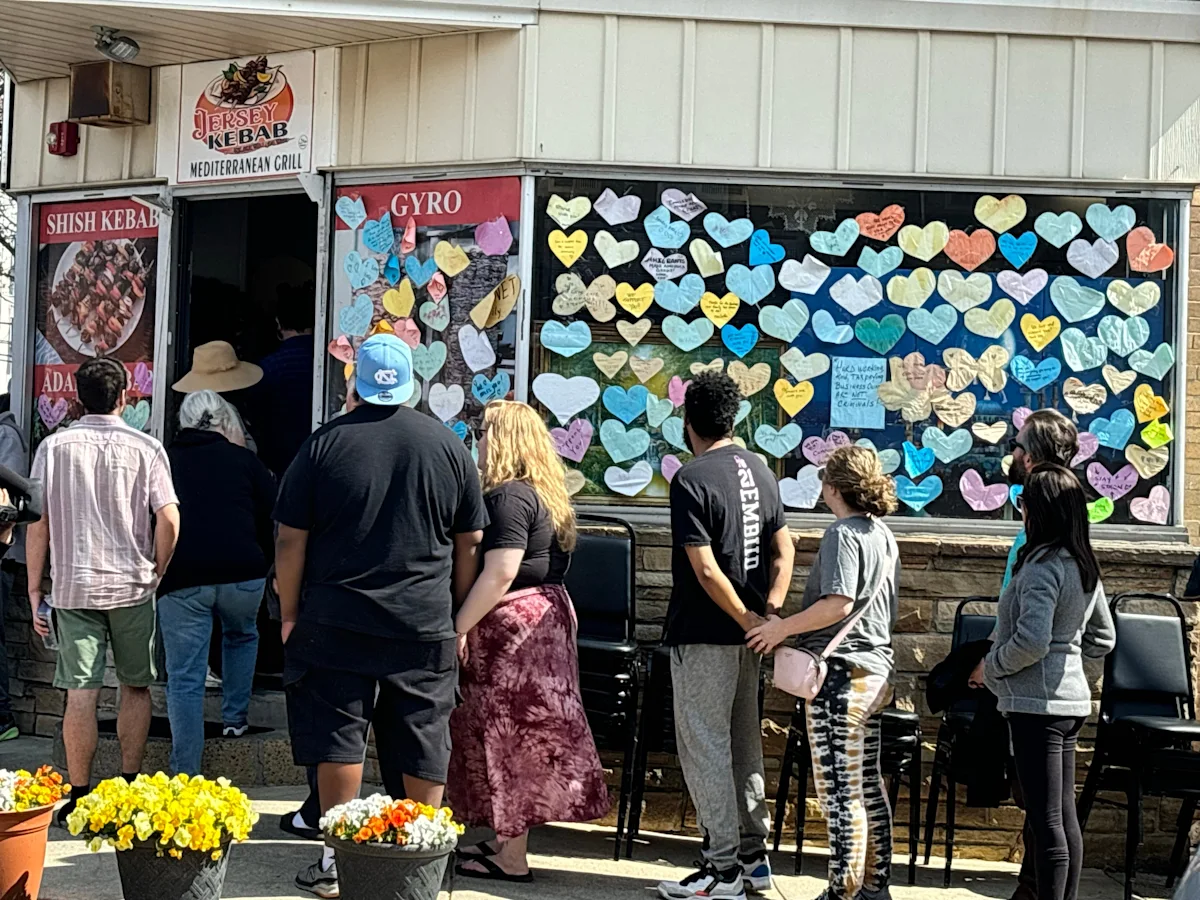
Guests line up outside of Jersey Kebab in Haddon Township for the restaurant’s reopening on March 30.
Paying a monthly fee to streamers like Prime and then having to pay to rent a movie. Paying an entrance fee at the local orchard to pick and pay for apples. Paying a doctor’s bill and then, separately, the hospital just because the doctor had the audacity to set up shop in their building. Buying a printer and then having to pay a subscription for the ink to use it.
The examples go on and get absurd. Maybe none more so than a new-ish platform on which people pay for second-hand restaurant reservations. Like Seatgeek, but for Saddle River Inn.
It works similar to concert or sports event ticket scalping: Anyone (or any bot) can make a reservation for free, and when that restaurant gets booked out, those same folks (or bots) can list the reservation and spark a bidding war among potential diners who couldn’t secure it through traditional means. The restaurant gets no cut of the sale, and these reservations can ultimately fetch a couple hundred bucks or sometimes, if there’s an event like – oh I don’t know, the World Cup – in town, a couple thousand.
Reservations for a table at New Orleans restaurant during the 2025 Super Bowl weekend sold for $2,100 on the third-party platform Appointment Trader.
While services like this might help folks get access to hot restaurants or bail out folks who forgot to make a reservation, widespread adoption of “reservation scalping” would put restaurants who bank on folks showing up for their tables in a precarious spot. Dan Richer, chef-owner of the popular Razza in Jersey City, said he typically holds a few tables for walk-ins, but a house full of no-shows would be no good.
“I do see a problem if let’s say one of these services book up all our reservations for the night and nobody came,” he said. “That would be a major problem.”
Fellow humans, why are we doing this to ourselves?
Razza in Jersey City
To be clear, this is different than the now somewhat common (albeit irksome) practice of restaurants requiring a deposit to secure your reservation; in those situations, an empty table equates to some serious missed revenue, and your deposit goes toward the final bill anyway.
Fortunately, the state of New Jersey put the kibosh on this practice ahead of the World Cup, banning third-party reservation trading.
Gov. Mikie Sherrill signed a bill on May 7 that bans third-party platforms from advertising, listing, promoting or selling reservations without the restaurant’s consent. There’s a $500 fine that compounds daily if the law is violated. It passed through the state legislature with wide bipartisan support.
“Third-party reservation brokers have sold tables that they do not own for outrageous prices, often without the knowledge of a restaurant or small business,” said State Sen. Senator Kristin Corrado (R-Bergen, Essex, Passaic), in a statement. “This new law protects patrons from price-gouging and ensures that the benefit of major events goes to our local businesses, not opportunistic middlemen.”
Before the law took effect, reservations at hot restaurants like Pasta Ramen in Montclair, Saddle River Inn, Steve & Cookie’s in Margate and others were being offered or requested on Appointment Trader. Richer said he’s not aware of folks using sites like these to get tables at Razza, but he can’t necessarily rule it out.
It’s worth noting that Appointment Trader responded to a similar ban in New York in 2025 by posting that it will comply and no longer host or advertise reservation swaps in the state. You can, however, currently book a “concierge” to secure and/or sell you the reservation of a specific restaurant that you search for on your own, a pivot toward more of a search engine-based model that Appointment Trader thinks might comply with the law and keep the reservation swapping going.
While it’s not new for third-party interlocutors to raise the overall price of dining; this one just feels the most salacious.
Who we pay when we pay for food
Most people know that when we eat at a restaurant, we’re not just paying for the plate of food placed before us. We’re also paying for the folks making and serving that food, for the lights and heat to be on and for the building itself, among other business expenses. But there are other hands that grab some of the money we proverbially place in the billfold that feel as gratuitous as paying for a reservation.
Big banks and credit card networks collect over $200 billion a year in transaction fees from U.S. retailers, including restaurants. I’ve noticed, anecdotally, that more and more restaurants are no longer willing to eat the 2-3% cost as money has gotten a little tight in this country over the past year or so. Enter us and our wallets.
Matt Cortina, the food and dining reporter, poses for a staff photo on Tuesday, Aug. 6, 2024, in Woodland Park, New Jersey.
Richer says he’s willing to eat that cost because he knows it’s a secure transaction and having too much cash around can be a safety concern for his staff. But he names a few other “silent partners” in his restaurant.
“There are only so many ways to slice the pie, and everybody wants to get paid and not necessarily be the ones doing the work,” he said.
Those “partners” include everything from his point-of-sale (POS) system to the laundry service, the air conditioning maintenance and even the dishwasher — the physical dishwashing machine — his staff uses.
“After a certain amount of time, we push the button to start the dishwasher and they charge us per wash,” he said. “So the busier we are, the more they get paid. And their machines always break.”
And don’t forget the third-party delivery apps that take a cut every time they deliver food.
Now you may read all this and think, “Well, the mopey Millennials have reached the, ‘Back in my day…,’ old-man-yells-at-cloud stage of development,” but I’d posit that we’re on the precipice of a fully automated society that costs us consumers money at every turn and reinforces itself like an ouroboros, creating and solving its own problems.
Just look at it: In order to combat people and bots booking reservations to resell online, there are online companies using artificial intelligence tools to scope out and reject the scalper bots’ requests. So now we live in a world where you can use AI yourself to book a legitimate reservation, the restaurant’s automated service can book it for you, and robots can cook and serve the meal.
We’ll always have to pay for dining out. But are we forgetting about the food?
Matt Cortina is a food reporter for NorthJersey.com/The Record. Reach him at mcortina@usatodayco.com.
This article originally appeared on NorthJersey.com: NJ restaurant reservation ban is just the beginning